Average February rate at KRW 1,455.3, KRW 1,444.9 just before the Lunar New Year holidays
"Gradual downward stabilization to continue within the trading range"
The upward trend in the won-dollar exchange rate, which had been threatening the 1,500-won level, has lost some steam. Market participants expect the rate to fluctuate within a trading range after the Lunar New Year holiday and to attempt to lower its level toward the low-to-mid 1,400-won range. Although both upward and downward pressures on the won remain in place, analysts judge that, in the short term, the bias is tilted toward a stronger won.
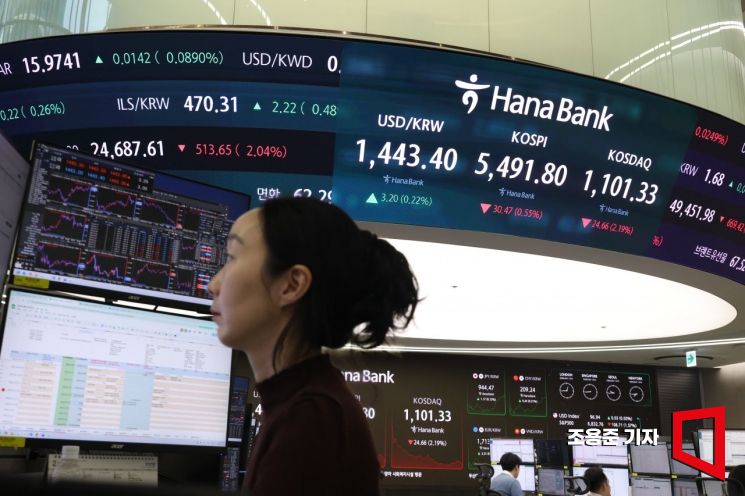 On the 13th, an employee is monitoring the stock market and exchange rates in the dealing room at Hana Bank's headquarters in Jung-gu, Seoul.
Diverging monetary policies in major economies seen as a factor for U.S. dollar weakness
According to the Bank of Korea’s Economic Statistics System (ECOS) on the 18th, the weekly closing level of the won-dollar exchange rate (as of 3:30 p.m.) on the 13th, the day before the Lunar New Year holiday, was 1,444.9 won, up 4.7 won from the previous day. After surging to as high as 1,478.1 won on January 20, the rate has recently lowered its level to the 1,440-won range. The average won-dollar exchange rate for the first two weeks of this month is 1,455.3 won.
The market expects the won-dollar exchange rate to continue its gradual attempt at downward stabilization. The divergence in monetary policy stances among major economies is seen as inducing weakness in the U.S. dollar. This is a factor that allows expectations for a relative strengthening of the won. During the Lunar New Year holiday, the U.S. Dollar Index (DXY) fluctuated within the 96-97 range.
In the United States, expectations remain largely unchanged that there will be around two rate cuts within this year, even though optimism about the economic outlook is strengthening. Byun Jeonggyu, Head of the FICC Division at Daiwa Securities Capital Markets Korea, said, “This time, indicators such as U.S. employment came out strong, but the Federal Reserve’s policy rate is still expected to be cut at least once in the first half of the year.”
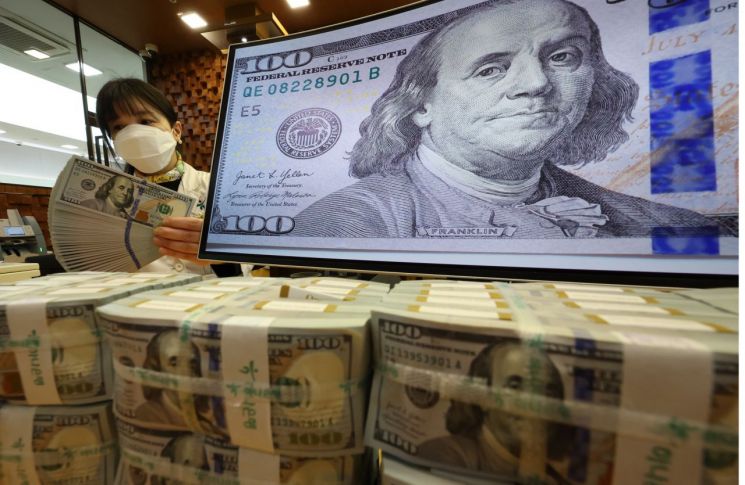 An employee is sorting U.S. dollar bills at the Hana Bank Counterfeit Response Center in Jung-gu, Seoul. Photo by Yonhap News
In contrast, at the European Central Bank (ECB), the prevailing view is that it has reached its terminal rate, having wrapped up a roughly one-year rate-cut cycle. At the Bank of Japan (BOJ), the probability of a rate hike is considered high, as aggressive fiscal policy has heightened inflation risks. The Bank of Korea likewise cannot rule out a prolonged rate-hold stance when considering financial stability conditions. Jeon Gyuyoun, a researcher at Hana Securities, said, “Given these Korea-U.S. rate differential conditions, a phase of relative strength for the won is likely to emerge.”
Experts, however, also believe that going forward, major policy uncertainties in the United States and elsewhere could undermine confidence in U.S. assets and amplify global dollar volatility. Previously, the volatility of the Dollar Index expanded sharply amid rising risks such as U.S. tariff threats, questions over the Fed’s independence, and the potential recurrence of a government shutdown. Lee Sangwon, Head of FX Analysis at the Korea Center for International Finance, said, “Factors such as the high likelihood that the growth gap between the United States and other advanced economies will widen this year will support the value of the dollar, but policy uncertainty remains a key variable,” adding, “Global investment banks’ year-end forecasts for the Dollar Index average 98.2, with a high of 100.9 and a low of 93.9, indicating that there is no clear consensus on the dollar’s direction.”
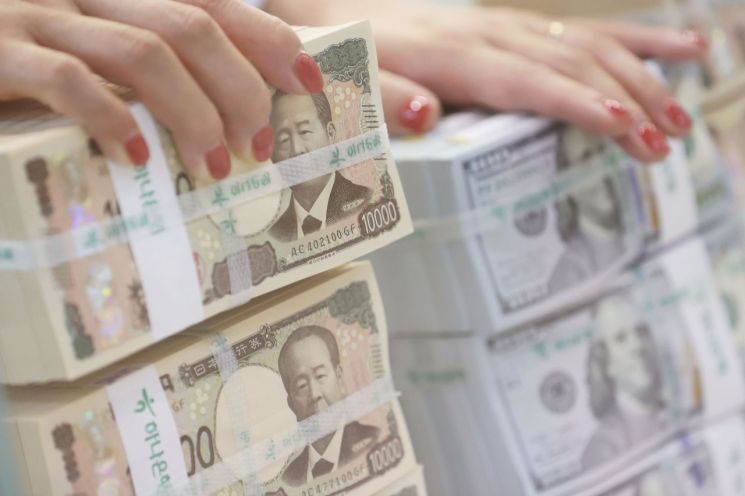 An employee is sorting Japanese yen and U.S. dollars at Hana Bank's Counterfeit Response Center in Jung-gu, Seoul. Photo by Yonhap News
Stronger co-movement with the yen and WGBI inclusion timing expected to support appreciation
Analysts also say that expectations for a stronger won driven by its increasing co-movement with the yen remain valid. While the Japanese government’s expanded spending is a medium-term depreciation factor for the yen, there is an assessment that, for the time being, expectations for economic stimulus in Japan will help the dollar-yen rate stabilize at lower levels, thereby inducing a concurrent strengthening of the won.
Inclusion in the FTSE World Government Bond Index (WGBI) is also expected to support won strength from a supply-demand perspective. Researcher Jeon noted, “Foreign bond inflows are usually accompanied by currency hedging, so their medium-to-long-term impact on the foreign exchange market will be limited,” but added, “Looking at past WGBI inclusion cases, the currencies of countries being added tended to appreciate temporarily around the actual inclusion date, so a short-term appreciation effect on the won before and after inclusion remains valid.”
The easing of bearish sentiment on the won resulting from foreign exchange market stabilization measures is also adding weight to the gradual downward bias in the exchange rate. Lee Jinkyoung, a researcher at Shinhan Investment & Securities, projected, “The won-dollar exchange rate will likely continue to fluctuate in a consolidation range in the low-to-mid 1,400-won band.”
© The Asia Business Daily(www.asiae.co.kr). All rights reserved.
![Clutching a Stolen Dior Bag, Saying "I Hate Being Poor but Real"... The Grotesque Con of a "Human Knockoff" [Slate]](https://cwcontent.asiae.co.kr/asiaresize/183/2026021902243444107_1771435474.jpg)

















