Harsh Criticism of Japanese Prime Minister over Remarks on Possible Taiwan Intervention
China's top foreign affairs official has stated that the prospects for future coexistence between China and the United States depend on the will of the United States.
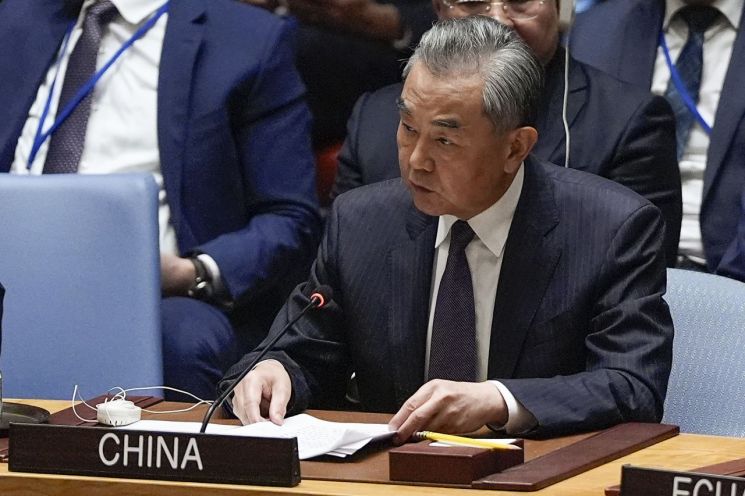 Wang Yi, China's foreign minister, is attending and speaking at a United Nations Security Council meeting held at the UN headquarters in New York, United States, on the 24th (local time). Photo by AP/Yonhap News
According to media outlets including the South China Morning Post (SCMP) in Hong Kong on the 14th, Wang Yi, Director of the Office of the Central Commission for Foreign Affairs of the Communist Party of China (who concurrently serves as foreign minister), said in a speech at the Munich Security Conference in Germany that China is seeking, and will continue to seek, the right path for the two major powers, China and the United States, to coexist through dialogue and negotiation, but added, "Whether we can achieve that goal ultimately depends on the United States."
Director Wang said China was encouraged by U.S. President Donald Trump showing respect toward Chinese President Xi Jinping and the Chinese people, but added, "We cannot be sure that everyone in the United States shares this view."
He stressed that certain forces in the United States "are forming small, exclusive cliques, and as they attempt to separate Taiwan from China, they are stepping on China's red line," adding that "this is highly likely to push China and the United States into a collision."
On this day, Director Wang also sharply criticized Japanese Prime Minister Sanae Takaichi's remarks suggesting possible intervention in the event of a Taiwan contingency. China-Japan relations have rapidly chilled since last November, shortly after Prime Minister Takaichi took office, when she suggested that Japan could intervene by invoking the right of collective self-defense in the event of a Taiwan emergency.
Director Wang said, "This is the first time in 80 years since the end of the war that a Japanese prime minister has made such remarks," and added, "This is a direct infringement on China's territorial sovereignty, a direct challenge to the fact that Taiwan has returned to China, and a complete breach of the promises Japan made to China."
He also drew a contrast with Germany, which has reflected on its past, saying that unlike Germany, Japan still pays homage to war criminals.
He pointed out, "This means that Japan harbors ambitions to invade and colonize Taiwan, and that the specter of militarism still haunts that country."
Regarding China-U.S. relations, after reaffirming the principles of mutual respect, peaceful coexistence, and "win-win cooperation" through dialogue and negotiation, he criticized certain figures in the United States for continuing, despite the goodwill of the two countries' leaders, to work to contain and blockade China and to attack and slander it.
On the same day, Director Wang also reaffirmed China's position as a self-proclaimed "defender of multilateralism," highlighting the contrast with the "unilateralist" course of the Trump administration in the United States.
He said, "The current United Nations is not perfect, but it is still the most universal and authoritative international organization in the world," stressing that "all countries, regardless of size or wealth, have a voice, a sacred right to vote, legitimate obligations, and equal rights."
Director Wang warned that without the United Nations, the world would revert to the "law of the jungle," in which the strong prey on the weak, and that many small and medium-sized countries would lose the multilateral foundation essential for their survival and development. He then argued, "The reason the international system is not functioning well enough does not lie with the United Nations, but with certain countries that exaggerate differences and disagreements and place themselves above all other nations."
On the war in Ukraine, he urged that Europe must not remain a bystander. He said Europe has the right to participate in negotiations related to the conflict, and that China supports Europe's courage in engaging in communication with Russia. On the Gaza Strip, he reaffirmed the position that the "two-state solution," under which Palestine becomes independent, needs to be implemented.
© The Asia Business Daily(www.asiae.co.kr). All rights reserved.
![Clutching a Stolen Dior Bag, Saying "I Hate Being Poor but Real"... The Grotesque Con of a "Human Knockoff" [Slate]](https://cwcontent.asiae.co.kr/asiaresize/183/2026021902243444107_1771435474.jpg)















