Demands Expand to Map Data Exports, Network Usage Fees, and Auto Safety Standards
Korea-U.S. Trade Negotiations Shift Focus from Tariff Rates to Regulatory Regimes
The United States is shifting the focus of its trade agenda with South Korea from tariffs to regulations, namely non-tariff barriers, thereby ramping up pressure. Instead of simply asking for adjustments to tariff rates, Washington is increasingly demanding that Korea revise its systems and regulations themselves, tilting the weight of Korea-U.S. trade negotiations away from tariff schedules toward the realm of laws and institutions.
According to trade experts on the 16th, the area that the United States currently finds most problematic is digital regulation. Restrictions on the overseas transfer of high-precision map data are a prime example. The U.S. side has argued that its platform companies are being denied access to data that are essential for advancing their map services and has been calling for deregulation.
In addition, it takes the view that discussions on introducing network usage fees and legislative moves to regulate online platforms could also function as measures that disadvantage U.S. information technology companies. Repeated complaints have been raised that restrictions on cross-border data transfers, requirements to localize cloud servers, and procedures for transferring personal information are barriers that constrain the operation of global services.
The automotive sector is another area where U.S. demands are heavily concentrated. Washington argues that applying Korea's separate safety and environmental standards, on top of the U.S. Federal Motor Vehicle Safety Standards (FMVSS) that a vehicle has already met, amounts to a de facto certification barrier. In particular, the demand to abolish the annual import cap of 50,000 units for U.S.-made vehicles has been a constant item at the negotiating table. From the U.S. perspective, certification and standards constitute a bigger barrier to market entry than tariffs.
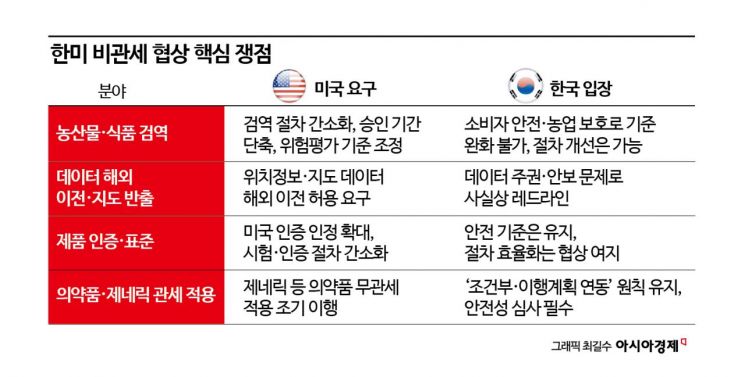
The same applies to the agricultural, food, pharmaceutical, and medical device sectors. There are recurring claims that sanitary and phytosanitary procedures for agricultural products, customs clearance times, and the expansion of testing items can act as import barriers, and that the approval periods and data submission methods for pharmaceuticals and medical devices are overly complex. Systems for the registration and evaluation of chemical substances, environmental and energy-efficiency standards, and regulations related to carbon emissions are also issues that the U.S. side has consistently raised.
The United States also includes restrictions on services and investment within the scope of non-tariff barriers. Foreign ownership caps in the broadcasting and media sector, rules governing entry into certain professional service markets, and public procurement procedures that favor domestic companies are repeatedly cited in reports by the Office of the United States Trade Representative (USTR). Online content and intellectual property protection regimes, as well as methods of copyright enforcement, are likewise classified as trade issues.
The reason these demands are more than mere expressions of opinion is that they are being raised in tandem with the tariff variable. If the United States signals the possibility of reimposing higher tariffs while simultaneously presenting deregulation demands, its negotiating leverage is multiplied. For the Korean government, policy space is inevitably narrowed between domestic objectives such as consumer protection, data security, and fair competition on the one hand, and external trade pressure on the other.
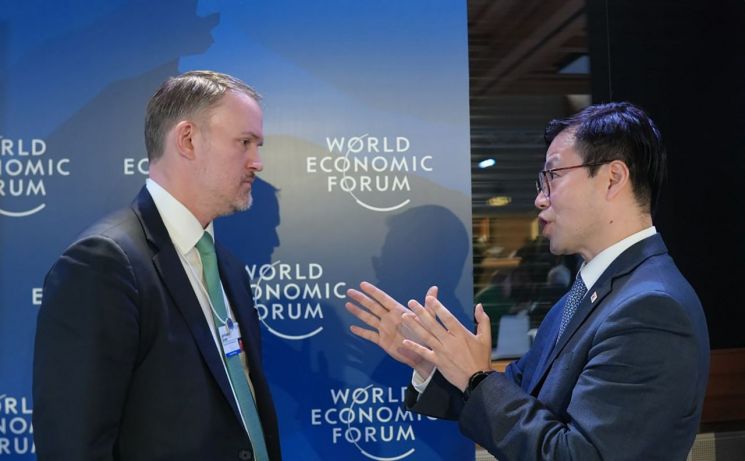
At present, Korean and U.S. trade officials are in frequent contact over both tariff and non-tariff issues. On the 11th, Trade Minister for Negotiations Yeo Han-koo held discussions for about an hour and a half with Rick Switzer, Deputy U.S. Trade Representative, on pending non-tariff barrier issues. The two sides shared the implementation status and future plans for improving non-tariff barriers that were included in the joint fact sheet of the Korea-U.S. summit in November last year, and, according to the explanation, engaged in intensive consultations on matters such as removing non-tariff barriers in the digital and automotive sectors. Yeo expressed his intention to continue discussions going forward, saying that the two sides should "carry on the talks in a productive manner."
For now, the Korean government maintains the position that domestic regulations are grounded in the public interest and are being implemented within the scope of international norms. At the same time, it has indicated a basic stance of reviewing issues that can be adjusted through formal consultation channels such as the Korea-U.S. Free Trade Agreement (FTA) Joint Committee. Trade experts believe that as the focus of trade negotiations gradually shifts from tariff rates to regulations, non-tariff barriers are increasingly likely to become a standing agenda item. They point out that while tariff negotiations are about adjusting numbers, regulatory negotiations entail legal amendments and policy changes, making them significantly more difficult.
© The Asia Business Daily(www.asiae.co.kr). All rights reserved.
![Clutching a Stolen Dior Bag, Saying "I Hate Being Poor but Real"... The Grotesque Con of a "Human Knockoff" [Slate]](https://cwcontent.asiae.co.kr/asiaresize/183/2026021902243444107_1771435474.jpg)












