19 Days of Turmoil Over the Merger
Both Democratic Party Leader Jung Cheongrae and Cho Kuk Innovation Party Leader Cho Kuk Left Wounded
The merger talks between the Democratic Party of Korea and the Cho Kuk Innovation Party have been suspended. Although it was Democratic Party leader Jung Cheongrae’s carefully calculated gambit ahead of the local elections, opposition within the Democratic Party has pushed the merger discussions between the two parties back until after the local elections. What outcome have these merger talks left for the major political forces?
According to political circles on the 14th, both parties are still working to heal the wounds left by the suspended merger talks. The Innovation Party held its Party Affairs Committee meeting the previous day, decided to halt merger talks before the local elections, and approved leader Jung’s proposal to create a “Preparatory Committee for Alliance and Unity” (hereinafter the Preparatory Committee). However, the Party Affairs Committee of the Innovation Party stated, “We express strong regret over the slander directed at the Innovation Party following the merger proposal, and we call for restraint from any future remarks that would undermine the line of alliance and unity.” In addition, the Committee declared that, separate from the launch of the Preparatory Committee, it would “devote itself to winning the local elections.”
Given that the two sides had even called each other “companion parties” using the same Chinese character for friend (友), this suggests that the damage was considerable.
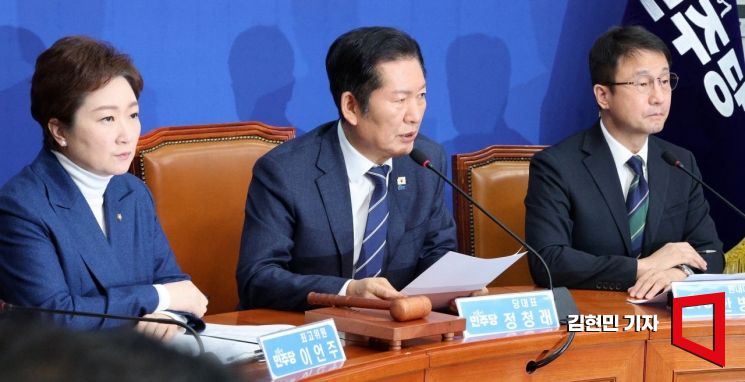 Jung Cheongrae, leader of the Democratic Party, is speaking at a Supreme Council meeting held at the National Assembly on Feb. 11, 2026. Photo by Kim Hyunmin
The merger proposal was made on the 22nd of last month when leader Jung convened an abrupt press conference. However, this proposal was pushed forward without prior discussion or preparation, having been conveyed to the party’s Supreme Council only 20 minutes before it was announced. In the end, Democratic Party Supreme Council members Lee Eonju, Kang Deukgu, and Hwang Myungseon pushed back. The conflict escalated into an all-out confrontation, going beyond “heated debate in a closed-door meeting” to open remarks and press conferences. The sparks flew onto the Innovation Party as well. The debate over whether unification with the Innovation Party would benefit the Democratic Party in the local elections expanded into slander directed at the Innovation Party.
Finally, on the 8th, leader Cho effectively issued an ultimatum, saying, “Please decide the Democratic Party’s official position by February 13, when the Lunar New Year holiday begins.” In particular, Cho protested that the rampant rumors of secret deals and share-trading arrangements were “insulting.”
Ultimately, after contacting the party’s main internal groups, leader Jung convened a general meeting of lawmakers on the 10th and backed down. Jung had initially stated his intention to seek the will of party members through a vote of the entire membership, but as he came under pressure due to controversies such as the special prosecutor recommendation issue, he decided for the time being to halt the merger in the face of opposition from lawmakers. This came 19 days after he proposed the merger.
After the merger was halted, the aftershocks continued
Political observers judge that, through this series of events, Jung’s leadership has been damaged. Jung won the party leadership, left vacant when President Lee Jaemyung ran for the presidential election, after a head-to-head contest with lawmaker Park Chandae. For Jung, seeking re-election as party leader with the power to control nominations in the next general election was regarded as his top priority. From this perspective, measures such as the one-person-one-vote system that strengthened the voting rights of dues-paying party members were also seen in political circles as Jung’s gambit for the next party convention.
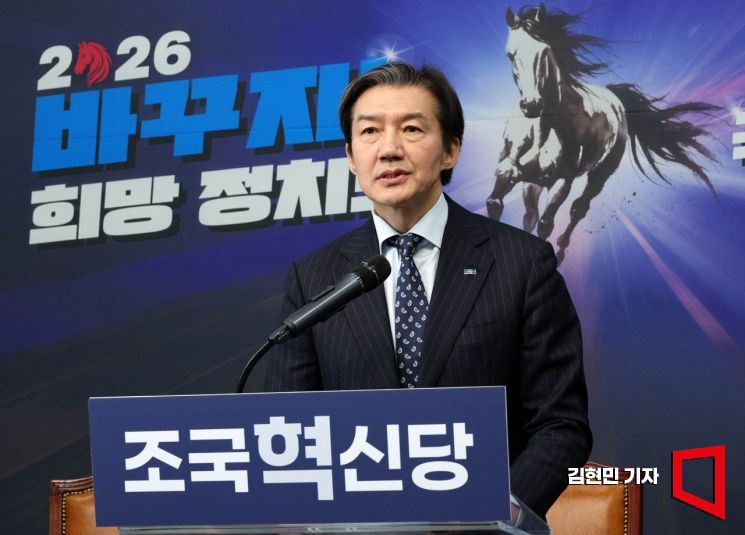 Cho Kuk, leader of the Cho Kuk Innovation Party, is expressing his position at the National Assembly on Feb. 11, 2026, regarding the Democratic Party of Korea's proposal to form a preparatory committee to pursue coalition and unification. Photo by Kim Hyunmin
However, the current merger controversy has left multiple wounds for Jung. First, the merger announcement, which was made without even consulting the Supreme Council members, has been cited as a problem in terms of how the party is managed and how leadership is exercised. In addition, the overwhelming opposition to the merger that emerged during the process of gathering internal party opinion confirmed that Jung’s grip on the party is relatively weak. On top of that, the emergence of concerns that the relationship between the party and the presidential office is creaking has been another blow.
The situation is still far from over.
Democratic Party lawmaker Han Junho, who resigned as chair of the Special Committee on Responding to Politically Motivated Prosecutorial Fabrication Indictments in order to run for governor of Gyeonggi Province, argued that the appointment of Democratic Party Supreme Council member Lee Sungyun, who is close to Jung, as his successor should be withdrawn, calling it “an appointment that betrays the trust of party members.” On the 13th, Han wrote on social media (SNS), targeting Lee, “The issue of having been deeply involved in the process of recommending as a second special prosecutor candidate the lawyer who had targeted President Lee Jaemyung in the Ssangbangwool case is by no means a light responsibility,” adding, “Having such a person head the special committee is a decision that destroys the common sense and trust of party members.” The Democratic National Innovation Council, the largest pro-Lee faction organization within the party, also protested in a statement that appointing Lee as chair of the special committee was “an act of directly confronting the president, who is the greatest victim of the political prosecution.”
Leader Cho is likewise not free from the damage caused by the merger episode. The relationship between the two parties, which had been regarded as part of the broader pro-democratic camp, has suffered significant harm. Every time noise has arisen over the merger, differences in perspectives regarding the political visions of the two parties have been highlighted. Considering his standing as a potential presidential candidate of the broader ruling camp, these are particularly painful wounds. Moreover, the election strategy of competing with the Democratic Party in the Honam region while forming alliances in other regions to block the election of People Power Party candidates is now being shaken. Even before the merger stage, defining the relationship between the two parties in the local elections was a pending task, but after the merger episode, their relationship has instead deteriorated further.
However, the fact that a merger could serve as the ultimate goal for both parties has now been confirmed, and this is expected to act as a catalyst for future electoral alliances between the two sides.
There is also analysis that Prime Minister Kim Minseok has enjoyed a windfall from this controversy. For Kim, whose potential candidacy in the Democratic Party’s national convention in August this year is being discussed, Jung’s crisis could translate into a political dividend. In addition, within the party, the structure of the pro-Lee faction as a counterweight to Jung has become more pronounced. In particular, the influence within the party of Supreme Council members Lee Eonju, Kang Deukgu, and Hwang Myungseon, who had checked Jung by voicing opposition to the merger issue, has been further strengthened.
© The Asia Business Daily(www.asiae.co.kr). All rights reserved.


















