Seventeen of Jeollanam-do's 22 Cities and Counties Classified as Medically Underserved Areas
Emergency Room Barely Maintained with Four Public Health Doctors
"Our hospital does not have a pediatric specialist."
Woo Eunji, who lives in Haenam-gun, Jeollanam-do, rushed her child to a nearby hospital after the child suffered burns on both hands, but the hospital refused to see them. On the 12th, she said, "Even when I called other hospitals, I was only told to go to a bigger hospital because they did not have pediatric specialists," adding, "I had never really felt it before, but that day I realized I was living in a medically underserved area. It was the first time I regretted moving down to Haenam."
Kwon Bitna, a resident of Muan-gun, recounted her experience of being transferred to a hospital 130 kilometers away for an emergency delivery. Kwon said, "At seven months pregnant, the medical staff determined that I needed an emergency delivery, but the local hospital did not have a Neonatal Intensive Care Unit (NICU)," and added, "If I had a C-section, only the newborn would have had to be sent to another hospital, so I chose to receive a tocolytic injection and go to a hospital in Suncheon instead."
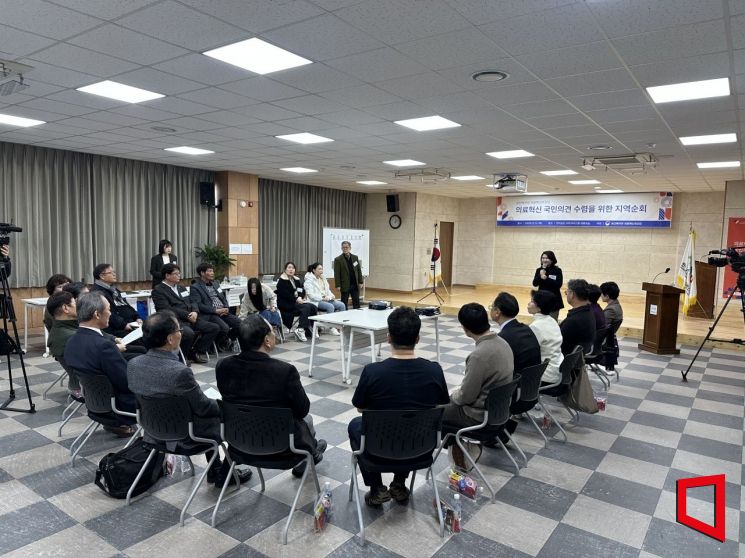 A regional medical-innovation tour meeting to hear the stories of residents in medically underserved areas is being held on the 12th at the Jeollanam-do Social Service Agency in Muan, Jeollanam-do. Photo by Lee Seongmin
Their stories were shared at a meeting held on the 12th for residents of medically underserved areas, organized by the Ministry of Health and Welfare at the Muan-gun Social Service Agency. The ministry arranged the event to understand the medical realities in underserved areas, review policy priorities, and reflect them in the future agenda of the Medical Innovation Committee.
Jeollanam-do is considered the region with the highest share of medically underserved areas in the country. Of its 22 cities and counties, 17 fall into the underserved category. Although the population is small, the land area is large, resulting in generally poor access to medical care. Jo Sookhee, head of the Jeollanam-do Public Health and Medical Support Group, pointed out, "The amenable mortality rate is 9 percentage points higher than in Gwangju, and the stroke transfer rate is about twice the national average," adding, "In the process of repeated transfers, there are not a few cases where the timing of treatment is missed and patients die."
Among medical staff, workforce shortages were cited as a key issue. Jeong Giho, head of Gangjin Medical Center, said, "We are barely able to run the emergency room with four public health doctors, and without them we would have to shut it down," and requested, "Please put in place institutional measures so that they can also take emergency shifts at nearby underserved-area emergency rooms after their regular working hours."
Min Youngdon, head of Suncheon Medical Center, said, "It is difficult for public medical institutions alone to shoulder all regional healthcare," and suggested, "We need to think about incentives that will encourage private-sector participation. Institutional improvements are needed so that public-sector doctors can also hold concurrent positions in doctorless rural areas."
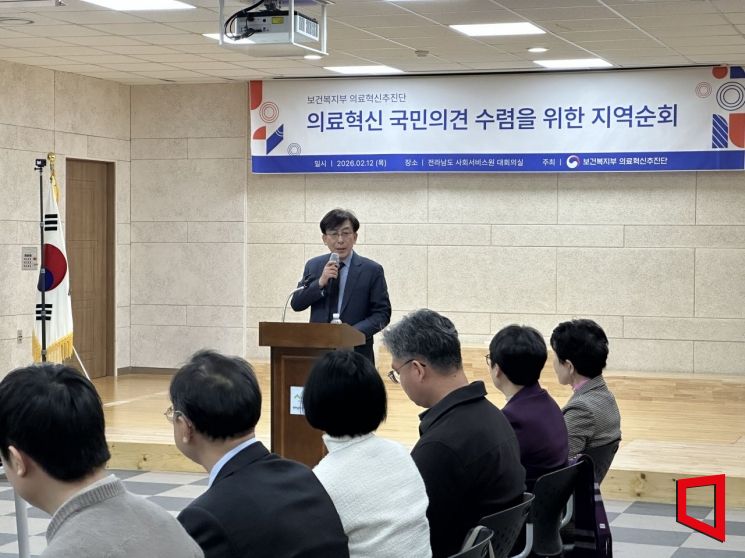 Jung Kihyun, Chair of the Medical Innovation Committee, is speaking at a regional medical innovation meeting held on the 12th at the Jeollanam-do Social Service Agency in Muan, Jeollanam-do. Photo by Lee Seongmin
As the government has decided to train an additional 668 doctors per year on average over the next five years starting next year, a new national medical school is also scheduled to be established in Jeollanam-do, with an enrollment quota of 100 students. However, time is needed to establish the school, so new student admissions will only be possible from 2030, and it is expected to take at least another 10 years after that before specialists can be produced.
Participants proposed measures such as: expanding the quota for contract-based regional doctors to secure short-term staff; promoting the designation of base hospitals in medically underserved areas; expanding basic infrastructure at health sub-centers and clinics; allocating budgets with higher weights for institutions in underserved areas; applying special provisions such as shortening the service period of public health doctors on islands and in underserved areas; and building medical information apps and other patient-centered measures.
The Medical Innovation Committee plans to hold its third meeting on the 26th and decide on its first agenda items. Although difficult tasks are piling up, the Ministry of Health and Welfare intends to identify priority issues as quickly as possible and turn them into policy. Jeong Gihyeon, Chair of the Medical Innovation Committee at the ministry, said, "We intend to focus on areas that have not yet been treated as problems but are nonetheless essential for the public."
© The Asia Business Daily(www.asiae.co.kr). All rights reserved.
![Clutching a Stolen Dior Bag, Saying "I Hate Being Poor but Real"... The Grotesque Con of a "Human Knockoff" [Slate]](https://cwcontent.asiae.co.kr/asiaresize/183/2026021902243444107_1771435474.jpg)

















