Seoul National University team achieves breakthrough in mass production of perovskite... Published in Nature
A Korean research team has developed a synthesis technology that enables the mass production of perovskite, a key material for next-generation displays, while maintaining 100% photoluminescence efficiency. As they have presented a process that can be scaled from the laboratory level to industrial scale, many assess that this brings the commercialization of ultra-high-resolution TVs and displays for augmented reality (AR) and virtual reality (VR) one step closer.
On February 19, the Ministry of Science and ICT announced that a research team led by Professor Lee Taewoo at Seoul National University had developed a cold-injection technology that synthesizes perovskite nanocrystals at around 0 C, successfully achieving mass production of high-quality perovskite nanocrystals. The research results were published on February 18 (local time) in the international journal Nature under the title "Cold-injection synthesis of highly emissive perovskite nanocrystals."
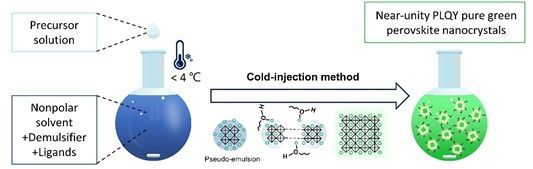 Schematic of the Cold-injection method. Left: injecting a perovskite precursor into a cold (≤4°C) ligand solution. Right: result of synthesizing perovskite nanocrystals with 100% photoluminescence quantum yield. When the precursor is added to the cold ligand solution, a 'quasi-emulsion' environment is formed, controlling the synthesis rate and suppressing crystal defects. As a result, high-quality pure green perovskite nanocrystals are synthesized in large quantities. Illustration and description: Professor Lee Taewoo, Seoul National University
Perovskite is considered a strong candidate for next-generation displays thanks to its color purity and emission properties that surpass those of organic light-emitting diodes (OLEDs) and inorganic quantum-dot light-emitting diodes (QLEDs). In particular, it is regarded as virtually the only emissive material capable of meeting "Rec. 2020," the next-generation UHD (4K and 8K) broadcast color-space standard set by the International Telecommunication Union (ITU). Its full width at half maximum (FWHM) is extremely narrow at about 20 nm, enabling clearer and more lifelike color reproduction.
Overcoming the limits of high-temperature synthesis... Realizing mass production with 0 C cold injection
Conventional synthesis of perovskite nanocrystals has mainly relied on a "hot-injection" method, in which a precursor is injected into a high-temperature solution above 150 C. While this approach can secure high crystallinity, it has limitations such as fire and explosion risks and the need for special equipment to block oxygen and moisture. Although room-temperature synthesis technologies have been proposed, they repeatedly suffered from excessively fast synthesis rates, which led to non-uniform crystal quality and a sharp drop in efficiency during mass production.
The research team focused on the fact that the degradation in quality during mass production was caused by an excessively fast synthesis rate. To address this, they developed a "cold-injection" method in which a precursor is injected into a ligand solution cooled to around 0 C, forming a pseudo-emulsion state before synthesis proceeds. In this low-temperature environment, the synthesis rate is controlled, suppressing crystal defects and forming uniform nanocrystals.
As a result, they demonstrated that mass production is possible while maintaining 100% photoluminescence efficiency even under ambient conditions. The team also succeeded in scaling up from a laboratory-scale synthesis of several milliliters to a 20 L industrial reactor, overcoming the limitations of existing technologies where efficiency decreased as the synthesis scale increased.
A perovskite light-emitting diode (PeLED) fabricated using this material achieved an external quantum efficiency (EQE) of 29.6%, securing world-class performance.
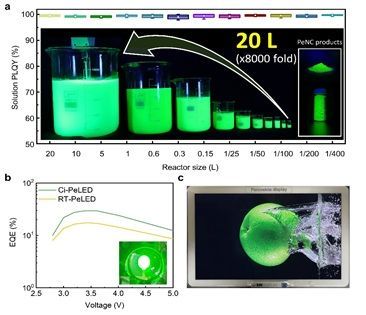 Large-scale synthesis and applications of perovskite nanocrystals using the cold-injection method.
a) Large-scale synthesis of perovskite nanocrystals at the 20 L scale using the cold-injection method
b) Realization of a high-efficiency PeLED with an external quantum efficiency (EQE) of 29.6%
c) Fabrication of a tablet display incorporating a color-conversion film
Figure and description: Lee Taewoo, Professor at Seoul National University
Verification up to commercialization... "Beyond technological dependence to a super-gap"
This research did not remain at the level of laboratory results. In collaboration with S&Display, a company founded by Professor Lee, the team produced a color-conversion film based on the mass-produced nanocrystals and mounted it on an actual tablet display to verify the feasibility of commercialization. The company recently received an Innovation Award at CES 2026, the first in the field of perovskite emitters, in recognition of its technological capabilities.
In particular, this technology is based on a fundamental patent secured by the research team in 2014, which significantly enhances its industrial value. Unlike the current structure in which patent fees are paid to overseas companies for core OLED material technologies, once perovskite displays enter full-scale commercialization, this technology is expected to help overcome technological dependence and strengthen the competitiveness of Korea's display industry.
Professor Lee Taewoo of Seoul National University said, "Through a new synthesis method called cold injection, we have succeeded in achieving mass production that is viable for actual commercialization, going beyond the laboratory scale," adding, "I hope this achievement will serve as a stepping stone for securing a super-gap in competitiveness in the next-generation display market." Koo Hyukchae, First Vice Minister of Science and ICT, said, "Professor Lee is a case of having grown from a young researcher to a mid-career and then a leading researcher through basic research programs," and added, "We will strengthen step-by-step, tailored support so that researchers from early-career scientists to eminent scholars can produce world-class results."
This study is a purely domestic achievement carried out through collaboration among Korean researchers, with Seoul National University at the center, together with Daegu Gyeongbuk Institute of Science and Technology (DGIST) and the Korea Basic Science Institute (KBSI). Attention is now focused on whether perovskite can move beyond being a 'next-generation candidate' to actually entering the stage of full-scale commercialization.
© The Asia Business Daily(www.asiae.co.kr). All rights reserved.


















