More Accurate Than Experts in Predicting Interest Rates, Inflation, and Corporate Earnings
A new study has found that the economic forecasts of amateur bettors on online prediction platforms such as Polymarket and Kalshi can be more accurate than those of economists at major Wall Street banks and investment firms, even though those economists are graduates of elite universities and receive high salaries.
According to a recent research report released by the National Bureau of Economic Research (NBER), Kalshi bettors were found to be about as accurate as highly trained experts when predicting specific economic indicators. In particular, amateurs showed higher accuracy than professionals in forecasting the Federal Reserve (Fed)'s interest rate decisions and the inflation rate.
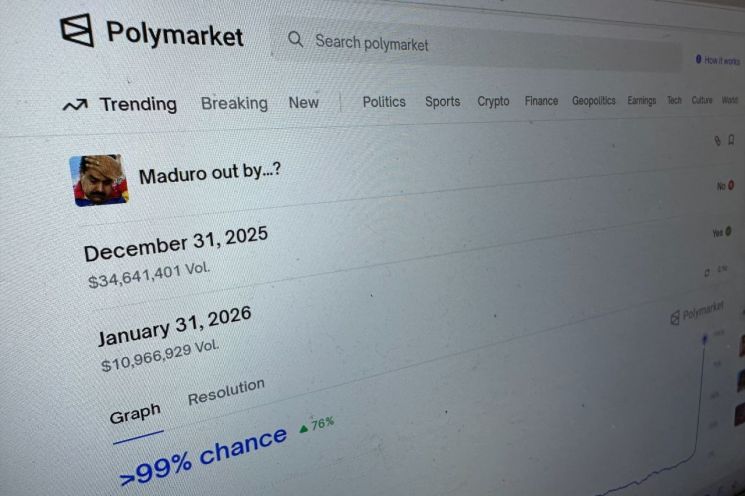 Polymarket webpage predicting the resignation of Venezuelan President Nicolas Maduro. Associated Press and Yonhap News Agency
Prediction markets are platforms where participants wager money on outcomes. They can bet on a wide range of events, from the results of sports games to the likelihood of a U.S. attack on Iran or the timing of the resignation of U.K. Prime Minister Keir Starmer, and they receive payouts according to the odds if their predictions are correct.
Jonathan Wright, a co-author of the report and professor of economics at Johns Hopkins University, said, "Gathering information from a large number of people can be a surprisingly effective way to make forecasts."
Thomas Simons, U.S. economist at investment firm Jefferies, paid close attention when former Fed Governor Kevin Warsh emerged in prediction markets as a leading candidate for the next Fed chair. At the time, President Donald Trump was pressuring for interest rate cuts, and because Warsh had previously advocated for high interest rates, many experts believed his chances of being nominated were slim. However, the prediction markets turned out to be right.
Economist Simons explained that, unlike professionals who must make forecasts even when the data are confusing and they lack confidence, betting participants have the advantage of only needing to make predictions when they are confident.
A research paper published by economists at London Business School and Yale University found that Polymarket bettors were more accurate than analysts in predicting corporate earnings.
Tais Jensen, a Yale University professor who contributed to the paper, analyzed that the reason thousands of amateurs performed relatively well was incentives. Analysts may face potential conflicts of interest, such as their firms earning higher trading commissions when they present optimistic outlooks. They also tend to avoid issuing earnings forecasts that fall outside conventional ranges. Prediction market participants, by contrast, are not constrained in this way.
Online prediction markets first appeared in the United States in the early 2000s. They were used to forecast election results and the likelihood of major global events, and were generally regarded as fairly accurate. However, in the 2010s, U.S. regulators began cracking down on these platforms, arguing that they were operating as illegal gambling sites.
Since then, some platforms have continued to operate in Europe, mainly focusing on sports betting. Political and economic issues were considered secondary. But the volume of betting on non-sports topics has grown rapidly. The amount wagered on political and economic predictions now exceeds 60 million dollars (about 86.5 billion won).
Edward Risley, Chief Executive Officer (CEO) of prediction market analytics firm Standd, said that many of their large-volume traders work in the same fields they bet on. For example, one user living in Hong Kong trades Nvidia stock as his primary job and uses a tariffs-related prediction market as a hedging tool. This allows him to avoid a severe blow even if the U.S. administration sharply escalates tariffs on China. CEO Risley added, "People who are really strong on election outcomes are often not very good at cryptocurrencies, and those who are strong on cryptocurrencies can be weak on geopolitics."
Michael Feroli, Chief U.S. Economist at JPMorgan, can tap into the extensive expertise of JPMorgan's political staff, country specialists, and equity researchers. Even so, he said he still consults prediction markets for more fine-tuned forecasts. "When you talk to people in Washington, D.C., they always say, 'I think the budget bill will pass,'" he noted. "You often have to push really hard to get a quantitative answer."
However, prediction markets do not outperform experts in every area. Economist Feroli said that when it comes to forecasting the Consumer Price Index (CPI) or Gross Domestic Product (GDP), prediction markets tend to follow the experts. Bettors monitor the Bloomberg consensus or read major investment banks' research reports and then place their bets.
Tara Sinclair, a George Washington University economist who studies forecasting, also agreed that in some areas prediction markets simply follow experts, and she pointed out that this is where the risk of prediction markets lies. The value of experts does not lie in the raw numbers themselves, but in their interpretation and forward-looking analysis. If the crowd ends up replacing experts entirely, the sources of information that bettors rely on will disappear, making it harder for them to predict outcomes. "Right now, there are information sources that individuals can draw on," Professor Sinclair said. "If you replace all of that, you end up with no information sources left to rely on."
© The Asia Business Daily(www.asiae.co.kr). All rights reserved.

















