WHO Points Out That "1 in 5 Adults Exceeds Recommended Level"
Consumer Groups Warn of "Risk of Being Seen as a Price Policy"
Food Industry Says "Effectiveness Debated Overseas"...Questions Raised Over Real Impact
As President Lee Jaemyung has proposed introducing a "sugar overuse levy," the related debate is intensifying in political circles. The Democratic Party of Korea argued that, as Koreans' sugar intake exceeds the World Health Organization (WHO) recommendation, policy tools are needed to improve public health. At the same time, concerns were raised about increased corporate burdens and the possibility of higher prices.
On the 12th, Representative Jung Taeho of the Democratic Party of Korea, a member of the National Assembly Strategy and Finance Committee, held a "forum on the sugar overuse levy" at the National Assembly Library in Yeouido, Seoul. Supreme Council Member Moon Jungbok and Kim Youngho, Chair of the National Assembly Education Committee, also attended the event.
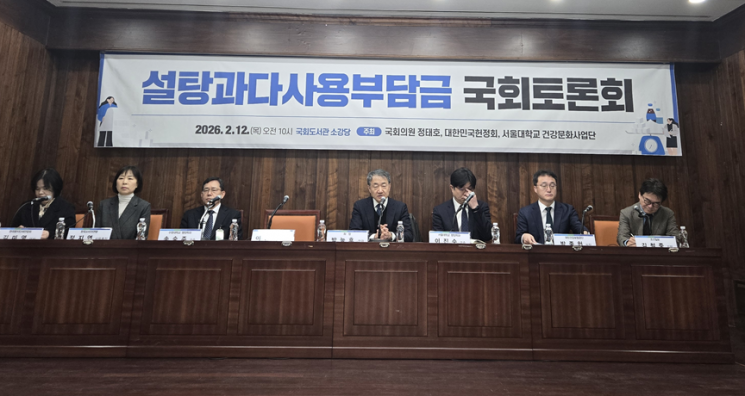 Former Minister of Health and Welfare Park Neunghu (fourth from the right) and panelists are exchanging views at a National Assembly forum on the surcharge for excessive sugar use on the 12th.
In his opening remarks, Representative Jung Taeho stressed the seriousness of excessive sugar consumption. He said, "According to the World Health Organization (WHO), 1 in 5 adults and 1 in 3 adolescents in Korea consume sugar in excess of the recommended level," adding, "In a situation where we even hear the phrase 'sugar republic,' further delaying discussion of a sugar levy amounts to the state abdicating its responsibility."
He went on to say, "Chronic diseases such as obesity, diabetes, and cardio-cerebrovascular diseases are rapidly spreading to younger generations beyond middle-aged and older adults," and pointed out that "this is closely related to the increased consumption of high-sugar foods such as delivery meals and carbonated drinks." He added, "Health problems caused by excessive sugar intake have reached a stage where they are difficult to solve through individual choice alone," and described them as "a challenge that the entire society must tackle together."
The "sugar levy" is a system that imposes a charge on certain processed foods, such as sweetened beverages that contain excessive amounts of sugar. The political vision is to curb consumption by imposing an economic burden on foods that are harmful to health and to use the funds raised to expand public healthcare or finance health promotion programs.
The starting point for the political debate was President Lee's social media comments. On January 28, President Lee wrote on X, "What do you think about a plan to curb the use of sugar and reinvest the levy in strengthening regional and public healthcare?" When critics later argued that this amounted to a tax hike, he drew a line, calling it "a distorted claim that tries to trap the discussion in a tax-hike frame."
At the forum, discussions continued over the name and legal nature of the measure. Lee Jinsu, a professor at the Graduate School of Public Administration at Seoul National University, explained, "This is not a tax on sugar itself, but is closer to a polluter-pays-type levy on overuse," adding, "Its purpose is not to secure revenue, but to induce changes in the behavior of producers and consumers." Some also argued that the levy should be limited to processed beverages and similar products that use excessive amounts of sugar, rather than on sugar itself. They warned that including essential cooking ingredients could spark controversy over fairness and regressivity.
Patient advocacy groups emphasized the importance of the term "overuse." Kim Miyoung, a director at the Korea Alliance of Patients Organization, said, "Sugar is an energy source for our bodies, but excessive consumption is the problem," and added, "There are cases, such as for patients with type 1 diabetes, where high-sugar foods can be lifesaving, so exceptional circumstances must be designed with great precision."
Consumer organizations expressed concern about possible price hikes. Jung Jiyeon, Secretary General of the Consumers Union of Korea, said, "The first thing consumers ask is whether beverage and snack prices will go up," and warned, "If it leads to higher prices, the measure could be perceived not as a health policy, but as a price policy." She also proposed a scheme similar to that of the United Kingdom, in which the levy is imposed only on products that exceed a certain sugar-content threshold, thereby encouraging companies to respond by reducing sugar rather than raising prices.
Industry, on the other hand, questioned the effectiveness of the measure. Lee Sangwook, Director General of the Korea Food Industry Association, argued, "From the public's perspective, this is no different from a tax," and said, "Even overseas, there is ongoing controversy over the effectiveness of sugar taxes." He also emphasized that the industry has already been expanding low-sugar and alternative-sugar products.
The use of the funds raised also emerged as a key issue. Supreme Council Member Moon Jungbok said, "Because the term 'sugar tax' triggers strong tax resistance, the discussion is taking place in the form of a levy," and revealed that "in addition to health promotion, converting the funds into education resources is also under review." Representative Kim Youngho said, "It is desirable to use the funds secured for the welfare of future generations," citing as examples improving the quality of school meals, strengthening sports and reading activities, and supporting youth mental health.
Experts pointed out that domestic evidence-based research must be accumulated before pushing ahead with the policy. Park Jongheon, director at the National Health Insurance Service, said, "We will expand research that analyzes the causal relationship between sugar and disease by linking national health insurance big data with the Korea National Health and Nutrition Examination Survey."
© The Asia Business Daily(www.asiae.co.kr). All rights reserved.
![Clutching a Stolen Dior Bag, Saying "I Hate Being Poor but Real"... The Grotesque Con of a "Human Knockoff" [Slate]](https://cwcontent.asiae.co.kr/asiaresize/183/2026021902243444107_1771435474.jpg)















