First Special Committee Meeting on Investment in the United States Held Behind Closed Doors
Park Sooyoung: "Anger and Dismay at Unilateral Handling in the Legislation and Judiciary Committee"
Kim Sanghun: "Work Report Substituted with Written Materials... No Disruption to March 9 Schedule"
The Special Committee for the passage of the Special Act on Investment in the United States (hereinafter referred to as the Special Committee) held its first meeting on the 12th, but calls for an early recess emerged from the outset, signaling a rocky start.
At the plenary session held that morning, the Special Committee elected People Power Party lawmaker Kim Sanghun as its chair, and Democratic Party lawmaker Jung Taeho and People Power Party lawmaker Park Sooyoung as its secretaries. At the beginning of the meeting, members of the Special Committee stressed the gravity of the matter and the need to safeguard the national interest, expressing their intention to "do their utmost," but the meeting was soon switched to a closed session.
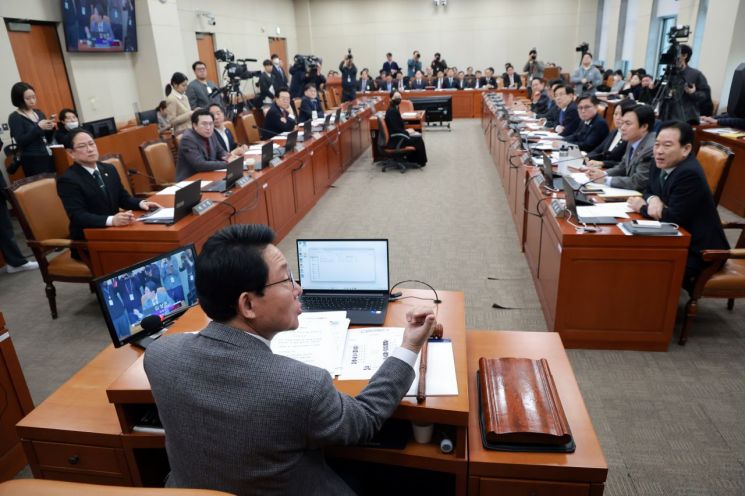 At the first plenary meeting of the Special Committee for the passage of the Special Act on Investment in the United States, held at the National Assembly on the 12th, Chairman Kim Sanghun of the People Power Party announced that the committee would be converted to a closed session and asked reporters to leave. Yonhap News
The Special Committee had planned to proceed with work reports after appointing the chair and secretaries and hearing opening remarks from the members. However, lawmaker Park Sooyoung said, "At the Legislation and Judiciary Committee yesterday, bills that do not help the national interest were railroaded through. We cannot help but feel anger and dismay at the way the Constitutional Court Act, which includes an increase in the number of justices and the introduction of a constitutional complaint system, was unilaterally handled," adding, "No matter how much we discuss in the Special Committee, there is no guarantee that (in the end) it will not be unilaterally passed." He went on to argue, "Let us adjourn today's meeting and, after the ruling and opposition parties reach some kind of agreement on measures to prevent one-sided action, resume the meeting."
In response, lawmaker Jung Taeho said, "I had been consulting with lawmaker Park before the committee convened, but he suddenly brought this up. It is regrettable that this departs from established practice," and added, "The Special Committee was convened based on an agreement between the floor leaders, so it is not appropriate for it to be influenced by the operation of other committees." He continued, "I think it would be appropriate for the Special Committee to conduct its work as the Special Committee, and for the floor leadership to properly handle other political issues," adding, "From the very start, bringing other political issues into the operation of the Special Committee is something the public will find hard to accept."
The move by the People Power Party is being interpreted as an attempt to link the issues of the constitutional complaint system and the increase in the number of Supreme Court justices, which the ruling party pushed through at the Legislation and Judiciary Committee the previous day as part of judicial reform, with the Special Act on Investment in the United States and other matters.
When the request for a recess was raised, Chair Kim Sanghun announced that the meeting would proceed in a closed session. Some ruling party lawmakers voiced objections to the shift to a closed meeting.
After adjourning the plenary session during the closed meeting, Chair Kim Sanghun met with reporters and said, "In the closed session, we heard remarks from the two ministers (Deputy Prime Minister and Minister of Economy and Finance Koo Yooncheol, and Minister of Trade, Industry and Energy Kim Jungkwan), and then the secretaries from both parties went into consultations," adding, "I do not know whether the meeting will resume." He explained, "We are on a timetable that calls for the bill to be handled by March 9, and we expressed the view that there will be no problem in passing the bill within that period," and added, "Although we were unable to conduct a normal work report, we substituted it with written materials."
Special Committee member and Democratic Party lawmaker Kim Hyunjung told reporters, "The ruling and opposition parties reached a hard-fought agreement on the issue of the national interest to launch this Special Committee," and added, "In the United States, they are saying that if the Special Act is not passed, tariffs will be raised, and for Hyundai Motor, if tariffs are raised to 25%, it will incur annual costs of more than 4 trillion won. It is extremely regrettable that other standing committee issues are being brought in and turning this into a political conflict."
© The Asia Business Daily(www.asiae.co.kr). All rights reserved.
![Clutching a Stolen Dior Bag, Saying "I Hate Being Poor but Real"... The Grotesque Con of a "Human Knockoff" [Slate]](https://cwcontent.asiae.co.kr/asiaresize/183/2026021902243444107_1771435474.jpg)















