Medium- to Long-Term Labor Supply and Demand and Additional Labor Demand Outlook for 2024?2034
Employment to Decrease by 303,000 Between 2029 and 2034
Discussion on New Designation of Gwangyang as a Preemptive Response Employment Crisis Area
There is a new medium- to long-term forecast that the number of employed people in Korea will shift into a decline phase around 2030. This is because the structural change of a shrinking working-age population driven by low birth rates and population aging is entering full swing. However, if the labor force participation rates of women, young people, and older people are raised to the level of Japan, the government projects that the annual economic growth rate would rise by an additional 0.4 percentage point, and that more than 1.22 million additional workers would be needed by 2034.
On the 12th, the Ministry of Employment and Labor held the "Second Employment Policy Deliberation Committee Meeting of 2026" and discussed and reviewed items including the "Medium- to Long-Term Labor Supply and Demand Outlook and Additional Labor Demand Outlook for 2024-2034" and the "2026 Employment Outlook and Employment Policy Direction."
According to the Korea Employment Information Service, the economically active population in 2034 is expected to increase by only 136,000 compared with 2024. This represents a sharp slowdown in the pace of increase, compared with an increase of 3.29 million between 2004 and 2014 and 2.56 million between 2014 and 2024. The number of employed people shows a similar pattern. The number of employed persons is forecast to increase by only 64,000 by 2034, which translates into an effective average annual growth rate of 0.0%. This means that, unlike last year’s medium- to long-term labor supply and demand outlook (2023-2033), which projected the total number of employed persons to increase by an annual average of 0.1%, employment will in effect enter a stagnation phase.
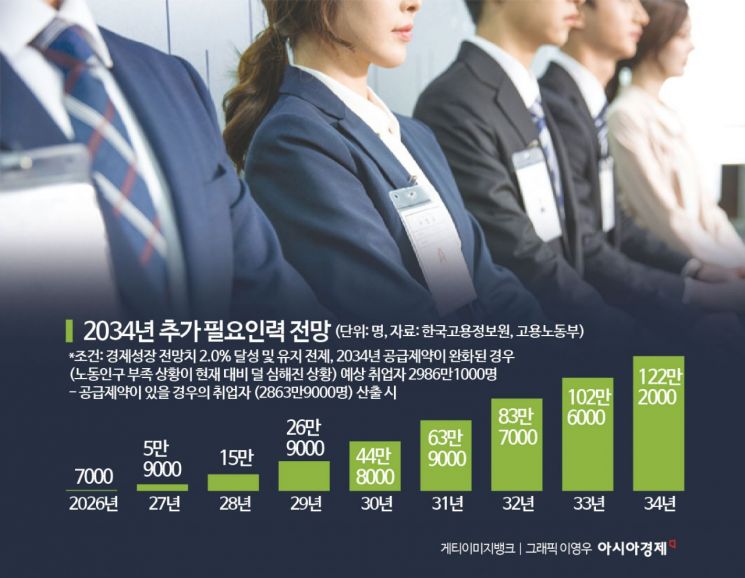
Decline from 2030... Clear divergence by industry = The number of employed persons is projected to increase by 367,000 in the first half of the outlook period (2024-2029), but to decrease by 303,000 in the second half (2029-2034), meaning that employment will start to decline from 2030. The outlook varies sharply by industry. Due to population aging and rising demand for care services, employment in social welfare services and healthcare is expected to increase by 692,000. Driven by technological change such as artificial intelligence (AI), employment is also projected to increase in research and development (58,000) and in the computer programming industry (55,000).
By contrast, due to the shift to online and platform-based business models and broader industrial transformation, retail trade is projected to lose 290,000 jobs, and wholesale trade is also expected to see employment fall by 121,000. By occupation, care and health service jobs (231,000) and health professionals (220,000) are expected to increase significantly, while employment in in-store sales jobs (-196,000) and skilled agricultural and livestock jobs (-86,000) is projected to continue to decline.
The government believes that easing constraints on labor supply would expand the economy’s growth potential. Assuming that the labor force participation rates of women, young people, and older people are raised to Japan’s 2024 level by 2034, the economic growth rate is projected to rise from 1.6% to 2.0%, an increase of 0.4 percentage point. Under this scenario, the number of employed persons is estimated to reach 29,861,000, which is 1,222,000 more than the baseline projection of 28,639,000.
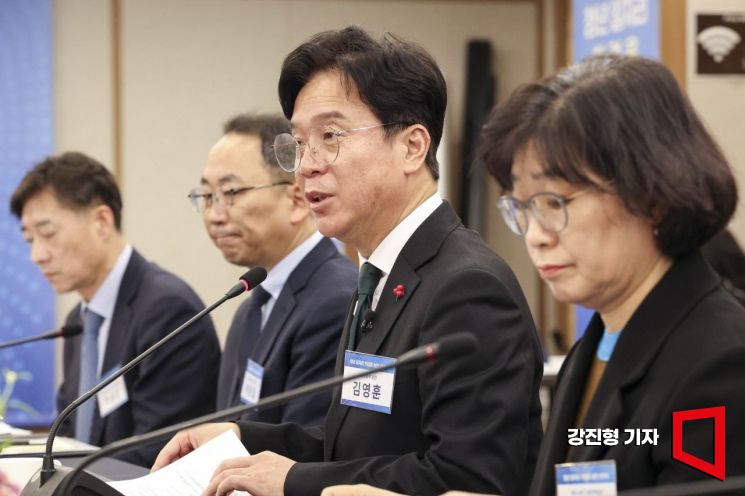 Kim Younghoon, Minister of Employment and Labor, is delivering opening remarks at the "Youth Employment First Step Practice Declaration Ceremony" held at the Press Center in Jung-gu, Seoul, on Dec. 8, 2025. Photo by Kang Jinhyung
"Narrowing gaps in access to work"... Parallel response to regional and industrial transition = The committee also discussed this year’s employment outlook and policy direction. The Bank of Korea and the Korea Development Institute (KDI) forecast this year’s employment rate at 62.9% and the unemployment rate at 2.8%, respectively, levels similar to last year. However, they expect structural constraints to persist, including external uncertainties such as the deterioration of the global trade environment and the reduction in new hiring of young people due to a growing preference for experienced workers.
The government has set "narrowing gaps in access to work" as its strategic objective. It will support the early employment of young people who are currently out of work and "taking a break," expand work-experience and recruitment events, and provide support to help employed young people adapt to their jobs. To revitalize regional employment, the government also plans to support the enactment of a tentatively named "Regional Employment Vitalization Act." For middle-aged and older workers, it will strengthen support for early career planning, prompt reemployment and job transitions, and continued employment in primary jobs. For working parents, it will reduce disparities in the use of parental leave and other schemes, and improve conditions for small and medium-sized enterprises to utilize these systems. It will also establish an integrated management system through the creation of a database on the employment status of foreign workers and enhanced support for occupational safety.
The government will also respond in parallel to industrial transition. It will establish a "Basic Plan for Employment Stability in Industrial Transition," covering carbon neutrality and digital transformation, and will expand AI capability-building training across all stages (entry, active employment, and transition). Upgrading the functions of employment centers, promoting employment AX (digital transformation of employment services), and closing gaps in employment insurance coverage were also presented as key tasks.
In addition, the government selected 11 tasks to be subject to employment impact assessments in 2026. These include 5 tasks in promising industrial fields such as AI, 2 tasks related to demographic structure such as foreign worker employment, and 4 tasks in regional policy areas such as youth employment and the social economy. In 2025, the government conducted employment impact assessments on 10 tasks, including the "Young Farmers’ Agricultural Settlement Support Project," and plans to send the results to relevant ministries and local governments and monitor whether the resulting policy recommendations are implemented.
Responses to regional employment crises were also discussed. A proposal to newly designate Gwangyang in South Jeolla Province, where employment has declined due to a slump in the steel industry, as a "Preemptive Response Employment Crisis Area" was placed on the agenda. For Yeosu in South Jeolla Province and Gwangsan District in Gwangju, which were designated in August last year, the government will review whether to extend the designation period. The government recently revised the relevant regulations to allow the maximum designation period to be extended.
Minister of Employment and Labor Kim Yeonghun said, "Medium- to long-term labor shortages and industrial transition are structural challenges," adding, "We will continue our policy efforts to ensure that everyone can participate in the labor market without any groups being left behind amid demographic change and the AI transition."
© The Asia Business Daily(www.asiae.co.kr). All rights reserved.
![Clutching a Stolen Dior Bag, Saying "I Hate Being Poor but Real"... The Grotesque Con of a "Human Knockoff" [Slate]](https://cwcontent.asiae.co.kr/asiaresize/183/2026021902243444107_1771435474.jpg)

















