An increase of 1.4 trillion dollars...
Deficit projected to reach 23.1 trillion dollars
"Large-scale tax cuts and immigration restrictions weaken the tax base"
The U.S. federal budget deficit could increase by an additional 1.4 trillion dollars (2,027 trillion won) over the next 10 years due to President Donald Trump’s tax cuts and immigration policies, according to a new projection.
The U.S. Congressional Budget Office (CBO) released its report on the economic and fiscal outlook for the next 10 years on the 11th (local time). According to the report, the cumulative budget deficit for 2026-2035 is projected to reach 23.1 trillion dollars (33,460 trillion won), which is 1.4 trillion dollars higher than the current projection. This is a 6% increase compared with the estimate made in January last year, when the Trump administration took office.
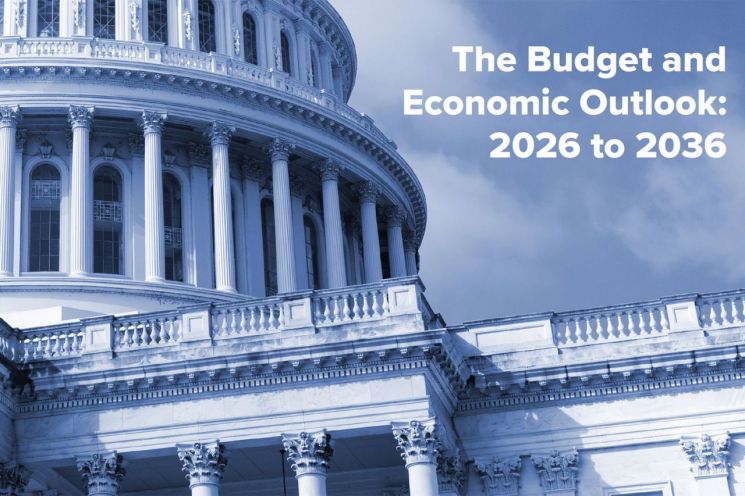 The Congressional Budget Office (CBO) report on economic and fiscal projections for the next 10 years, released on the 11th (local time). CBO.
The report identified the One Big Beautiful Bill Act (OBBBA), which passed in July last year, as a key factor behind the widening deficit. This large-scale tax cut policy of the Trump administration significantly raises tax credit rates for investment in facilities and equipment within the United States, while restricting linkages with foreign entities (PFE) such as China. The report also stated that immigration restrictions will affect future deficits. While limiting immigrants may reduce certain welfare expenditures, it could also expand the budget deficit by weakening the tax base as the labor force shrinks.
Looking at the details, the deficit over the 10-year period is projected to increase by 4.7 trillion dollars (6,807 trillion won) due to the tax cuts, and by 500 billion dollars (724 trillion won) due to immigration restrictions. However, the CBO projected that revenue secured through tariff policy will reduce the deficit by 3 trillion dollars (4,344 trillion won). Net interest outlays are expected to surge from 1 trillion dollars (1,448 trillion won) this year to 2.1 trillion dollars (3,041 trillion won) in 2036, driven by higher debt levels and an increase in average interest rates.
The CBO estimated that this year’s budget deficit will reach 1.85 trillion dollars (1,448.42 trillion won), equivalent to 5.8% of gross domestic product (GDP). This is 0.3 percentage point higher than the projection made before President Trump returned to office. The Wall Street Journal (WSJ) pointed out, “This year, the United States will spend 1.33 dollars for every 1 dollar it collects in taxes and tariffs,” adding, “This is a historically high level of deficit, rarely seen outside of emergencies and wartime.”
However, due to structural factors such as population aging and rising medical expenditures, the budget deficit is expected to widen even further over the next 10 years. The annual deficit-to-GDP ratio is projected to climb to 6.7% in 2036. Bloomberg News commented, “If the CBO’s projections are correct, it will derail Treasury Secretary Scott Bessent’s goal of reducing the deficit to around 3% by the end of President Trump’s term.”
The fiscal burden from health and welfare programs such as Social Security and medical assistance is also increasing. These costs, which averaged about 8% of GDP over the past 50 years, have now risen to 11.2% and are projected to reach 12.6% by 2036.
At a press conference that day, CBO Director Phillip Swagel warned, “Our budget projections continue to show that the fiscal path is not sustainable.” Federal Reserve (Fed) Chair Jerome Powell also said at a press conference last month that “no matter how high the current level of debt is, nothing catastrophic happens immediately,” but added, “The problem is that the government is on an unsustainable path.”
© The Asia Business Daily(www.asiae.co.kr). All rights reserved.
![Clutching a Stolen Dior Bag, Saying "I Hate Being Poor but Real"... The Grotesque Con of a "Human Knockoff" [Slate]](https://cwcontent.asiae.co.kr/asiaresize/183/2026021902243444107_1771435474.jpg)















