From 11 Years and 8 Months to 8 Years and 2 Months
Shortening Timelines by Up to 42 Months
The government has unveiled a plan to streamline procedures and shorten the time needed to expand public incineration facilities by up to 42 months (3 years and 6 months). By overhauling the entire process from site selection to design, permits and construction, the government aims to reduce the average project duration from the current 140 months (11 years and 8 months) to 98 months (8 years and 2 months).
On February 12, the Ministry of Climate, Energy and Environment announced these measures in a briefing at the Government Complex Seoul, under the title “Plan to Shorten Public Incineration Facility Expansion Projects.” Accordingly, the duration of each of the four key procedural stages required to build incineration facilities will be reduced.
The backdrop to this plan is the rapid change in waste treatment conditions. Starting this year, the direct landfilling of municipal solid waste in the metropolitan area has been banned, and this ban will be expanded nationwide from 2030. While demand for incineration is increasing, new incineration facilities repeatedly take more than 10 years just to break ground due to local opposition and complex administrative procedures. As a result, concerns have been raised about regional treatment gaps, increased costs for private outsourcing, and higher expenses for transporting waste to other regions.
First, the initial project stage, “Project Structuring and Site Selection” (including a strategic environmental assessment), will be shortened from 30 months to up to 18 months. For expansion projects on existing sites, approval by the site selection committee will be rationalized by replacing it with resolutions by resident councils, and the strategic environmental assessment will be reviewed on a priority and focused basis. In addition, the government plans to raise the surcharge on waste treatment fees to expand funding for resident support and thereby improve local acceptance.
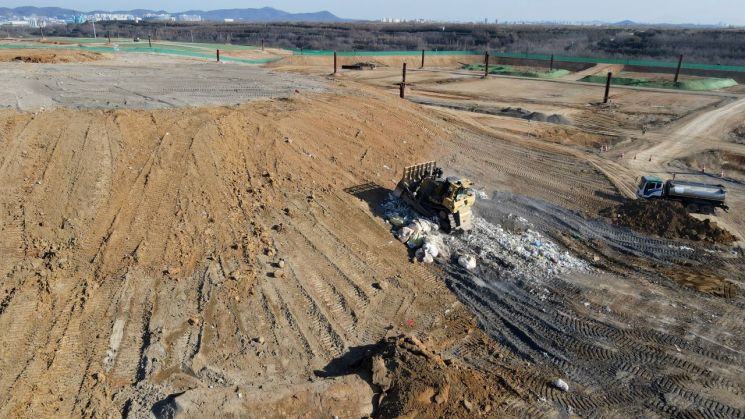 On the morning of January 2, when the ban on direct landfill of household waste in the Seoul metropolitan area went into full effect, the Sudogwon Maeripji in Seo-gu, Incheon was quiet. Yonhap News.
The “Master Plan Formulation and Administrative Procedures” stage will be reduced from 38 months to 27 months. The government will prepare standard guidelines for calculating incineration facility capacity and coordinate with relevant agencies to ensure that local fiscal investment reviews proceed quickly. Some consultation procedures will be simplified by skipping the regional office level and handling them directly within the ministry.
The “Basic and Detailed Design Stage” (including parallel permitting) will also be shortened from 24 months to up to 17 months. Design work, environmental impact assessments, integrated environmental permits, and construction technology reviews will be carried out simultaneously so that design adequacy reviews can be completed quickly. In this stage as well, consultation procedures will be reduced to minimize administrative time. Finally, the construction period for facilities will be cut from 48 months to up to 36 months by shortening the construction schedule through methods such as simultaneous and advance manufacturing of equipment.
The procedures for managing total project costs will also be improved. By prioritizing design-build turnkey projects and lump-sum subsidy projects, the time required to adjust total project costs will be reduced. These project types are excluded from design adequacy reviews and total project cost management, so the procedural burden is relatively lower. A “Public Incineration Facility Expansion Support Team” will be operated to provide specialized responses.
Financial support will also be expanded. Previously, state subsidies focused on the installation costs of incineration equipment and community benefit facilities (20% of incineration facility installation costs), but going forward, additional items such as land acquisition costs will also be subsidized.
Through this streamlining of procedures, the government plans to accelerate the expansion of public incineration facilities, promote stable and self-reliant waste treatment, and reduce regional conflicts and social costs.
© The Asia Business Daily(www.asiae.co.kr). All rights reserved.

















