Rural Development Administration Develops Subtropical Fruit "Heating Energy Demand Prediction System"
Enables Forecasting of Heating Costs by Crop and Cultivation Area
Supports Heating Operation Planning...Reduces Management Uncertainty
As cultivation of subtropical crops such as mango, passionfruit, papaya, and dragon fruit has increased in Korea, the Rural Development Administration has built a system that informs growers in advance of the scale of heating energy required for subtropical fruit cultivation by region.
On the 11th, the Rural Development Administration announced that it has developed the "Subtropical Fruit Heating Demand Prediction Information System," which allows users to check in advance the heating energy requirement levels by cultivation area for a total of five subtropical fruits: mango, passionfruit, papaya, dragon fruit, and mandarins, and has begun offering it as a public service.
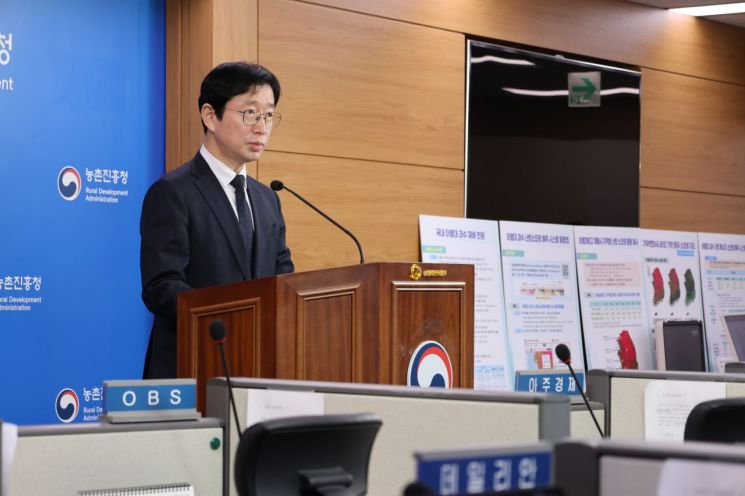
As global warming accelerates, the areas in Korea where subtropical crops can be grown are expanding, and accordingly, the cultivation area for subtropical fruits is also continuously increasing. As of 2025, the domestic cultivation area for subtropical fruits reaches 1,198.6 hectares, accounting for 41.2% of all subtropical crops. Subtropical fruits are fruits whose place of origin is a subtropical climate zone or that are mainly grown in subtropical regions. Because they are vulnerable to cold, they often require protected cultivation facilities and heating during winter.
Kim Daehyun, Director General of the National Institute of Horticultural and Herbal Science at the Rural Development Administration, said, "The scale of heating energy required varies greatly depending on the local climate," adding, "Therefore, as subtropical fruit cultivation expands, it becomes increasingly important to identify and systematically manage heating energy usage by region in advance."
According to the Subtropical Fruit Heating Demand Prediction Information System newly developed by the Rural Development Administration, if subtropical mango is grown on a 10-are plot (about 300 pyeong) in the Jeonju area, it is expected that, based on an average year, 13,426 liters of kerosene and 116,539 kilowatt-hours (kWh) of electricity will be required annually. Given that last year's average duty-free kerosene price was 1,119 won per liter, kerosene heating costs amount to 15,024,000 won. This corresponds to 38.6% of gross farm receipts, including production costs. In Seogwipo, energy costs account for 17.2% of gross farm receipts, in Chungju 46.7%, and in Dongducheon 47.0%, indicating that the burden of heating costs increases as the average temperature decreases.
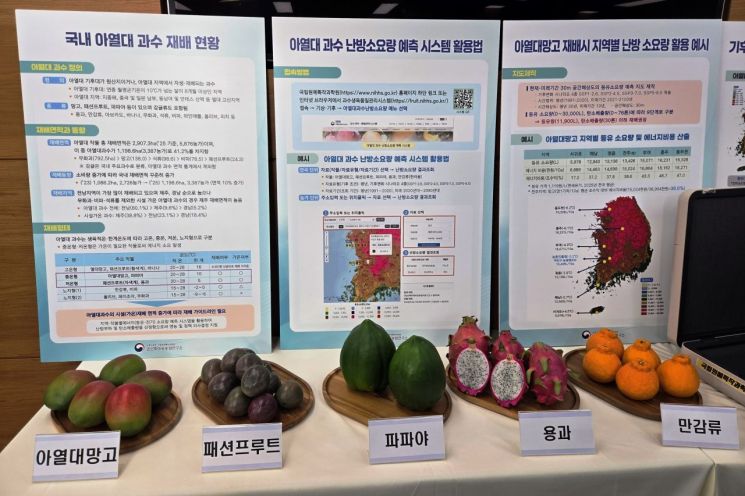 Using the "Subtropical Fruit Heating Energy Demand Prediction Information System" built by the Rural Development Administration, users can check cultivation-area-specific heating energy demand levels for five subtropical fruit crops: tropical mango, passionfruit, papaya, dragon fruit, and mandarins. By Joo Sangdon
This system is designed to compare current and future heating energy demand (kerosene and electricity) for the five subtropical fruits by crop and by region. By using it, farmers can estimate the level of heating burden at a specific site on a plot-by-plot basis even before starting subtropical fruit cultivation, enabling them to make rational decisions. In particular, by also predicting the scale of carbon dioxide emissions associated with energy use, the system is expected to contribute to reviewing directions for related policy making and technology development.
Director General Kim said, "In a situation where subtropical fruit cultivation is rapidly expanding due to climate change, the heating energy demand prediction system will serve as a key foundation for reducing management uncertainty for farmers and enabling scientific management of energy use," and added, "Since energy savings directly lead to greenhouse gas reduction, we will continue to refine crop-specific cultivation indicators that reflect climate change scenarios so that we can achieve both carbon neutrality and the sustainability of agriculture."
The subtropical fruit heating demand prediction information can be accessed on the website of the Fruit Growth and Quality Management System of the National Institute of Horticultural and Herbal Science by directly entering the farm address or selecting the location on a map, and then choosing the crop, type of climate change scenario, and analysis period.
© The Asia Business Daily(www.asiae.co.kr). All rights reserved.
![Clutching a Stolen Dior Bag, Saying "I Hate Being Poor but Real"... The Grotesque Con of a "Human Knockoff" [Slate]](https://cwcontent.asiae.co.kr/asiaresize/183/2026021902243444107_1771435474.jpg)
















