Police Veterans in High Demand in the Era of the Serious Crime Investigation Agency
The Winning Formula for Non-Referral Success
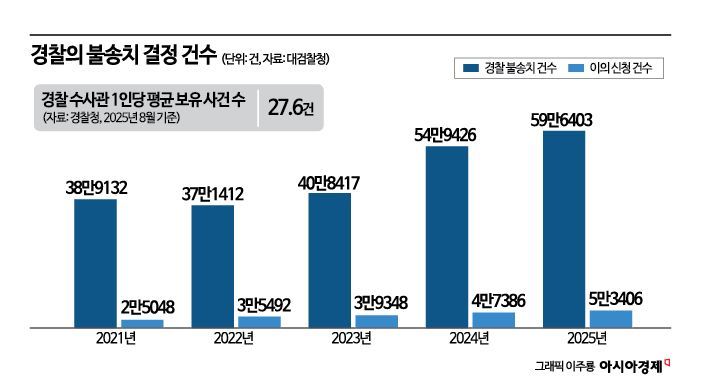
"Non-Referral Cases" Surge 53% in Four Years
Case Outcomes Decided at the Police Stage
Police Worklo
"Insufficient evidence; no charges."
This was the final sentence in the non-indictment decision notice that 33-year-old (alias) Kim Hyunsoo received from the National Police Agency in mid-October last year. It was the result he received after two years. Kim said, "It felt like receiving a not-guilty verdict."
The case dates back to October 2023. Near the end of the workday, he got a call from the police. They said that the IP account associated with Kim had been detected in connection with illegal footage related to the so-called "second Nth Room" case, known as the "Yoon Drawer (Cash Bundle Man) case." He was even summoned on suspicion of committing an obscene act using a communications medium. He felt like he could not breathe. Kim had never purchased or downloaded the video in question, nor had he ever possessed or watched it.
"121.XXX.XXX.XXX. This is your IP address, right?" a police investigator asked when Kim appeared at the station about two weeks later. What the police presented was the IP address of the email recipient to whom the illegal footage link had been sent. It matched the account on Kim's laptop. The attorney from the law firm's police response team who accompanied him spoke up. "You are treating an IP address like an unchangeable 'fingerprint,' but that is not the case."
The attorney carefully laid out the possibility that Kim's IP address had been hacked or falsified. He also submitted a reply from a foreign IP-masking software provider. The document indicated that there was a likelihood that the IP address in question had been altered or spoofed. In addition, he established an alibi by tracing Kim's route after work and proving through CCTV footage that Kim had been on duty at the time. Because CCTV footage is typically retained for only about 30 days, the attorney had gone to the scene immediately after being retained and proactively secured the evidence. In the end, the case was closed with a non-referral decision.
The former-police-officer-turned attorney who represented Kim said, "If a case is closed at the preliminary inquiry stage, no investigative record remains, but once it is formally registered as a case, a record is created," adding, "We set our strategy with the goal of having the case closed before formal registration." He added, "Because I know how an investigator's conviction is formed in the process of moving from preliminary inquiry to formal case registration, I can respond in a way that fits that process."

As in Kim's case, there is a growing number of situations in which the direction of a case is effectively decided at the police stage. According to statistics from the Supreme Prosecutors' Office and the National Police Agency as of the 12th, the number of "non-referral cases" in which the police, after investigation, determine that there is no suspicion and close the case increased 53.3% over four years, from 389,132 cases in 2021 to 596,403 cases last year. The authority to act as the first gateway for criminal cases and to determine their ultimate course is being concentrated in the hands of the police. Meanwhile, the police workload has exceeded its threshold. As of August last year, police investigators handled an average of 27.6 cases each. This is why major law firms are strengthening their "police investigation response teams," which prominently feature former senior police officers.
Law firm police teams operate a 24-hour response system. To secure dashboard camera footage, which is considered key evidence in criminal cases, they personally persuade vehicle owners, check the angle of elevator CCTV cameras, and visit building management offices. A lawyer who previously worked at the Seoul Metropolitan Police Agency said, "There are cases where an investigator is handling more than 50 cases at the same time," adding, "Because it is important to clearly articulate the grounds for the conclusion so that no complaints remain, we develop our response strategy to align with that point."
They also set up multiple scenarios before giving statements in front of investigators. In cases where a client has difficulty communicating smoothly, they do not insist solely on the "principle of the party's own statement." Instead, they redesign the structure of the statement based on the purpose of supplementary statements or the presence of a person in a trust relationship. The attorney reorganizes and explains the key issues, the client confirms them, and then the investigator reconfirms them; the statement strategy is built around this process. Organizing expected questions in advance and reviewing the logic of the responses is also part of the police team's role.
Conversely, when the likelihood of a case being referred to the prosecution is low, they sometimes guide the complainant to withdraw the complaint rather than insist on an unreasonable fight. By extracting likely questions from investigators and directly grilling the client in a mock session, they indirectly demonstrate that it will not be easy for the case to be referred. This approach is possible because they are former police officers who thoroughly understand the investigative structure and flow.
Once the Serious Crime Investigation Agency (Jungsoocheong) is launched, the investigative response strategies of these law firm police teams are expected to become even more sophisticated. A partner at one law firm said, "Law firms prefer former senior police officers not because of textbook legal theories, but because of their real-world experience directing search-and-seizure operations and interrogating suspects," adding, "The Serious Crime Investigation Agency will likely have not only priority investigative authority but also the power to close cases, so the role of police teams in responding to it will inevitably grow even larger in the future."
© The Asia Business Daily(www.asiae.co.kr). All rights reserved.
![Clutching a Stolen Dior Bag, Saying "I Hate Being Poor but Real"... The Grotesque Con of a "Human Knockoff" [Slate]](https://cwcontent.asiae.co.kr/asiaresize/183/2026021902243444107_1771435474.jpg)
















