"Employment flexibility is labor regression," Lee once snapped
After taking office, President puts "employment flexibility" on the agenda
Productivity gains will ultimately require accompanying labor reform
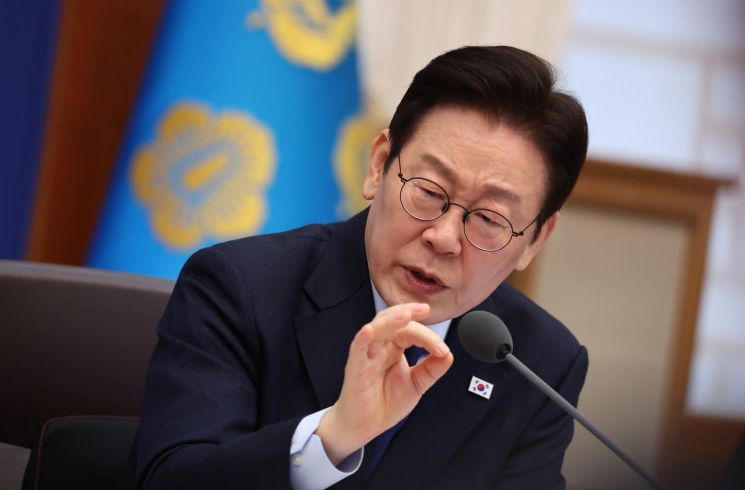 President Lee Jaemyung is speaking at a Cabinet meeting held at the Blue House on the 10th. Yonhap News
President Lee Jaemyung is pushing ahead with labor reform centered on increasing employment flexibility. President Lee, who in the past had strongly condemned employment flexibility as a "deterioration of labor rights," is now expressing his determination for reform, saying that "alternatives must be prepared." This is seen as a judgment that, in order to raise South Korea's potential growth rate amid a rapidly changing industrial environment, the rigid labor market must ultimately be changed.
At a Cabinet meeting held at the Blue House on the 10th, President Lee said, "In companies, once they hire workers, they have to hold on to them even during a downturn, so they simply do not use regular employees," adding, "An abnormal structure has been created in which work is subcontracted out, and then subcontracted out again." He went on to stress, "From the workers' perspective, employment stability is important, but in order to improve the overall quality of jobs, we need to come up with alternatives for employment flexibility."
As a solution, he proposed a grand compromise through social dialogue. Under this approach, if labor unions concede on employment flexibility, companies would shoulder the burden of the social safety net. President Lee said, "Because the gap between regular and non-regular workers is so large, it feels like standing on the edge of a cliff. That is why people cling to their positions so desperately," and added, "To make people believe that there is a way to live even if they have to leave their jobs because of employment flexibility, the safety net must be expanded. In the end, companies must bear that burden."
This is not the first time President Lee has mentioned the need for employment flexibility. At the first Cabinet meeting after his inauguration on June 5 last year, President Lee urged, "We need a social grand compromise so that labor market flexibility, the social safety net, and the burden on employers can create a virtuous cycle." He instructed the Ministry of Employment and Labor to conduct related research. In a meeting with the heads of the two major national labor confederations in September of the same year, he also said, "We need to have an open discussion on the issue of employment flexibility."
Changed environment and status... President Lee changes his remarks
These remarks by President Lee are completely different from his past stance. In February 2016, when he was mayor of Seongnam, President Lee criticized via his social networking service (SNS), saying, "Are you going to pass the so-called 'labor-deterioration bill' that promotes employment flexibility, liberalizes dismissals, and expands non-regular employment?" Along with the post, he attached a graph showing that in 2013 the "proportion of workers employed for less than one year" was 32.8 percent, the second-highest among member countries of the Organisation for Economic Co-operation and Development (OECD). In January of the same year, he also pointedly remarked, "Precarious, low-wage, long working hours are the causes of polarization and economic stagnation, and yet you want to make dismissals easier again?"
These comments were made as he was directly criticizing the labor reform being pursued by the Park Geun-hye administration. At the time, President Park pushed for labor reform centered on employment flexibility, emphasizing that job creation was urgently needed. To the labor community, her administration offered the expansion of unemployment benefits and industrial accident insurance as a carrot, presenting them as an expansion of the social safety net. Former President Park even delivered a New Year address to the nation in an attempt to persuade the public, but the effort at a grand compromise failed as labor circles strongly opposed guidelines that allowed the dismissal of low performers, among other measures.
Regarding the point at which President Lee's position changed, the Blue House explained, "He (President Lee) believes that since the industrial environment has changed, he cannot think in the same way as in the past." A Blue House official added, "President Lee often says that the labor market cannot remain as it is and tells us to come up with alternatives," and further explained, "Now that he is in the position of president, he cannot look at only one side of the issue." The official also conveyed, "Employment flexibility is a burdensome issue for President Lee as well, but he believes there is no other choice in the broader trend."
There is also an interpretation that the issue of "low productivity" in the Korean economy lies in the background. President Lee has declared this year to be "the first year of a great leap forward" and set a goal of raising the potential growth rate, and the prevailing view is that productivity must be supported through labor reform to achieve this. The Bank of Korea has for several years pointed to the "decline in total factor productivity" as a cause of low growth and has argued that labor policies need to be improved. Jung Gyucheol, a research fellow at the Korea Development Institute (KDI), advised in a report published in November last year that "it is necessary to make the labor market more flexible."
© The Asia Business Daily(www.asiae.co.kr). All rights reserved.

















