668 More Students Per Year on Average Over 5 Years, Total Increase of 3,342
All Selected Under the "Regional Physician Track" at 32 Medical Schools Outside Seoul
Medical School Expansion That Both the Moon and Yoon Administrations Failed to Achieve
KMA Criticizes Government for "Inviting Educational Deterioration" While Closely Watching Public Opinion
The government is once again pushing to expand medical school enrollment for the first time in two years, drawing backlash from the medical community. Although it has promised measures such as a phased increase over five years and stronger support for medical education, the Korean Medical Association (KMA) warned that "the government will bear full responsibility for the medical system collapse that will unfold going forward."
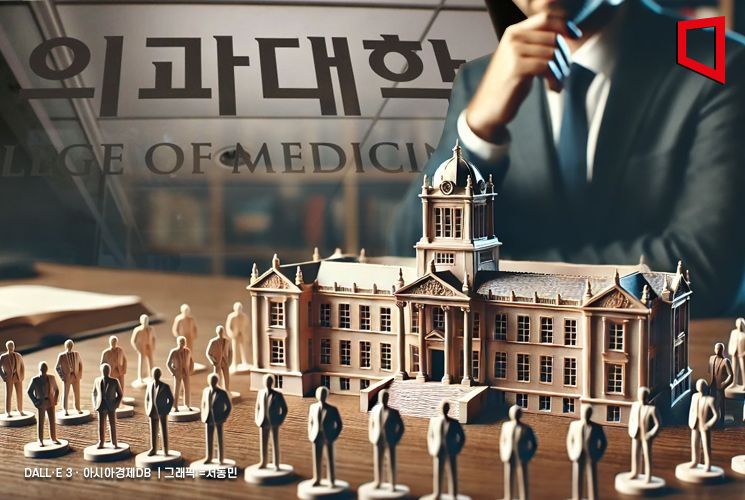
On the 10th, the Ministry of Health and Welfare held the 7th Health and Medical Policy Deliberation Committee (HMPDC) meeting at the Government Complex Seoul and decided to increase the annual number of new physicians trained at 32 medical schools outside Seoul by an average of 668 per year from 2027 to 2031.
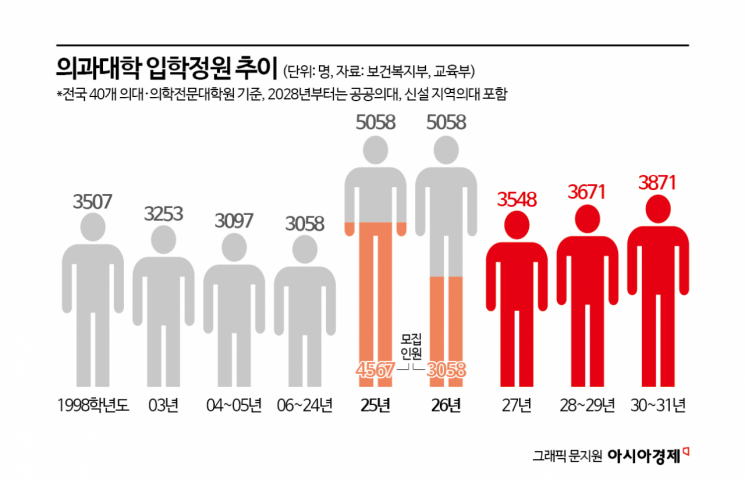
First, the medical school enrollment quota for next year has been set at 3,548, an increase of 490 from 3,058 before the government-medical community conflict. This figure reflects only 80% of the planned increase in order to ease the burden on the educational field, where students from the 2024 and 2025 cohorts are currently taking classes together. From the 2028 academic year, which is the year after next, the quota will be raised by 613 students per year for two years, and from the 2030 academic year, it will be raised by 813 students per year for another two years.
As a result, the medical school quota for the 2028 and 2029 academic years will be 3,671. After that, once a public medical school and a regional medical school are established and each recruits 100 new students, the quota for the 2030 and 2031 academic years will increase to 3,871. The total number of additional students over the five years will be 3,342, and all of them will be selected under the regional physician track at 32 medical schools nationwide outside Seoul. Students admitted under the regional physician system will receive support for admission fees, tuition, textbook costs, and dormitory fees, but in return they will be required to serve for 10 years after obtaining their medical license in an area near the location of their high school.
The Ministry of Health and Welfare plans to allocate the additional quota by region, taking into account local medical infrastructure and the educational conditions of each medical school. To strengthen the role of regional base national university medical schools and hospitals, "small national university medical schools" with fewer than 50 students in their quota will be allowed to increase their quota by up to 100%. The quota for each medical school is scheduled to be finalized in April after deliberation by the Ministry of Education’s allocation committee. From the 2032 academic year onward, the government plans to recalculate the shortage of physicians and adjust the quota accordingly.
The nationwide medical school admission quota started at 1,040 in the 1950s and steadily increased to 3,507 in 1998, but was reduced to 3,253 in 2001 and to 3,058 in 2006 in response to demands from physicians opposing the 2000 separation of prescribing and dispensing. It was then frozen at that level for as long as 18 years, until 2024.
In 2020, under the Moon Jae-in administration, the government attempted to establish a public medical school and increase the quota by 400 students per year, but the plan was scrapped when physicians launched collective action, including refusal to provide treatment. The Yoon Suk Yeol administration expanded the 2025 academic year quota by 2,000 to 5,058, but as some universities adjusted their intake in response to concerns about side effects from the rapid increase, the actual number recruited was only 4,567. For the 2026 academic year, without changing the quota, the number of students to be recruited was reverted to 3,058, the level before the increase.
Meanwhile, immediately after the government announced its plan to increase medical school enrollment, KMA President Kim Taekwoo held an emergency press conference and stated, "For the past two years, we have engaged in dialogue with a determination akin to cutting our own bones in order to prevent turmoil in the medical field, but we cannot help but express deep regret and concern as we are now faced with a government decision that is fixated solely on numbers and completely devoid of rational reasoning."
President Kim said, "When students on leave from the 2025 academic year and those returning from military service come back in the 2027 academic year, the number of students will surge dramatically, creating a shock on par with the massive increase in 2025 and resulting in a situation where the on-site educational infrastructure is unable to sustain education at all." He continued, "The government bears full responsibility for the poor educational environment that will be mass-produced in inadequate lecture rooms and practice rooms, the ensuing controversy over the competence of the physicians trained under such conditions, and the collapse of medical education." However, within the KMA, there are reportedly critical views of collective action such as mass resignations by residents, and given the possibility that public opinion could turn against them, the association is said to be cautious about extreme responses such as a general strike.
The Korean Association of Medical College Professors also pointed out in an open inquiry sent that day to the Minister of Health and Welfare and the Minister of Education, "Even without any further increase, the number of enrolled students in the 2027 academic year has already exceeded the maximum increase rate used as a benchmark by the HMPDC," adding, "Considering all matters necessary for education, including faculty, students who have repeated a year, buildings, and facilities, it will be even more impossible to maintain normal medical education."
© The Asia Business Daily(www.asiae.co.kr). All rights reserved.
![Clutching a Stolen Dior Bag, Saying "I Hate Being Poor but Real"... The Grotesque Con of a "Human Knockoff" [Slate]](https://cwcontent.asiae.co.kr/asiaresize/183/2026021902243444107_1771435474.jpg)












