Joint Symposium by the Bank of Korea Economic Research Institute and the Yonsei Institute for Life and Future of Humanity
Utilizing existing space to reduce psychological resistance and provide end-of-life care, funerals, and cremation in a single plac
"In today's presentation, I would like to propose installing small, decentralized cremation facilities within large hospital funeral halls. By utilizing existing space to distribute small-scale facilities, we can reduce psychological resistance, and by completing 'end-of-life care, funeral, and cremation' in a single space, we can enhance convenience for bereaved families while alleviating NIMBY (Not In My Back Yard) sentiment."
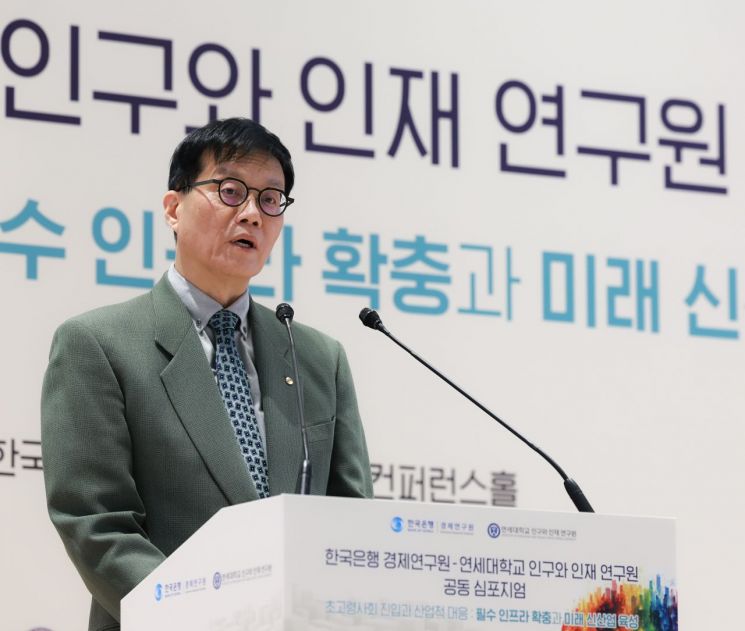 Lee Changyong, Governor of the Bank of Korea, is delivering congratulatory remarks at the 'Bank of Korea Economic Research Institute - Yonsei University Population and Talent Research Institute Joint Symposium' held at the Bank of Korea in Jung-gu, Seoul on the afternoon of the 10th. Photo by Bank of Korea
The Bank of Korea's structural reform report is now turning its attention to "the Republic of Korea entering a super-aged society." The underlying idea is that the country should convert its transition into a super-aged society from a social burden into an industrial opportunity, and, in doing so, focus on expanding essential infrastructure and fostering future new industries. At a symposium jointly hosted on the 10th by the Bank of Korea Economic Research Institute and the Yonsei University Population and Talent Research Institute at the Bank of Korea in Jung-gu, Seoul, the shortage of cremation facilities and the supply-demand imbalance in elderly care facilities were highlighted as representative issues.
In his congratulatory address, Bank of Korea Governor Lee Changyong said, "Cremation facilities are perceived as a representative type of NIMBY facility, and as a result of delays in expanding such facilities, we are now seeing cases where traditional three-day funerals are extended to five days," adding, "If these bottlenecks are not resolved, the burden and inefficiency of the funeral process will inevitably grow further in the future." He stressed that "it could be a solution whereby local communities that benefit from the medical services of large hospitals also accept the essential funeral facilities, thereby increasing local acceptance of essential facilities while distributing the social burden in a more reasonable manner."
The supply-demand imbalance in elderly care facilities was seen as stemming from the fact that the current long-term care reimbursement rate is applied uniformly nationwide, even though real estate cost gaps among regions are large. Governor Lee pointed out, "In large cities where real estate costs are high, the supply of facilities is constrained and a decline in service quality is observed, whereas there is a tendency for facilities to be located in relatively low-cost suburban or provincial areas," adding, "As a result, in urban centers where demand is actually high, it has become difficult for people to receive care near their families." He went on, "What the Bank of Korea Economic Research Institute is proposing in today's presentation is that long-term care services should continue to be publicly guaranteed as they are now, but that users should bear part of the costs corresponding to land and building rent," and emphasized that "this proposal is worth discussing as a realistic alternative that, while taking into account the sustainability of public finances, can simultaneously encourage the expansion and quality improvement of facilities in high-demand areas."
The issue of utilizing bio data was also raised. He noted, "Health and medical data in our country have enormous potential value, to the extent that they are called 'diamonds in the age of AI.' This is because medical records spanning an individual's entire life cycle are being digitized and accumulated, and, based on a national identification system, we also have a structural advantage that allows these data to be linked and utilized."However, it was pointed out that, in reality, the responsibility and burden of protecting personal information are excessively concentrated on individuals and medical institutions, which has prevented sufficient utilization of the data. Governor Lee stressed that the new system proposed in today's presentation, under which the state would approve the use of data only for research recognized as being in the public interest and such approved research would then activate the distribution of bio data, "deserves attention because it can promote data utilization and, at the same time, lead to a virtuous cycle in which medical institutions channel the profits generated through this utilization back into medical services."
He said, "Aging is clearly a crisis that our society faces, but at the same time it is also a structural shift that creates new demand," adding, "As demand for essential end-of-life services such as care, medical treatment, and funerals is rapidly increasing, there is a limit to what can be supported with constrained public finances alone, so we must also build a sustainable supply base from an industrial perspective." He further emphasized, "The silver economy should no longer remain only within the realm of welfare, but must now be recognized as an important industrial domain that can create added value through innovation and technology."
Governor Lee said, "I am well aware that all of today's proposals are not easy to introduce immediately under the current institutional framework, as each involves its own constraints and complex interests," but added, "If we simply conclude that 'discussion is impossible' for these reasons, it will be difficult to translate the opportunities embedded in this transformation into tangible outcomes. Rather than resting on the achievements of existing industries such as semiconductors, we must discover new growth paths through rationalizing regulations and changing our way of thinking, so that we can narrow the gaps arising from 'K-shaped growth' and provide ample opportunities for future generations."
© The Asia Business Daily(www.asiae.co.kr). All rights reserved.
![Clutching a Stolen Dior Bag, Saying "I Hate Being Poor but Real"... The Grotesque Con of a "Human Knockoff" [Slate]](https://cwcontent.asiae.co.kr/asiaresize/183/2026021902243444107_1771435474.jpg)















