MAFRA Finalizes Implementation Guidelines...First Payments at End of This Month
"Gas Stations, Convenience Stores, Hanaro Marts" Usable up to 50,000 Won per Month
New Residents to Receive Retroactive Payments After 90 Days From Application
Fraudulent Claims Subject to Recovery, Application Restrictions, and Penalty Surcharges
Office workers and university students whose address is registered in an area selected for the rural basic income pilot project but who work or attend school in another region can also receive basic income if they reside in the relevant area for at least three days. However, if they fail to meet the actual residence requirement or receive basic income through false claims, an administrative penalty of up to five times the amount wrongfully received may be imposed.
The Ministry of Agriculture, Food and Rural Affairs announced on the 10th that it will finalize and notify local governments of the "Guidelines for Implementing the Rural Basic Income Pilot Project," which include these details.
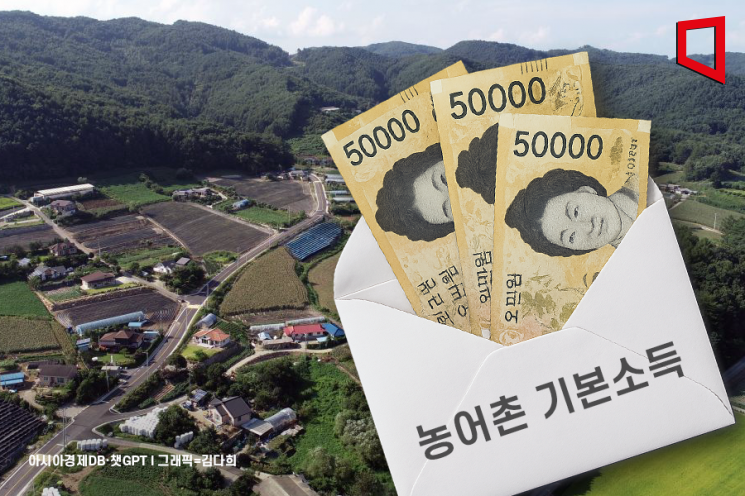
The rural basic income pilot project is a policy designed to improve the quality of life of residents and promote balanced regional development by providing basic income to residents in rural areas facing the risk of depopulation, thereby creating a virtuous cycle in the local economy and revitalizing the social and solidarity economy.
To respond urgently to the crisis of rural extinction, the Ministry of Agriculture, Food and Rural Affairs selected the rural basic income pilot project as a national policy task in August last year, and from September carried out a public call for pilot regions, consultations on establishing a new social security program, and budget approval in the plenary session of the National Assembly. Through this process, it ultimately designated 10 counties as pilot regions. The selected pilot regions are 10 counties in 8 provinces: Yeoncheon in Gyeonggi Province; Jeongseon in Gangwon Province; Okcheon in North Chungcheong Province; Cheongyang in South Chungcheong Province; Sunchang and Jangsu in North Jeolla Province; Sinan and Gokseong in South Jeolla Province; Yeongyang in North Gyeongsang Province; and Namhae in South Gyeongsang Province.
Residents of the 10 counties will receive a basic income of 150,000 won per person each month in the form of local gift certificates during the pilot period (2026-2027), with no restrictions on age or income. Except for Gokseong, where payments are scheduled for late March, the remaining nine counties plan to make the first basic income payments between the 26th and 27th of this month.
To receive basic income, applicants must have their resident registration and actually reside in the relevant county for at least 30 days prior to the application date. Workers employed in other regions and university students can also receive basic income if they reside in the relevant area for at least three days. For example, an office worker whose address is registered in Yeoncheon County but who lives in Seoul, where they work, from Monday to Thursday and stays in Yeoncheon County from Friday to Sunday is eligible for payment. University students enrolled at universities in other regions are also eligible to receive basic income for the period during which they reside in the relevant area on weekends, or when they stay in the target area at least three days a week during vacation.
Residents who moved into the pilot regions after the date of selection can apply starting 30 days after their move-in. Once it is confirmed that they have actually resided in the area for at least 90 days after the application date, basic income for three months will be paid retroactively.
To ease the administrative burden of verifying actual residence and to enhance objectivity and efficiency in decision-making, the ministry plans to operate township and town committees and village survey teams composed of village heads, members of residents' self-governing committees, and public officials. It also plans to establish and operate a reporting center for fraudulent claims to ensure thorough post-management. Those found to have received benefits fraudulently will not only be required to return the funds but will also be barred from applying for basic income for the next two years and will be subject to a penalty of up to five times the amount fraudulently received.
The places where basic income can be spent will be limited to designated living zones set for each township and town, taking into account differences in conditions such as the density of commercial districts and residents' daily movement patterns. For residents in townships (myeon) where there are relatively fewer places to use the funds, the usage period for basic income has been extended to six months. Residents living in a township will be able to use their February 2026 basic income until June.
For gas stations, convenience stores, and Nonghyup Hanaro Marts, the monthly spending limit has been set at 50,000 won. An official from the Ministry of Agriculture, Food and Rural Affairs explained, "Of the 150,000 won in basic income, only up to 50,000 won can be used at gas stations, convenience stores, and Nonghyup Hanaro Marts. The remaining 100,000 won must be spent within the designated living zone."
During the pilot period, the Ministry of Agriculture, Food and Rural Affairs plans to objectively verify the policy effects and implement evidence-based policy by having the National Research Council for Economics, Humanities and Social Sciences organize a Rural Basic Society Research Group to conduct systematic evaluations in the economic, social, and administrative fields. In particular, it will evaluate key outcomes such as improvements in residents' quality of life, revitalization of the local economy, and restoration of community, and will review the direction of the full-scale program based on these results.
Minister Song Miryeong of the Ministry of Agriculture, Food and Rural Affairs said, "Through rural basic income, we will actively support these regions at risk of extinction so that they can regain vitality and become rural communities that people return to and want to stay in."
© The Asia Business Daily(www.asiae.co.kr). All rights reserved.
![Clutching a Stolen Dior Bag, Saying "I Hate Being Poor but Real"... The Grotesque Con of a "Human Knockoff" [Slate]](https://cwcontent.asiae.co.kr/asiaresize/183/2026021902243444107_1771435474.jpg)











