Value-added tax down 10%, corporate tax down 4.4%
Total expenditure at 591 trillion won, up 61.5 trillion won from a year earlier
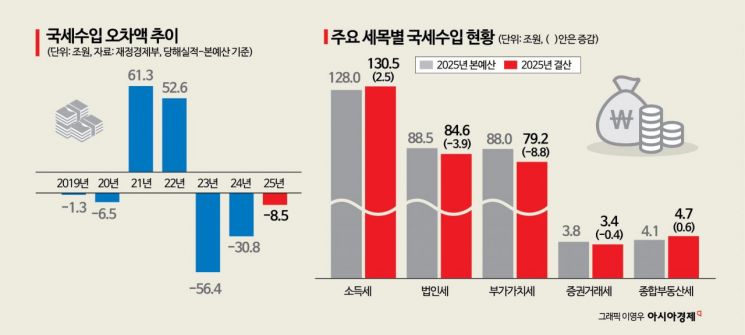
Last year, a tax revenue shortfall of more than 8 trillion won occurred, marking a tax revenue miss for the third consecutive year since 2023. For three years in a row, actual tax revenue has fallen short of the initial budget, and most of the under-collected national taxes came from value-added tax and corporate tax. As the economy deteriorated, spending needs increased while revenue declined, worsening the state treasury’s condition. With the government’s consolidated surplus, which is the amount left after tax collection and spending, reaching only 3.2 trillion won, and with that amount to be sequentially used for local allocation tax and debt repayment under the National Finance Act, projections indicate that only about 100 billion won will be available as effective funding for a “cherry blossom” supplementary budget. As a result, it is expected that issuing deficit-financing government bonds will be unavoidable.
On the 10th, the Ministry of Economy and Finance announced the “Closing Results of Total Revenue and Total Expenditure for Fiscal Year 2025.” This is essentially a national household account that finalizes the income collected over the past year through tax collection and other means, and the expenditures made by each government ministry, allowing comparison with the previous year’s fiscal plan to gauge how much was collected and how much was spent.
The revenue base has partially recovered, but...
Last year’s annual national tax revenue stood at 373.9 trillion won, down 8.5 trillion won from the initial budget of 382.4 trillion won. This means that actual national tax revenue fell short of the amount projected when the budget was drafted by nearly 8.5 trillion won. In June last year, the government conducted a revenue adjustment to pre-reflect the expected tax under-collection in the budget and announced a revised tax revenue estimate; compared with that projection, however, the actual shortfall was 4 trillion won smaller.
Of the 8.5 trillion won tax revenue shortfall, the largest portion came from declines in value-added tax and corporate tax. Value-added tax amounted to 79.2 trillion won, 8.8 trillion won (down 10.0%) less than the initial budget of 88 trillion won. Corporate tax also came in at 84.6 trillion won, a decrease of 3.9 trillion won (down 4.4%) compared with the budgeted 88.5 trillion won. Although corporate earnings improved compared with the previous year, they fell short of expectations at the time of budget planning. The recovery, which was concentrated in a few sectors such as semiconductors, appears to have been insufficient to translate into a broad expansion of the overall corporate tax base. The transportation, energy and environment tax also missed expectations, totaling 13.2 trillion won, which was 1.9 trillion won (down 12.6%) less than the budgeted 15.1 trillion won.
Some tax items exceeded budget and partially offset the decline. Inheritance and gift tax revenue reached 16.5 trillion won, an increase of 3.7 trillion won (up 28.9%) from the initial budget of 12.8 trillion won, and earned income tax revenue rose to 68.4 trillion won, up 3.7 trillion won (up 5.7%) from the budgeted 64.7 trillion won. The increase in the number of regular employees and the upward trend in wages led to higher tax revenue.
Non-tax revenue, which is income other than taxes, amounted to 224 trillion won. Non-tax revenue refers to local government income excluding local taxes, local allocation taxes, and subsidies, and includes items such as road usage fees and fines. An official from the Ministry of Economy and Finance explained, “The main reason for the decrease in non-tax revenue was the decline in proceeds from the sale of government-owned property, due to failed auctions of NXC shares received as payment in kind.”

The national household account is in surplus, but lacks firepower for a supplementary budget
Total expenditure reached 591 trillion won, an increase of 61.5 trillion won from the previous year’s 529.5 trillion won. The consolidated surplus, which is the amount remaining after subtracting total expenditure and carryover appropriations to the next year from total revenue, recorded a surplus of 3.2 trillion won. Of this, 100 billion won in general account consolidated surplus, which can be used for the state’s own fiscal purposes, must be spent in the following order under the National Finance Act: settlement of local allocation taxes and grants, contributions to the Public Funds Redemption Fund, and debt repayment. Only if money remains after that can it be used to finance a supplementary budget.
Unspent appropriations in the final accounts amounted to 10 trillion won, down 10.1 trillion won from the previous year, indicating that inefficiencies in executing the government’s spending plans improved compared with last year. Out of the 604.7 trillion won in current-year budget appropriations that the government planned to spend this year, 97.7% was actually executed. This execution rate was the highest in the past five years. The Ministry of Economy and Finance explained, “This is the result of actively executing the budget aimed at boosting economic vitality and stabilizing people’s livelihoods.” The unspent appropriations in the final accounts included 4.5 trillion won in intra-government transactions. The de facto amount of unspent funds, including unused project expenses and contingency reserves, stood at 5.4 trillion won. An official from the Ministry of Economy and Finance said, “Last year, there were no unspent local allocation taxes linked to domestic taxes.” The 2025 fiscal balance and national debt figures will be announced in April after the final settlement of central government funds is completed.
© The Asia Business Daily(www.asiae.co.kr). All rights reserved.
![Clutching a Stolen Dior Bag, Saying "I Hate Being Poor but Real"... The Grotesque Con of a "Human Knockoff" [Slate]](https://cwcontent.asiae.co.kr/asiaresize/183/2026021902243444107_1771435474.jpg)

















