Strengthening the U.S.-Japan alliance to push for revisions to security documents
Ongoing conflict with China... closer strategic coordination with Taiwan
With South Korea, historical issues such as Dokdo and Yasukuni Shrine remain potential stumbling blocks
After successfully completing the House of Representatives election, Japanese Prime Minister Takaichi Sanae will focus on diplomatic activities for the time being. There is growing interest both inside and outside Japan in what kind of relationships Prime Minister Takaichi, backed by an overwhelming number of seats, will pursue with neighboring countries going forward.
The Yomiuri Shimbun reported on the 10th that "Prime Minister Takaichi, who has established a new center of gravity, plans to move quickly on diplomatic responses." The top priority is the U.S.-Japan summit to be held in the United States on the 19th of next month. At this meeting, Prime Minister Takaichi is expected to convey to U.S. President Donald Trump in concrete terms her intention to increase defense spending. Her strategy is to strengthen the U.S.-Japan alliance externally, while internally securing justification for bolstering defense capabilities, including revising security-related documents, which has been her goal.
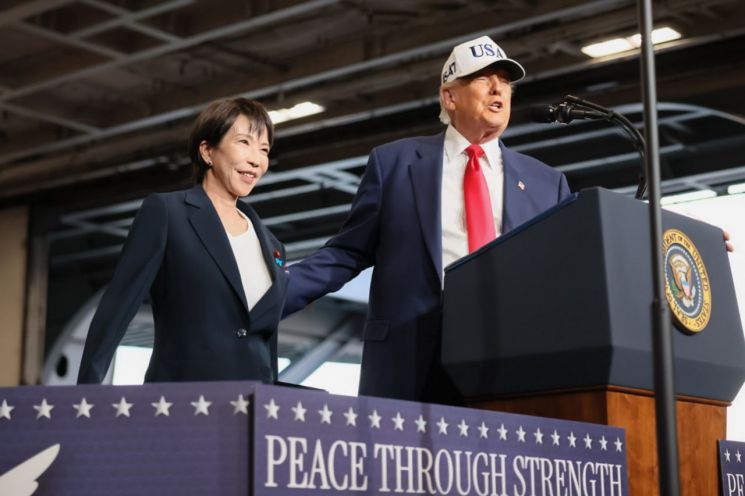 Trump Donald, President of the United States, who visited the U.S. Navy base in Yokosuka, Kanagawa Prefecture, Japan, is posing with Takaichi Sanae, Prime Minister of Japan. Prime Minister's Official Residence.
There is a strong possibility that a warm breeze will blow over U.S.-Japan relations going forward. It is highly likely that she will join hands with President Trump to try to counter China's pressure. At a press conference on the 9th, Prime Minister Takaichi stated, "We will once again confirm the unwavering solidarity between the United States and Japan, while at the same time promoting cooperation in a wide range of areas, including diplomacy, the economy, and security."
President Trump and Prime Minister Takaichi have already showcased their closeness via social networking services (SNS) during the House of Representatives election campaign. On the 5th, President Trump posted a message of support for Prime Minister Takaichi on SNS. Prime Minister Takaichi responded the previous day on X (X, formerly Twitter), saying, "I look forward to working together to strengthen the U.S.-Japan alliance."
 On October 31 last year, Takaichi Sanae, Japanese Prime Minister, and Xi Jinping, President of China, are shaking hands ahead of the China-Japan summit held in Gyeongju. Yonhap News.
Relations with China are expected to deteriorate further. At a regular press briefing the previous day, Lin Jian, spokesperson for the Chinese Ministry of Foreign Affairs, said, "Japan must not ignore the concerns of the international community and must not follow in the footsteps of militarism," and again demanded, "Japan must retract Prime Minister Takaichi's remarks regarding Taiwan." The Chinese government has already announced measures such as restricting Japanese companies' access to critical minerals and issuing advisories against travel. If Japan in the future revises its "three non-nuclear principles" to allow the introduction of nuclear weapons, or increases its military capabilities through constitutional revision, the conflict is expected to reach a climax.
Given that Prime Minister Takaichi has already secured an overwhelming number of seats, some observers believe she will not feel the need to lower her profile and rush to manage conflicts with China. Prime Minister Takaichi plans to push for a meeting with Chinese President Xi Jinping ahead of the Asia-Pacific Economic Cooperation (APEC) summit to be held in China in November this year.
On the contrary, strategic coordination with Taiwan is expected to be strengthened. Taiwan President Lai Ching-te stated on SNS the previous day that "the election results are an expression of voters' trust in Prime Minister Takaichi's leadership and vision." Within Taiwan's ruling party, some are arguing that this opportunity should be used to strengthen security cooperation. In downtown Taipei, banners reading "Great Victory" have even been put up. In particular, there is a strong possibility that cooperation in the semiconductor sector will be enhanced in connection with the Japanese government's policy of "reviving Japan as a semiconductor powerhouse." TSMC pledged to introduce a "3 nm (1 nm = one-billionth of a meter)" process at its Kumamoto plant in Japan just before the election. Observers say that supply chain cooperation between the two sides will become even closer.
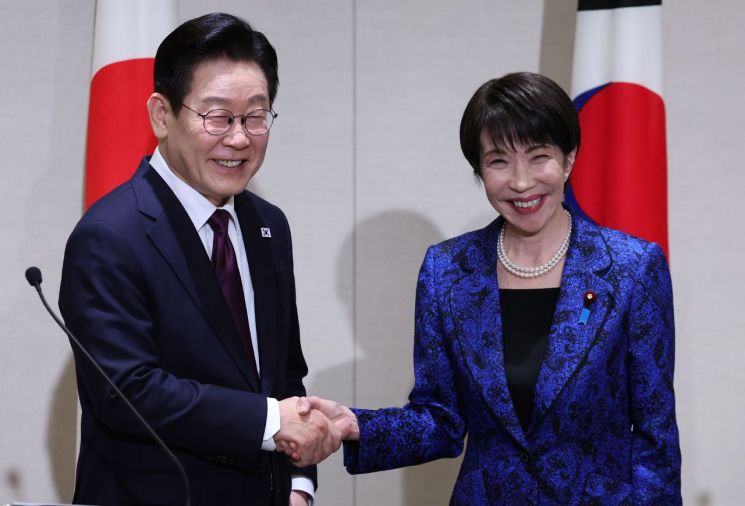 President Lee Jaemyung and Prime Minister Takaichi Sanae of Japan are shaking hands at the summit venue in Nara Prefecture, Japan on the 13th of last month. Nara (Japan)=Yonhap News Agency.
With our country, relations have improved to some extent through shuttle diplomacy, but historical issues may emerge as an unexpected stumbling block. Byeon Jinil, editor-in-chief of the Japanese Korea-focused magazine "Korea Report," pointed out on Yahoo Japan that "although sentiment toward Japan has improved, the far-right label attached to Prime Minister Takaichi still has not come off."
He went on to analyze that historical issues such as Dokdo Day on the 22nd and visits to Yasukuni Shrine will surface as thorny challenges. Prime Minister Takaichi has consistently maintained that ministers should attend "Takeshima Day" (Japan's name for Dokdo), which is held in Shimane Prefecture, and has also stated that she will work to secure the understanding of relevant countries in order to create an environment that allows visits to Yasukuni Shrine.
© The Asia Business Daily(www.asiae.co.kr). All rights reserved.



















