Big Tech's First "Century Bonds" Since the Dot-com Bubble
Lower Financial Burden Thanks to 100-year Compounding Discount Effect
A Statement of Confidence in Long-term Corporate Survival
Alphabet Expects 185 Billion Dollars in Capital Expenditures
Alphabet, the parent company of Google, is issuing 100-year corporate bonds to fund large-scale investments in artificial intelligence (AI) infrastructure. This is the first time since the dot-com bubble of the 1990s that a big tech company has issued ultra-long-term bonds with a 100-year maturity.
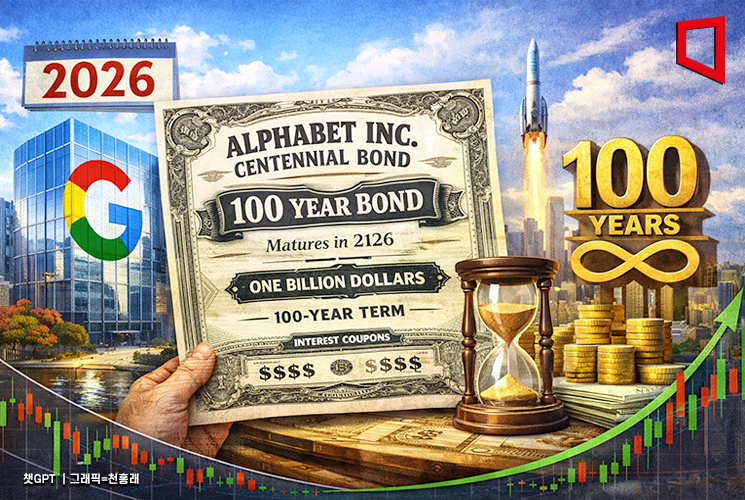
According to the Financial Times (FT), Bloomberg and others on the 9th (local time), Alphabet has formed a syndicate of underwriter banks to issue 100-year bonds denominated in British pounds. This is the first time Alphabet has issued 100-year bonds, known as “century bonds.” Among U.S. technology stocks, IBM issued 100-year corporate bonds in 1996. As for 100-year bonds denominated in British pounds like Alphabet’s, only three issuers have ever come to market: the University of Oxford, EDF (?lectricit? de France), and the Wellcome Trust.
Issuing 100-year bonds implies that creditors view Alphabet’s creditworthiness as strong enough to lock up their money with the company for a century. For Alphabet, it secures massive funding while enjoying a “permanent capital effect,” since repayment is pushed 100 years into the future.
Yoon Yeosam, a researcher at Meritz Securities, said, “Long-term bonds usually carry relatively higher interest rates, but 100-year bonds are not structured so that the interest rate rises without limit. On the contrary, due to compounding discount effects, the effective rate falls, which makes them reasonable in terms of cost and financially positive for the issuing company.”
When calculating a bond’s interest rate (yield), the longer the maturity, the closer the present value of the principal to be repaid in the future approaches zero. As a result, 100-year bonds exhibit a rate-lowering effect. Because these are ultra-long-term bonds, the nominal coupon rate itself can be set high, but when it is effectively spread and discounted over 100 years, the issuer’s actual funding cost (effective interest rate) can end up being lower.
In November last year, Alphabet raised 17.5 billion dollars (about 25 trillion won) in the U.S. bond market and 6.5 billion euros (about 11 trillion won) in Europe. The 50-year tranche issued at that time was the longest-maturity bond issued by a technology company in the United States last year.
The reason Alphabet is aggressively issuing bonds is to invest in AI infrastructure. Alphabet expects this year’s capital expenditures (CAPEX) to reach 185 billion dollars (about 269 trillion won), roughly twice last year’s total amount.
Recently, big tech companies such as Alphabet, Amazon, and Meta have raised their capital expenditure (CAPEX) plans. These big tech “hyperscalers,” which are pouring astronomical sums into AI, borrowed 165 billion dollars (about 240 trillion won) last year through bond issuance and other means. Because of this, the FT reported that some in the market are questioning whether they can sustain this unprecedented “spending spree” solely with their existing cash flows.
© The Asia Business Daily(www.asiae.co.kr). All rights reserved.
![Clutching a Stolen Dior Bag, Saying "I Hate Being Poor but Real"... The Grotesque Con of a "Human Knockoff" [Slate]](https://cwcontent.asiae.co.kr/asiaresize/183/2026021902243444107_1771435474.jpg)

















