"Responding to Coupang and non-tariff barriers separately from the tariff negotiations"
"Activating contingency plans for each scenario of reciprocal tariffs being ruled unconstitutional or constitutional"
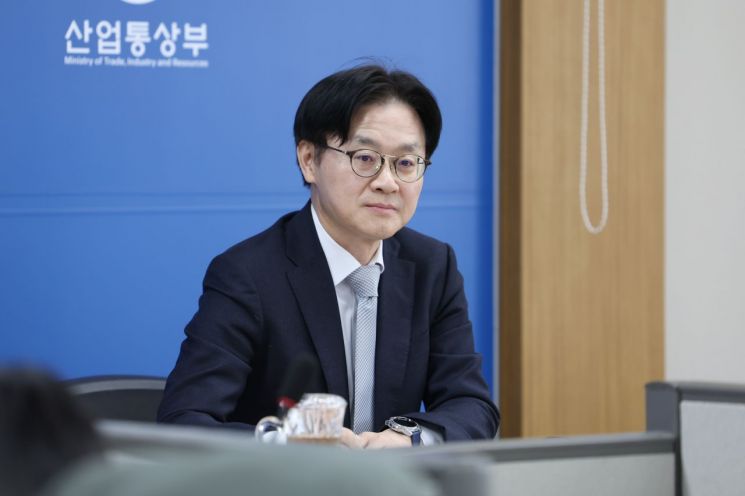 Kim Jungkwan, Minister of Trade, Industry and Energy, met with reporters at the Government Complex Sejong on the afternoon of the 9th, explained issues such as U.S.-Korea tariff increases, and is taking questions. Ministry of Trade, Industry and Energy.
Regarding the Korea-U.S. tariff negotiations on the 9th, Minister of Trade, Industry and Energy Kim Junggwan stated, "If the Special Act on Investment in the United States is passed, we judge that the likelihood of deferring the tariff increase will be high," adding, "Our current goal is to resolve this without any tariff increase, if possible."
"All-out efforts to conclude tariff talks before publication in the Federal Register"
In the afternoon at the Government Complex Sejong, Minister Kim met with reporters and said, "Since President Trump personally mentioned the delay of our Special Act as the reason for the tariff increase via social media (SNS), I believe that once this issue is resolved to some extent, the situation could also change."
He added, "It is difficult to predict with certainty because many other issues can arise in the meantime, but it is clear that the passage of the Special Act will be an important variable."
When asked when he expects the measure to be published in the U.S. Federal Register, Minister Kim replied, "Normally, it takes about three days to one week for publication in the Federal Register, so the fact that it has already been two weeks suggests that, in various respects, our explanations and efforts have to some extent been conveyed to the U.S. side." He continued, "While it is important to try to prevent publication in the Federal Register, I believe it is even more important to block the tariff increase itself," stressing, "We are doing our utmost to ensure that, in whatever form, the tariff increase does not materialize."
He drew a clear line when asked whether the Coupang issue is affecting the tariff negotiations. Minister Kim explained, "We are viewing investment in the United States, non-tariff barriers, and the Coupang case as separate issues," and added, "We see the main reason President Trump cited for the tariff increase as the delay in the Special Act."
He went on, "However, it is also true that once one trade issue arises, it tends to become linked with other issues," adding, "Recently, we understand that the United States has been raising, all at once, various matters in which it has felt dissatisfaction regarding our country." He then emphasized, "It is not appropriate to directly connect this matter with the tariff negotiations."
On the issue of non-tariff barriers, he said, "Relevant industries and ministries are continuing their discussions," and added, "The Korea-U.S. Free Trade Agreement (FTA) Joint Committee could also be convened as appropriate to the situation."
Regarding reports that hardline and conciliatory approaches are clashing within the presidential office over the Korea-U.S. negotiations, he said, "In any discussion, there can be a variety of positions. However, both the presidential office and the administration as a whole are holding discussions from the perspective of how to maximize the national interest."
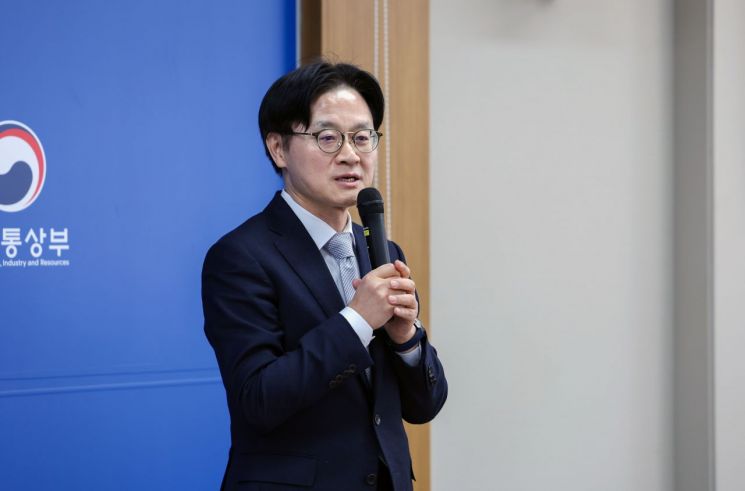 On the 9th, Kim Jeonggwan, Minister of Trade, Industry and Energy, met with reporters and explained current issues such as Korea-U.S. tariffs. Ministry of Trade, Industry and Energy.
As for contingency strategies in the event that reciprocal tariffs are ruled unconstitutional, he said, "Internally, we will activate contingency plans for each scenario, including a ruling of complete unconstitutionality, partial unconstitutionality, or constitutionality," while adding, "It is difficult to disclose specific details."
Regarding investment projects in the United States, he said, "Although there has been a variety of media speculation about the energy sector, nuclear power, and so on, we are not at the stage of talking about any single specific project," and added, "We are in discussions with the United States on multiple projects." He further commented, "From a practical standpoint as well, it is reasonable to make an announcement after the law has been passed."
On his consultations with U.S. Secretary of Commerce Howard Lutnick, he said, "Japan is able to move projects forward without separate legislation, whereas Korea has a structure that requires the enactment of a law, and I explained this point," adding, "I also shared that the ruling and opposition parties recently agreed to pass the Special Act by early March, and the U.S. side responded very positively to this."
"Reform of state-owned resource companies is inevitable... Accelerating the 5-Poles 3-Special Zones and petrochemical measures"
On this day, in addition to trade issues, Minister Kim also addressed major industrial policies and public institution matters. Referring to the "M.AX (Manufacturing AI Transformation)" strategy and the "5-Poles 3-Special Zones" regional growth policy, which he is currently promoting while touring the country, he said, "The voices I hear in the field are far more vivid than the reports I receive at the office," adding, "In particular, as a policymaker, I feel deeply and heavily, to the point of embarrassment, the problems of jobs and daily life that young people in the regions are facing."
He continued, "We are gathering a wide range of opinions on bold incentive schemes and on directions for nurturing industries by region, and after consultations with the relevant ministries, we will announce concrete measures."
He expressed strong concern over the moral hazard controversy involving state-owned resource companies. Minister Kim said, "As the minister in charge, I see the situation as serious enough to feel personally responsible," adding, "Behaviors that can hardly be regarded as those of 21st-century public corporations are being repeated, so reform of state-owned resource companies is not a choice but an absolute necessity." Concerning allegations of embezzlement at an overseas branch of the Korea National Oil Corporation and the personnel vetting controversy at Korea Gas Corporation, he said, "We are in a situation where all we can do is apologize to the public," stressing the need for structural improvements.
On the nuclear power plant export framework, in relation to the need to adjust roles between Korea Electric Power Corporation and Korea Hydro & Nuclear Power, he said, "The consultancy work is now in its final stage, and we intend to wrap it up within the first quarter," adding, "We will maintain a Team Korea-style cooperation system so that conflicts between the two organizations do not undermine our competitiveness in nuclear exports." He then added, "In a situation where the global nuclear power market is expanding, it is important not to miss the opportunity."
Regarding restructuring measures for the petrochemical industry, he said, "The Daesan project is progressing first, so we should be able to make a concrete announcement around the end of February," adding, "The petrochemical measures will be announced step by step in a region-specific, specialized manner, rather than as a plan for the industry as a whole."
Responding to concerns about growth imbalances between industries, he said, "I am relieved that we have semiconductors," and stressed, "The task for the government is not to maintain a structure that relies on a single sector, but to create two or three more industries like semiconductors." He added, "The core task is to build a healthy industrial ecosystem in which large and small to medium-sized enterprises grow together."
© The Asia Business Daily(www.asiae.co.kr). All rights reserved.