Governor Lee Chanjin Outlines This Year's Work Plan in Press Briefing
Ex Officio Investigative Authority for Capital Market Special Judicial Police... New Special Judicial Police for Illegal Private Financing
FSS Special Judicial Police to Be Placed
Lee Chanjin, Governor of the Financial Supervisory Service (FSS), stated that in connection with the expansion of the FSS’s special judicial police (SJPs), he has completed consultations with the Financial Services Commission (FSC) on granting ex officio investigative authority to the capital market SJPs and on newly establishing SJPs in the area of illegal private lending among livelihood-related crimes. The FSS SJPs will now be subject to the control of the Investigation Review Committee under the Securities and Futures Commission (SFC) of the FSC.
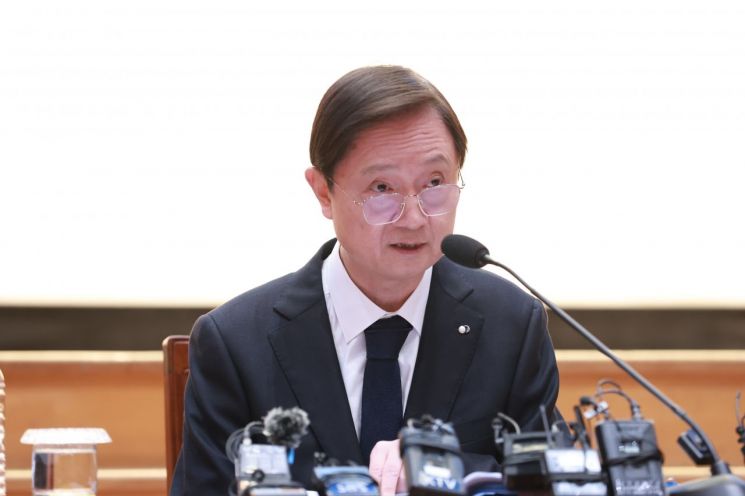
Governor Lee made these remarks in response to questions about the expansion of the SJPs after announcing the “2026 FSS Work Plan” at the FSS headquarters in Yeouido, Seoul, on the morning of the 9th.
He explained, “We have agreed with the FSC not to grant SJP authority for corporate accounting reviews or inspections of financial companies,” adding, “Since the FSS SJPs’ authority would become excessively powerful if they were to conduct ex officio investigations directly, we have put in place control mechanisms.”
In particular, he noted that the FSS SJPs will now be placed under the control of the Investigation Review Committee under the SFC. Although there had initially been discussion of placing the committee under the FSS, it appears that, amid concerns about potential abuse of authority, a decision was reached to have the SJPs controlled by the SFC’s committee instead.
Governor Lee said, “We plan to commence investigations only after cases have gone through the Investigation Review Committee, and we are currently working closely with the FSC on details such as the committee’s composition,” and added, “Even for ex officio investigations, once an investigation begins, it will proceed under the direction of the prosecution pursuant to the Criminal Procedure Act and on the basis of court-issued warrants.”
Regarding the controversy over where the Investigation Review Committee should be placed, he emphasized, “The key issues are the speed of investigations and the prompt preservation of evidence,” and said, “It is important to reach a conclusion within 48 hours.” He went on to say, “Debates over who holds the initiative are pointless and meaningless,” and added, “We did not quarrel with the FSC over who would take the lead.”
Asked why SJPs were not introduced in the area of insurance fraud among livelihood-related crimes, Governor Lee replied, “There are many institutions that feel uncomfortable about the expansion of the FSS SJPs,” and said, “If sufficient social and public demand, trust in the FSS, and public opinion are built up, I believe the legislative environment will broaden in the future.”
He also reaffirmed his conviction that the FSS should be designated as an independent national institution. Previously, on the 5th, during a work report to the National Assembly’s Political Affairs Committee, he had stated that, like the U.S. Securities and Exchange Commission (SEC) or Japan’s Financial Services Agency (FSA), the FSS should be designated as a national institution.
Governor Lee argued, “The SEC and the FSA operate with special-appointment positions, and their compensation systems are completely different from those of regular civil servants; they are independent bodies,” and said, “Given the need for independence in the FSS’s social role and functions, it is desirable to designate the FSS as an independent national institution.”
He then evaluated the current framework, in which the FSC directs and controls the FSS’s work, as “a transitional structure that was created after the International Monetary Fund (IMF) foreign exchange crisis.” He also made clear his opposition to designating the FSS as a public institution, noting that the agency’s independence and operations could be swayed by changes in administrations and national policy directions.
Governor Lee further stressed the importance of preventive consumer protection. To this end, he plans to strengthen the activities of external advisory committees.
He said, “Every two months, we will select a topic and seek advice from external members on whether the internal preventive consumer protection system is functioning properly,” and added, “We will also gather the advisory committee’s views on whether internal control standards by business sector are operating appropriately and reflect them in our supervisory work.”
He also stated that the FSS will monitor in advance financial products that could lead to large-scale consumer damage, and if risks are detected, it will convene roundtable meetings or push for institutional improvements. For this purpose, the FSS plans to hold a risk response meeting chaired by the Governor in February and submit the first agenda item there.
© The Asia Business Daily(www.asiae.co.kr). All rights reserved.

















