Semiconductor boom seen lifting corporate and income taxes above forecasts
Extra tax revenue could enable an extra budget of around 10 trillion won
Market strain seen inevitable if extra budget is paired with new bond issuance
As the possibility of drafting a supplementary budget (extra budget) has been raised since the beginning of the year, whether the so-called "Cherry Blossom Extra Budget," which aims to minimize government bond issuance starting from next month's corporate tax filings, will materialize has emerged as a key variable for fiscal policy. This is because the fiscal conditions appear to be improving as the likelihood of excess tax revenue increases in line with better earnings at large corporations. However, some point out that the legal grounds for an extra budget under the National Finance Act, as well as inflationary pressure from expansionary fiscal policy, could act as constraints.
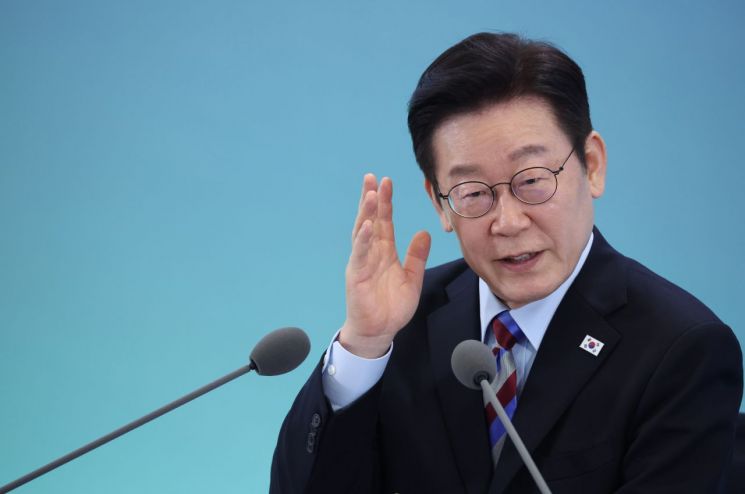 President Lee Jaemyung is speaking at the "Listening to the Hearts of Gyeongnam" town hall meeting held on the 6th at the Changwon Convention Center in Seongsan-gu, Changwon. Yonhap News.
According to the Ministry of Economy and Finance and the Ministry of Planning and Budget on the 9th, the government is putting more weight on the prospect that corporate tax and earned income tax, which will be tallied at the end of March, will exceed earlier expectations due to the recent recovery in the semiconductor industry and the stock market rally. The government set this year's national tax revenue budget (annual forecast) at a total of 390.2 trillion won, projecting that 86.5 trillion won in corporate tax and 68.5 trillion won in income tax would be collected, but the actual increase could be larger than these figures.
The starting point of the current debate over an extra budget also lies in the improvement of tax revenue conditions. Market participants predict that corporate tax revenue, led by semiconductor companies, will increase by 3 trillion to 5 trillion won, or as much as 7 trillion to 8 trillion won, compared with the previous forecast. As the KOSPI and KOSDAQ indices continue to hit new highs, there are also projections that securities transaction tax revenue could exceed the government's forecast by around 1 trillion won. In that case, the additional tax revenue that could be secured is estimated at 4 trillion to 6 trillion won on a conservative basis, and around 10 trillion won in a more optimistic scenario. This is reinforcing the view that the government could pursue an extra budget of around 10 trillion won.
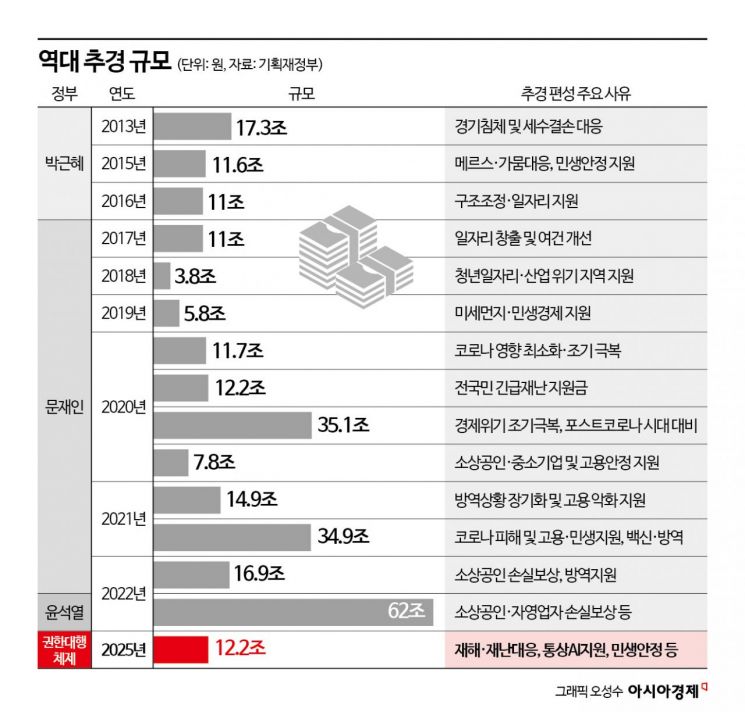
Extra budget as a 'buffer' rather than a stimulus
The political burden of an extra budget financed by increased tax revenue is also considerably lower. President Lee Jaemyung previously drew a line by saying, "This will not be an extra budget that issues tens of trillions of won in deficit-financing government bonds," but if the government uses excess tax revenue, it can mitigate controversy over damaging fiscal soundness and thereby strengthen the justification for pushing ahead with the policy.
President Lee views the nature of this extra budget as a buffer against downside risks in the first half of the year, based on the judgment that the recovery in consumption is slow and that youth employment indicators are revealing structural constraints. If it materializes, this extra budget is highly likely to focus on supplementing existing policies rather than launching new large-scale projects. The main focus is expected to be on areas such as culture and content, start-ups, and strengthening youth employment, where spending can be executed quickly and short-term effects can be realized.
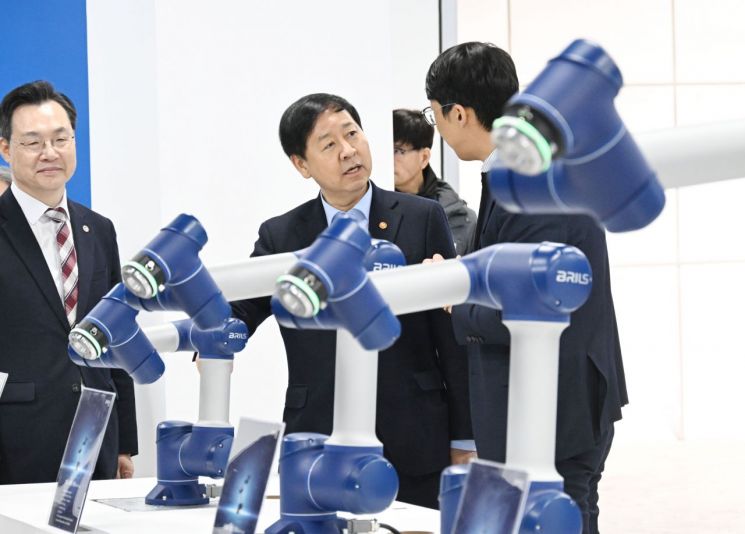 Koo Yuncheol, Deputy Prime Minister and Minister of Economy and Finance, visited Brills in Yeonsu-gu, Incheon, a company that designs robot solutions and builds a robot standardization platform, and is listening to explanations of the products and the production process from the company's CEO. Feb. 5, 2026, Yonhap News
This approach is small in scale but aims to maximize the public's sense of impact. It can also serve as the rationale for meeting the requirements for drafting an extra budget under the National Finance Act in a situation where it is difficult to clearly define the current phase as a recession. The timing of the extra budget is expected to come into focus after corporate tax filing and payment at the end of next month. If tax revenue significantly exceeds projections, a first-half scenario would be possible in which an extra budget bill is drafted in April or May and submitted to the National Assembly in June.
A limited extra budget that partially accompanies government bond issuance cannot be ruled out either. Even if tax revenue falls short of expectations, if the need for economic management grows, the government may still draw up an extra budget by issuing around 5 trillion won in government bonds. However, an extra budget accompanied by government bond issuance would impose a burden on the market. Since talk of a possible extra budget began, the yield on three-year Treasury bonds has risen by more than about 30 basis points (0.30 percentage point) in just over a month, from the 2.9% range early last month to the 3.2% range early this month. Even taking into account weaker expectations for a base rate cut, this is interpreted as the market having already priced in the possibility of increased government bond supply. In this context, if an additional issuance of around 5 trillion won in government bonds is added, interest rate volatility will inevitably increase further, leaving the government with no choice but to be cautious about an extra budget.
Inflationary pressure from an extra budget is another variable. According to a study recently published by the Korean Association of Public Finance, when government debt increases by 1%, consumer prices rise by up to 0.15%. In particular, some point out that if the government pursues expansionary fiscal policy while running a fiscal deficit, it could stoke inflation expectations and lead to medium- to long-term upward pressure on prices. Kang Sungjin, professor of economics at Korea University, analyzed, "An extra budget funded by increased corporate tax revenue may be close to a matter of justification. Given that the budget has already been drafted in deficit, if an extra budget of at least 10 trillion won is injected at once, it could exert upward pressure on prices at the current exchange rate."
© The Asia Business Daily(www.asiae.co.kr). All rights reserved.



















