KOSPI Reclaims 5,300 Intraday on Feb. 9
JP Morgan Sees 7,500, Citi Forecasts 7,000
"Strong Semiconductor Earnings and Scaling Up Policies Seen as Positive"
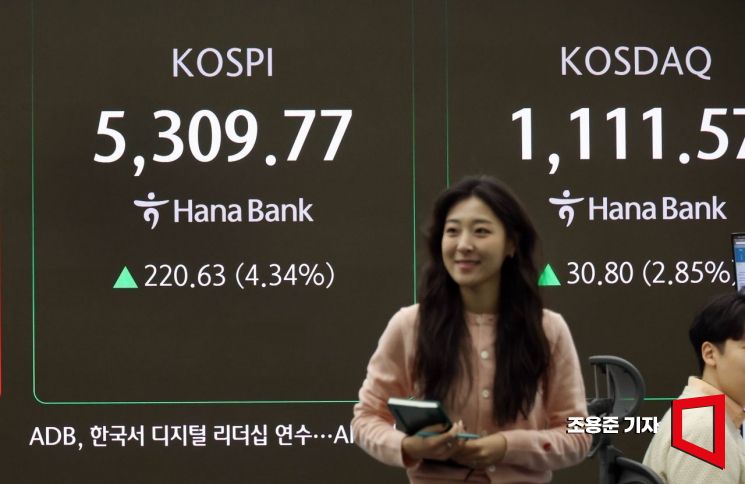 An employee monitors the stock market and exchange rates in the dealing room at Hana Bank's Seoul headquarters as the KOSPI opened more than 4% higher. The KOSPI opened at 5,299.10, up 4.13% from the previous trading day, marking a record-high opening, while the KOSDAQ opened at 1,109.91, up 2.7%. Feb. 9, 2026 Jo Yongjun, Reporter
Major domestic and global securities firms are successively projecting that the KOSPI could not only surpass the 6,000-point level but also potentially reach 7,000. Analysts say that, with the Korean economy entering a recovery phase led by semiconductors, and government policies to enhance corporate value (Scaling Up), such as the third amendment to the Commercial Act, will further push the index higher.
On Feb. 9, the KOSPI opened at 5,299.10, up 209.96 points (4.13%) from the previous trading day, and had risen to 5,312.06 points as of 9:35 a.m. Low-priced buying flowed in on the perception that the recent stock market decline had been excessive, and the market was also influenced by a rebound in the three major New York stock indexes last Friday. Last Friday, the Dow Jones Industrial Average surged 2.47%, surpassing 50,000 points for the first time in history.
Although market volatility has increased since February, the securities industry believes there is ample room for further gains in the KOSPI. In a Korea equity report released on Feb. 6, global investment bank Citi analyzed that, contrary to some concerns, there are no signs of a market downturn such as an overheating of the Korean economy or uncontrollable inflation.
Accordingly, Citi raised its KOSPI target level from 5,500 points to 7,000 points. The target is based on applying a price-to-book ratio (PBR) of 2.1 times, which reflects a 20% premium over the historical peak PBR of the past 20 years.
Citi expects the Korean economy to grow 2.4% this year, exceeding its potential growth rate of 1.8%. In particular, it forecasts that, supported by strong semiconductor-centered manufacturing output, exports, and facility investment, as well as base effects, Korea will post higher-than-expected economic growth. It also expects inflation to come in below the Bank of Korea's 2.0% target, achieving a Goldilocks condition.
Earlier, on Feb. 2, JP Morgan also raised its KOSPI target index in its Korea equity strategy report, setting 6,000 as the base-case scenario and 7,500 as the bull-case scenario. According to JP Morgan, 60% of the KOSPI's gains since last September have been driven by Samsung Electronics and SK Hynix, and it expects these two stocks to continue leading the index higher.
Among domestic securities firms, NH Investment & Securities on Feb. 5 set a 12-month KOSPI target of 7,300 points. Kim Byoungyeon, Head of Investment Strategy at NH Investment & Securities, stressed, "The KOSPI is currently in an expansion phase in which both corporate earnings growth and valuation (multiple) expansion are occurring simultaneously," adding, "The index has room for further upside."
© The Asia Business Daily(www.asiae.co.kr). All rights reserved.

















