21st Korean Robotics Conference Held on Largest Scale Ever
Professor Park Jongwoo of Seoul National University: "VLA Alone Cannot Bridge the Manipulation Gap with Data"
Lee Hongrak, Head of LG AI Research, CEO Choi Hyukryeol of Aidin Robotics, and Others Present Future Directions for Robot Development
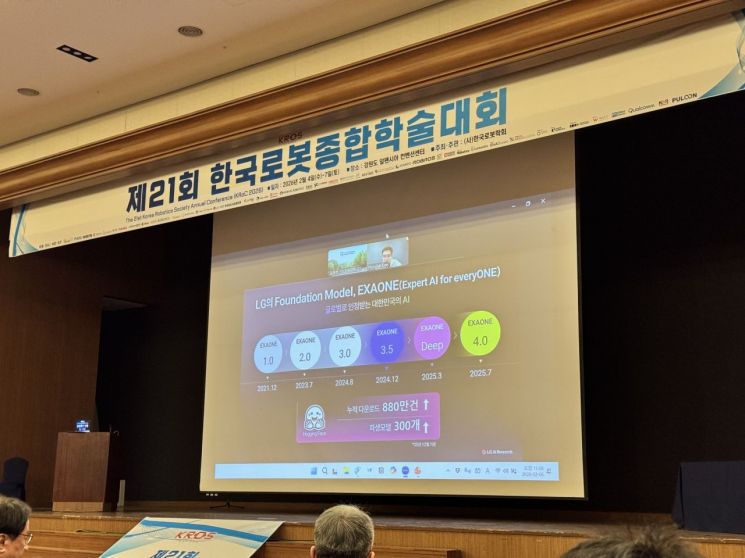 Lee Hongrak, Head of LG AI Research, is delivering a speech remotely at the 21st Korea Robot Conference (KRoC 2026) on the 6th. Photo by Paek Jongmin, Tech Specialist
Despite a cold wave of minus 10 degrees Celsius, more than 2,000 scholars responsible for the future of Korean robotics flocked to Pyeongchang, Gangwon Province, from the 4th to the 7th. They gathered for the 21st Korean Robotics Conference (KRoC 2026). The event, held on the largest scale ever, was both a celebration welcoming the robotics boom sparked by Atlas, showcased by Boston Dynamics, a subsidiary of Hyundai Motor Company, at CES 2026, and a forum to reflect on the future direction and challenges of Korean robotics research.
The key theme was a renewed effort to confront the "wall of the real world" that robots face, even amid high expectations surrounding generative AI and foundation models. Speakers delivering keynote and special lectures each pointed out the limits of AI-centered discourse from their own vantage points and conveyed the message that robotics technology must return to physics, systems, and industrial reality.
In the first keynote lecture, Professor Park Jongwoo of Seoul National University, speaking on the topic "Rethinking VLA (Vision-Language-Action): Bridging the Robot Manipulation Gap," noted that although the robotics community has recently focused on data and scale and placed high expectations on vision-language-action (VLA) models, these alone are unlikely to solve the fundamental problems of robot manipulation.
He emphasized that "robot manipulation is a complex process that requires precise coordination of motion and force under contact conditions," highlighting the characteristics of the physical world, which is full of uncertainties such as friction, deformation, and unexpected contacts. Professor Park analyzed that current VLA models mainly rely on "position-centric outputs" and therefore fail to sufficiently capture force and compliance, which are at the core of manipulation. He also stressed that there is a gap that cannot be closed by data alone because of data sparsity and the physical limitations of simulators.
As a solution, Professor Park proposed a shift from a "method-centered" to a "problem-centered" approach. He argued that "the expectation that applying AI to humanoids will solve everything is easily exaggerated," and insisted that in order to achieve the success rates of 99.5% or higher demanded on industrial sites, the robot’s own "inductive structure" must be embedded into the models. His proposal is for a new hierarchical architecture that uses traditional robotics knowledge such as kinematics, dynamics, and control theory as the bottom layer of AI models.
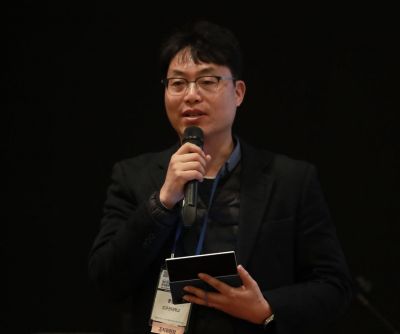 Moon Hyungpil, Chair of the Organizing Committee of the 21st Korea Robot Comprehensive Academic Conference (KRoC 2026), is speaking. Photo by Paek Jongmin, Tech Specialist
In the second keynote lecture, Lee Hongrak, head of LG AI Research and professor at the University of Michigan, presented a roadmap for AI evolving beyond simple information generation into agents and connecting with the physical world. He said, "AI is moving into an era of agentic AI, where it can plan and execute autonomously in digital environments,"
and demonstrated how "ChatEXAONE" is being advanced into a work agent that performs everything from planning and execution to evaluation in enterprise environments.
Lee predicted that digital agent technology will ultimately expand into physical AI. He outlined a vision in which autonomous behavioral capabilities accumulated in virtual space are combined with robotic systems to evolve into robust systems that solve real-world problems, such as autonomous R&D robots in chemistry and life sciences or smart factories.
In a special lecture, Professor Choi Hyukryeol of Sungkyunkwan University, who is also CEO of Aidin Robotics, pointed out concrete limitations from the perspective of industrial sites. His proposal was to transform robots from "machines that see" into "partners that touch and work." He emphasized that "for robots to enter everyday life and industry, seeing is not enough; issues of contact and force must be addressed." Identifying tasks that involve frequent contact, such as hot dog cooking, sanding, and polishing, as bottlenecks to the commercialization of robots, Professor Choi argued that force sensors must become standard robot components rather than measurement instruments. "Only when sturdy, inexpensive, and easy-to-use sensors are widely adopted will innovation on the ground become possible," he said.
Regarding the VLA boom, Professor Choi advised that "force data are physical quantities, so they are very noisy and complex," and that instead of simply feeding them into large models, they should be encoded and utilized as "meaningful signals," such as state transitions or appropriate force ranges.
Moon Hyungpil, Chair of the KRoC 2026 Organizing Committee and professor at Sungkyunkwan University, said, "There is a large gap between the robots seen in the glamorous videos from big tech companies and those in actual industrial sites. Industry wants Six Sigma-level perfection (a defect rate of 3 to 4 out of 1 million), but lab-level technologies or demo videos still cannot bridge that gap. How we close this gap between expectations and reality is the task facing our academic community."
Meanwhile, the academic conference, which turned into a four-day festival of robotics with more than 2,000 participants and a total of 549 papers presented, successfully concluded on the 7th with an awards ceremony and banquet. Corporate participation was also active, with more than 40 companies taking part in the exhibition. Exhibition space was so limited that not all companies that requested to participate could be accommodated.
In the quadruped robot autonomous driving category of the Robot Competition, the "ROMODOG" team from Hongik University won first place, while in the DIY drone category, the "Impact" team from Ajou University took the top prize. The AFCV Best Paper Award went to the team from Inha University (led by Cho Dongjin), and the Best Undergraduate Paper Awards were given to teams from Seoul National University of Science and Technology and Gachon University.
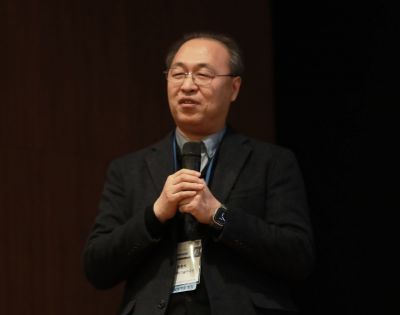 Choi Jongseok, president of the Korean Robotics Society, is delivering remarks. Photo by Paek Jongmin, Tech Specialist
In the general category, Best Paper Awards went to teams from Hanyang University; a joint team from UNIST, the University of Manchester, and KAIST; Seoul National University; KAIST; and Ajou University. The Grand Prize for Best Paper (general category) was awarded to the team led by KAIST researcher Lee Nakhyung (supervised by Professor Kyung Kiuk) for their paper "Development of an Independent 3-DOF Bending Force-Feedback Haptic Glove Using Electrostatic Clutches."
At the RED Show, which recognizes creative robot demonstrations, the team from Sungkyunkwan University (led by Ahn Jaemin and supervised by Professor Choi Hyukryeol) won the Grand Prize, while the team from Seoul National University of Science and Technology (led by Lim Jeongrok and supervised by Professor Jung Kwangpil) received the Grand Prize in the undergraduate category. The Korean Robotics Society’s Society Award for Best Paper went to the paper "Improving Robot Task Speed Based on Imitation Learning," authored by the team led by Boros principal researcher Park Hyunjun.
Professor Kim Jinhyeon of Seoul National University of Science and Technology, who will serve as the organizing committee chair for the next conference, pledged, "Next year’s conference will be transformed into an event not only for researchers, but also for many people who are interested in robots to participate together."
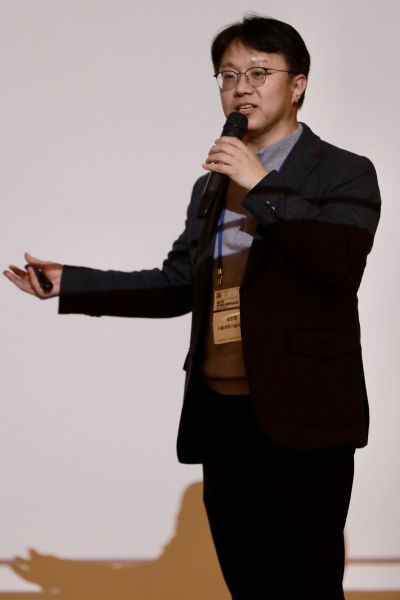 Kim Jinhyun, a professor at Seoul National University of Science and Technology, is explaining the direction for next year's academic conference. Photo by Paek Jongmin, Tech Specialist
© The Asia Business Daily(www.asiae.co.kr). All rights reserved.
![Clutching a Stolen Dior Bag, Saying "I Hate Being Poor but Real"... The Grotesque Con of a "Human Knockoff" [Slate]](https://cwcontent.asiae.co.kr/asiaresize/183/2026021902243444107_1771435474.jpg)

















