FT survey of 45 U.S. economists
56% of respondents: "AI boom will have little impact on interest rates"
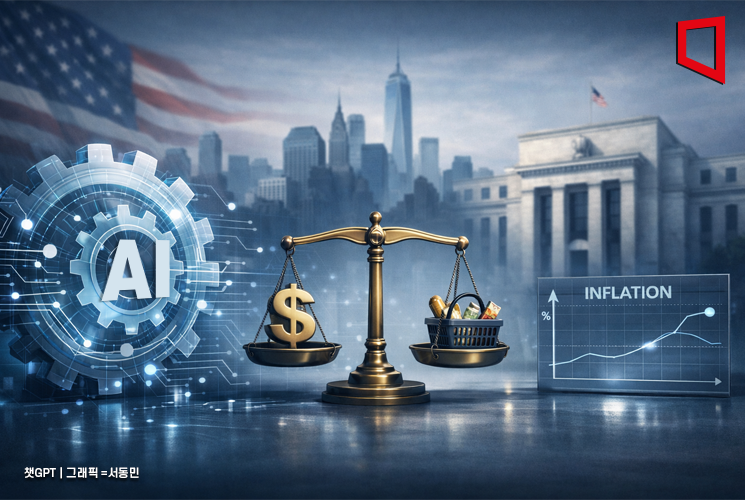
U.S. economists have assessed that productivity gains from artificial intelligence (AI) will have only a minimal impact on inflation. This runs counter to the argument by Kevin Warsh, candidate for chair of the U.S. Federal Reserve (Fed), who claims that AI will significantly boost U.S. economic productivity and thereby allow interest rates to be cut without stoking inflation. It is being interpreted as a sign that it will not be easy for Warsh to persuade members of the Federal Open Market Committee (FOMC) to lower the federal funds rate.
According to a survey conducted on the 8th (local time) by the Clark Center for Global Markets at the University of Chicago of 45 U.S. economists, 56% of respondents said that "the current AI boom will not have a major impact on interest rates in the near term." The Financial Times (FT) explained that this implies that the reduction in the neutral rate would be less than 0.2 percentage points.
Jonathan Wright, a professor at Johns Hopkins University who previously worked as a Fed economist, said, "I do not view the AI boom as a deflationary shock," adding, "In the short run, it is also unlikely to generate a major surge in inflation."
By contrast, 32% of respondents said that, because of the AI boom, the Fed might need to raise the neutral rate slightly. Some Fed economists and academic economists currently argue that AI could increase demand and heighten upward pressure on prices. This position is the opposite of that of Fed chair candidate Warsh, who contends that boosting productivity through AI will expand supply and thereby contain inflation.
Philip Jefferson, Fed Vice Chair for Monetary Policy, said at a Brookings Institution event on the 6th that "even if AI ultimately succeeds in greatly enhancing the productive capacity of the economy, in the absence of monetary policy actions, the surge in demand generated by AI-related activity could temporarily push up inflation," citing the impact of the current data-center construction boom as an example.
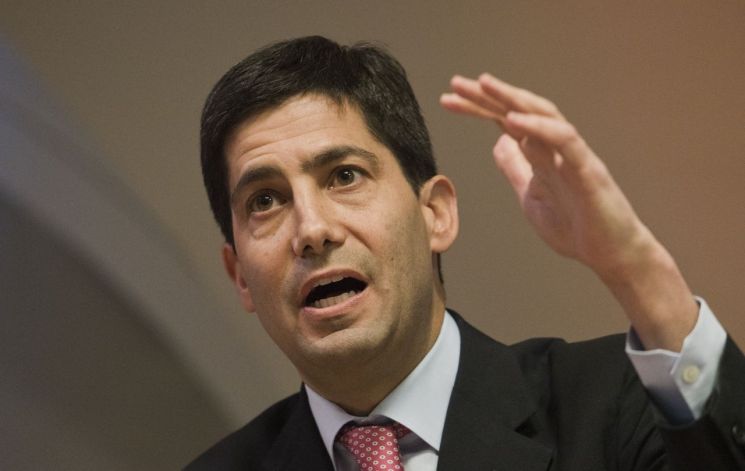
FT explained that this suggests it may be difficult for Warsh to convince FOMC members to cut interest rates on the grounds of AI-driven productivity gains.
The total scale of FOMC rate cuts this year is expected to be only 0.25 percentage points. In that case, the federal funds rate would remain above 3.25%. The current U.S. policy rate stands in a range of 3.50% to 3.75%.
This is far higher than the 1% level that President Donald Trump has said the U.S. economy needs. In an interview with NBC on the 4th, President Trump said, "I think rates are going to come down," adding, "We need to lower rates."
On the Fed's balance sheet, there appears to be broad agreement. Warsh has criticized the Fed's balance sheet as "excessively bloated" and has argued that it should be reduced. His logic is that the Fed should continue quantitative tightening on its balance sheet to first anchor inflation expectations, thereby preventing Treasury yields from rising even if the policy rate is cut.
In the "FT-Chicago Booth" survey, 67% of respondents said they believe the size of the U.S. balance sheet should be kept below 6 trillion dollars over the next two years.
Karen Dynan, a professor at Harvard University, said, "If there is continued evidence that liquidity is ample and short-term funding markets are stable, it is not unreasonable, conditionally, to shrink the balance sheet somewhat further."
A similar share of respondents expect that Warsh will achieve his goal and that the size of the balance sheet will return to below 1 trillion dollars, the level seen before 2008.
The FOMC, by contrast, has supported the decision to end the quantitative tightening policy that had been in place for three years. Under this policy, the central bank's assets shrank from 9 trillion dollars to 6.6 trillion dollars.
Meanwhile, most of the economists surveyed did not support the Trump administration's goal of loosening regulation of the banking system, a policy that Warsh has backed. About 60% of respondents said such deregulation would have little impact on growth in the short term but would significantly increase the risk of a financial crisis.
© The Asia Business Daily(www.asiae.co.kr). All rights reserved.
![Clutching a Stolen Dior Bag, Saying "I Hate Being Poor but Real"... The Grotesque Con of a "Human Knockoff" [Slate]](https://cwcontent.asiae.co.kr/asiaresize/183/2026021902243444107_1771435474.jpg)













