Two Alerts Issued in a Single Season for the First Time in 10 Years
Influenza A Was Predominant in November Last Year
Recently in Japan, the number of influenza (flu) patients has surged again, prompting the issuance of a second alert. It is reported to be the first time in the past 10 years that a flu alert has been issued twice in a single season.
According to TBS Japan and other outlets on February 6, the Ministry of Health, Labour and Welfare of Japan announced that, as of February 1, the weekly average number of patients reported by approximately 3,000 medical institutions nationwide was 30.03 per institution. This is almost double the figure from the previous week, and the weekly average number of patients has been rising for four consecutive weeks. Japanese health authorities issued the first alert in November last year, after which the upward trend slowed, but the recent sharp increase in patient numbers has led to the issuance of a second alert.
At present, 22 prefectures have exceeded the alert threshold of 30 patients per medical institution. The most severely affected area is Oita Prefecture, with an average of 52.48 patients reported per institution, followed by Kagoshima Prefecture with 49.60 and Miyagi Prefecture with 49.02. In major metropolitan areas, Tokyo recorded 26.67, Aichi Prefecture 38.75, Osaka City 20.59, and Fukuoka Prefecture 30.54.
During the surge in flu cases in November last year, influenza A viruses were predominant. However, more recently, there has been a marked increase in detections of influenza B viruses, changing the overall pattern. The Tokyo Metropolitan Government stated that about 90% of the virus types reported by designated medical institutions over the past week were influenza B. As a result, influenza B is being identified as the main driver of the renewed spread.
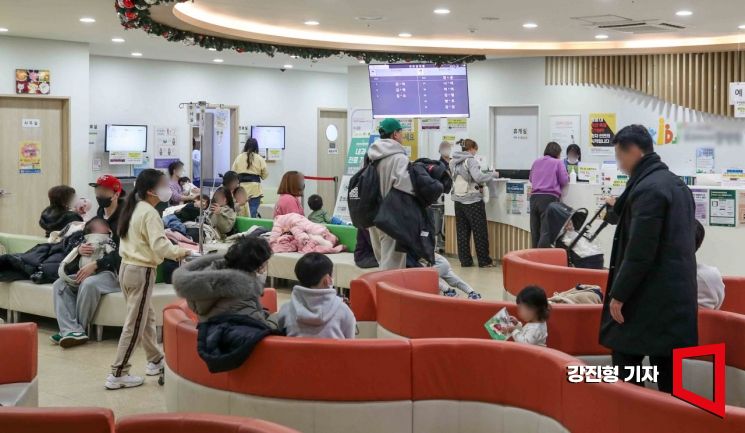
With the rise in infections, thousands of schools have been closed or have suspended classes. Across Japan, a total of 6,415 schools and educational institutions have implemented either full school closures or class-level suspensions.
Meanwhile, in Korea as well, the number of suspected flu patients has been increasing for four consecutive weeks this year. According to the Korea Disease Control and Prevention Agency on January 30, during the fourth week of this year (January 18 to 24), the proportion of suspected flu patients among those visiting sample surveillance medical institutions (clinics) was 47.7 per 1,000 outpatient visits. This is higher than the previous week’s 44.9, and the authorities are paying close attention to the fact that the proportion of patients, which had declined toward the end of last year, has now been rising again for four consecutive weeks. The proportion in the fourth week of January was about 30.7% higher than the 36.5 recorded during the same period a year earlier, and more than five times the current seasonal epidemic threshold of 9.1.
By age group, the proportion of patients was highest among those aged 7 to 12, at 139.6 per 1,000, followed by 85.1 among those aged 13 to 18, and 81.7 among those aged 1 to 6. The most frequently detected virus in the fourth week was influenza B, with a detection rate of 25.4%. Among influenza A viruses, the H3N2 subtype accounted for 10.0%, and the H1N1 subtype for 0.4%. Up to the first week of this year, influenza A (H3N2) had been dominant, but from the second week onward, the detection rate of influenza B has exceeded that of influenza A. Therefore, even if someone has already contracted and recovered from influenza A, they can still be infected again with influenza B, so extra caution is required.
© The Asia Business Daily(www.asiae.co.kr). All rights reserved.
![Clutching a Stolen Dior Bag, Saying "I Hate Being Poor but Real"... The Grotesque Con of a "Human Knockoff" [Slate]](https://cwcontent.asiae.co.kr/asiaresize/183/2026021902243444107_1771435474.jpg)
















