Korea Automotive Technology Institute: "Easing Cost and Technology Burdens... Reshaping the Industry Landscape"
With Nvidia unveiling its open autonomous driving development solution "Alpa Mayo," forecasts are emerging that, in the autonomous driving domain, a horizontally segmented division of labor between finished vehicle manufacturers and big tech platform companies will spread. However, experts note that the key issue will be how to address automakers' concerns that they could become dependent on such platforms.
On the 9th, the Korea Automotive Technology Institute stated in its report titled "The New Autonomous Driving Ecosystem Envisioned by Alpa Mayo" that "Alpa Mayo has the potential to reduce the cost and technology challenges of autonomous driving and to reshape the industry landscape," adding that "big tech companies with integrated software (SW) and hardware (HW) capabilities could come to dominate the autonomous driving ecosystem."
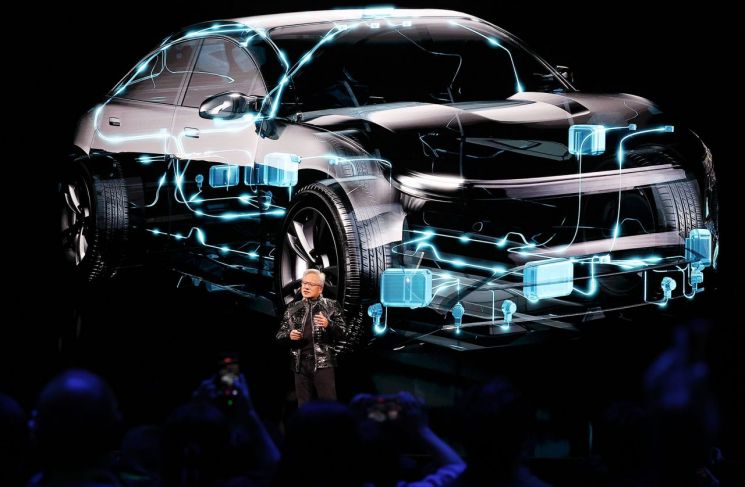
Currently, the autonomous driving industry is facing limitations in the form of a "high-cost structure" and "technological uncertainty" just before full-scale commercialization. Because advanced technology requires broad investment in SW development, integration, testing and validation, data collection and storage, and system development, it is difficult in reality for a single company to shoulder all of these costs.
Global consulting firm McKinsey has projected that the worldwide rollout of robotaxis will be delayed from 2029 to 2030, and pilot operations of Level 4 private passenger cars at the city level will be pushed back from 2030 to 2032.
The report also pointed out that, in terms of how autonomous driving is implemented, both rule-based methods and End-to-End (E2E) methods exhibit inherent structural limitations. It stated, "Rule-based approaches show a markedly weak ability to respond to unstructured, exceptional situations (edge cases) that have not been predefined," and explained, "The E2E approach led by Tesla has reached a high level of technology, but it is constrained by the black-box problem, in which the decision-making process cannot be explained."
By contrast, Nvidia Alpa Mayo is characterized by its aim to serve as an open, integrated platform that covers the entire lifecycle of autonomous driving technology development. It consists of three elements: the vision-language-action (VLA) model "Alpa Mayo 1," which embeds linguistic reasoning capabilities; the simulation open framework "AlpaSim"; and an open physical AI dataset.
The report described it as "a hybrid architecture that combines the intuitive reasoning of AI with rule-based safety verification," and analyzed, "Because it can adopt a hybrid approach in which a traditional rule-based autonomous driving structure is built separately to perform real-time supervision, it implements a safety-oriented approach in which 'Alpa Mayo 1' leads driving in normal situations, while the traditional system holds control authority in uncertain situations."
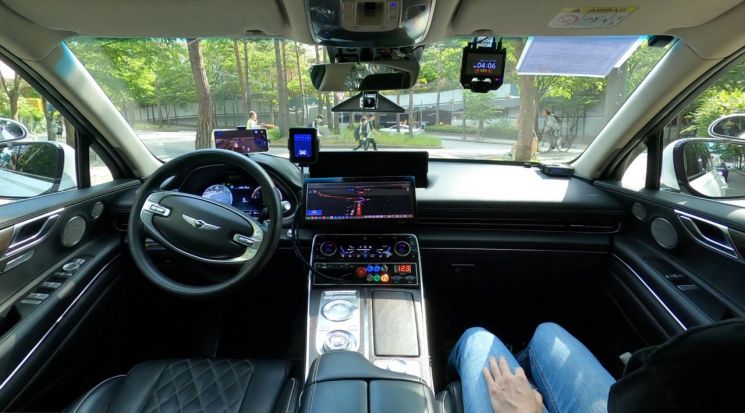
The report assessed that this architecture holds the potential to resolve technical challenges in the autonomous driving industry and to reduce development costs. It went on to say, "The market is likely to split into an E2E-centered regime and a hybrid regime that combines 'E2E + rule-based' approaches," adding, "The hybrid regime may gain the upper hand in terms of safety and regulatory compliance."
However, it also pointed out that "the linguistic explanation capabilities of VLA do not guarantee complete physical responses to unexpected variables, and a simulation-centered learning approach can never be entirely free from issues of consistency with the real world," adding, "There also remains a structural gap between the probabilistic reasoning nature of AI and regulatory frameworks that demand clear causal relationships."
Hansol Kim, senior researcher at the Korea Automotive Technology Institute, said, "Nvidia could secure leadership in the autonomous driving ecosystem and become a driving force in setting standards," and predicted, "If the technological gap in autonomous driving between companies narrows, future competition may shift away from who takes the lead in technology development and toward the technological utility that consumers actually experience in mass-produced vehicles."
© The Asia Business Daily(www.asiae.co.kr). All rights reserved.
![Clutching a Stolen Dior Bag, Saying "I Hate Being Poor but Real"... The Grotesque Con of a "Human Knockoff" [Slate]](https://cwcontent.asiae.co.kr/asiaresize/183/2026021902243444107_1771435474.jpg)

















