2026 Joint Economics Conference Held
Special Lecture by Kim Injun, Honorary President of the Korean Economic Association
"Asset Polarization Fuels Intergenerational Conflict and Political Instability"
"When a real estate bubble deepens asset polarization and heightens political instability, it is ultimately future generations that suffer the most. To avoid falling into the trap that advanced countries face, we must first resolve the task of deflating the real estate bubble."
Kim Injun, Honorary President of the Korean Economic Association (Professor Emeritus in the Department of Economics at Seoul National University), delivered a special lecture titled "At the Crossroads of Overcoming the Advanced Country Trap" at the 2026 Joint Economics Conference held at Chung-Ang University in Seoul on the 5th.
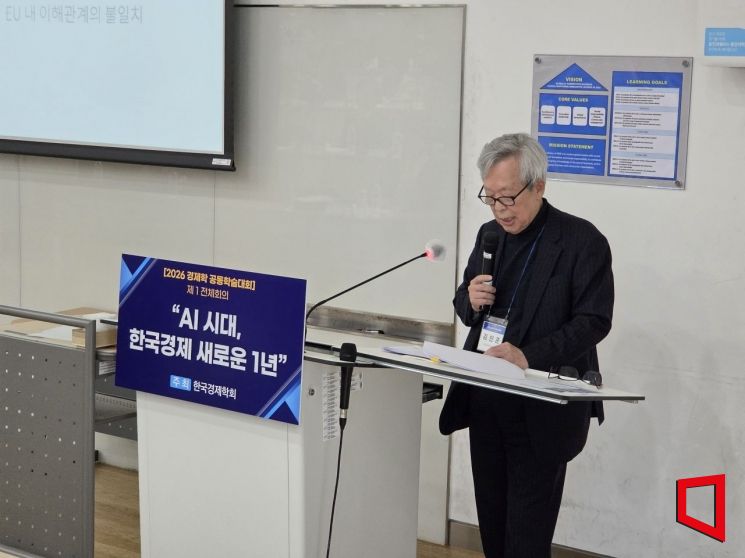 Kim Injun, Honorary President of the Korean Economic Association, is presenting at the 2026 Joint Conference on Economics on the 5th. Photo by Lim Onyu
Honorary President Kim defined the advanced country trap as "a state in which the economy stagnates in the long term, fails to secure new growth engines, and national security remains unstable." He expressed concern, saying, "We too can fall into the advanced country trap."
Domestically, the real estate problem was cited as a major cause. As one indicator showing that the domestic real estate market is overheated, Honorary President Kim pointed to the ratio of national net assets to gross domestic product (GDP). He noted, "From 2011 to 2017, it remained at a stable level between 7.5 and 7.8, but as of the end of 2024 it rose to 9.4 and has since stayed at a high level."
He also interpreted the price-to-income ratio (PIR) for housing in Seoul, which exceeds 15 times annual income, and the Jeonse-to-price ratio in the Gangnam area, which is over 40%, as additional signs of a real estate bubble.
As the background to the real estate bubble, Honorary President Kim cited the imbalance in housing supply and demand concentrated in the Seoul metropolitan area, and excess liquidity caused by a prolonged period of monetary easing. He pointed out, "The bubble in the real estate market ultimately intensifies asset polarization, thereby deepening intergenerational inequality, and at the same time can trigger political instability." He added, "In the end, that burden will be shifted onto future generations."
As a measure to deflate the real estate bubble, Honorary President Kim proposed expanding land supply for housing in Seoul and the wider metropolitan area. He explained, "The government should boldly implement policies that expand land supply in Seoul and the metropolitan area and seek to stabilize prices," adding, "Through an agreement between the ruling and opposition parties, we should also reconsider long-standing policies on absolute agricultural land and green belts."
Securing new growth engines was mentioned as another way to avoid falling into the advanced country trap. Honorary President Kim said, "We should secure international competitiveness centered on three pillars: semiconductors and artificial intelligence (AI), energy, and bio, and pursue balanced national development by linking these with regional economies."
He continued, "The government and companies must jointly pursue new-industry policies, and in the AI era we must establish a new labor-management relationship."
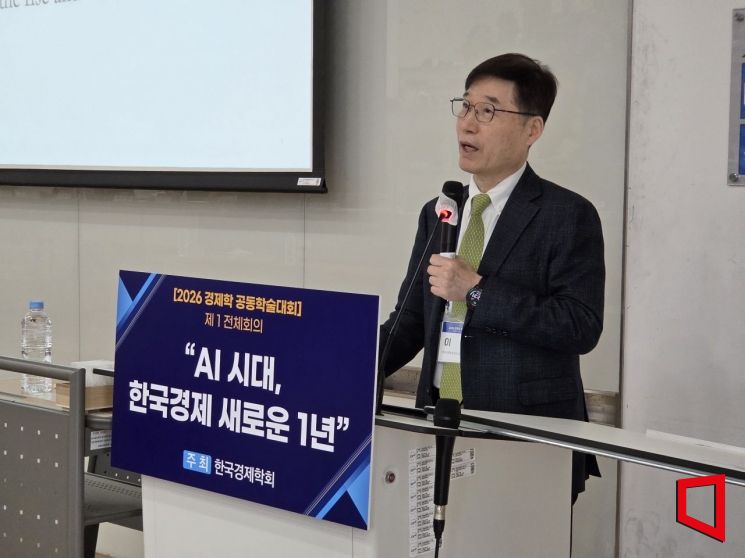 Lee Geun, a professor at Chung-Ang University who has completed his term as president of the Korean Economic Association, is giving a farewell lecture at the 2026 Joint Academic Conference on Economics on the 5th. Photo by Im Onyu
At the conference that day, Lee Geun, Seokhak Professor at Chung-Ang University, who had completed his term as president of the Korean Economic Association, delivered a "farewell lecture" titled "New Schumpeterian Economics and Latecomers' Catch-up and Overtaking." Professor Lee cited short-cycle technological innovation as the key reason Korea was able to avoid the middle-income trap and catch up with advanced economies. The middle-income trap refers to a situation in which growth stalls at the middle-income stage and a country fails to advance to high-income status.
Professor Lee analyzed, "Korea and Taiwan were able to escape the middle-income trap by specializing in short-cycle technologies with brief life cycles." Short-cycle technologies are characterized by low entry barriers and high growth potential. He explained, "Now we are smoothly entering long-cycle technology industries, moving beyond specialization in short-cycle technologies," and added, "The shift from short-cycle in the early stage to long-cycle in the later stage is the reason Korea was able to avoid falling into the middle-income trap."
© The Asia Business Daily(www.asiae.co.kr). All rights reserved.