Jeong Kiseok, NHIS President: "The Problem Is the Volume of Services, Not the Fee Schedule"
Eradicating Administrator-Run Hospitals with "Special Judicial Police"...Leading "Integrated Medical and Long-Term Care"
The National Health Insurance Service (NHIS) has set its top priority this year as preventing unnecessary and excessive medical treatment that drives up health insurance expenditures, and establishing a data-based "appropriate care" system. It plans to conduct in-depth analysis of excessive medical practices and release the findings to the public, while also introducing "special judicial police powers" to eradicate illegally established medical institutions and thereby strengthen its benefit management function.
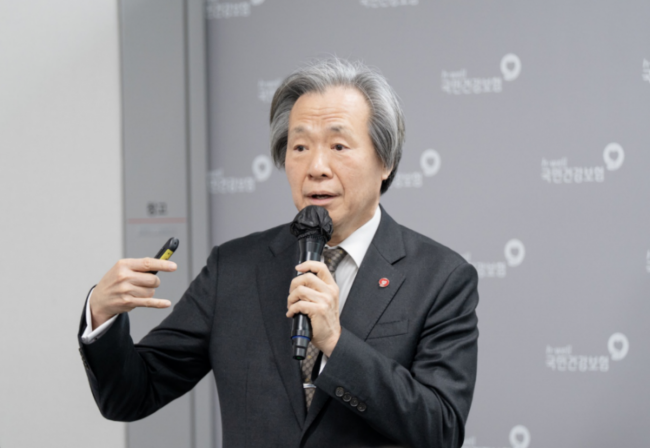 Jeong Kisuk, president of the National Health Insurance Service, is speaking at a press briefing on the 5th at the National Health Insurance Service Yeouido Northern Branch in Yeongdeungpo-gu, Seoul. National Health Insurance Service.
On the 5th, NHIS President Jeong Kisuk held a press briefing at the NHIS Yeouido office in Seoul and said, "With medical expenses surging due to the growing elderly population, depletion of the NHIS finances will be inevitable if the current pace of spending growth continues," adding, "We need measures that analyze medical institutions' treatment patterns, identify types of overtreatment, and induce medical institutions to voluntarily improve."
President Jeong identified the essence of the NHIS financial crisis not as "fees (medical service prices)" but as an explosive increase in "volume of services (number of treatments and tests)." He pointed out, "Although our country's population began to decline in 2020, the graph of medical expenditure has been rising steeply," and added, "The core problem is not simply that there are more elderly people, but that the number of medical procedures performed per the same population has increased tremendously." While annual hikes in health insurance premiums have remained in the 1-2% range each year, benefit payments have been growing at more than 5-8% annually, pushing last year's benefit expenditures to 102 trillion won.
President Jeong cited examples such as hospitals and clinics conducting an excessive number of unnecessary vitamin tests on patients with precocious puberty, or performing overly frequent nasopharyngoscopy on patients with the common cold, and explained, "The NHIS has formed the Appropriate Care Management Program (NHIS-CAMP) and is conducting detailed analysis of about 250,000 disease-specific procedure groups." He added, "We will release the results this year through the medical expense information disclosure system," and said, "By having big data, medical experts, and related agencies work together, we will establish a culture of appropriate care so that the public can receive rational, evidence-based medical services."
He once again stressed the need to introduce special judicial police powers to eradicate illegally established institutions such as so-called "administrator-run hospitals" and pharmacies that rent out licenses. President Jeong explained, "The NHIS already has more than 200 experienced personnel, so once investigative authority is granted, we will be able to immediately conduct account tracing to prevent siphoning off of funds."
Regarding concerns from the medical community about excessive regulation, he drew a line by saying, "Only about 300 institutions with suspected cases are currently subject to intensive investigation," and added, "Since the target is limited to illegal institutions, legitimate medical institutions have nothing to worry about."
On this year's key agenda item of integrated care services, he stated that the NHIS will serve as a "care coordinator" linking local governments with medical and long-term care institutions. Using big data, the NHIS plans to proactively identify people in need of care and to build a map that provides an at-a-glance view of care resources by region, thereby connecting them to appropriate services.
As part of its digital innovation efforts, in the latter half of this month the NHIS will introduce "NHIS-Call," an artificial intelligence (AI) counselor, and "NHIS-Mate," a work assistant for employees. Through these tools, the NHIS aims to provide 24-hour counseling services to the public, and to enable employees, regardless of years of service, to perform accurate work based on standardized professional knowledge.
Meanwhile, President Jeong expressed deep regret over the recent appellate court ruling in the tobacco lawsuit. He pointed out that the government in the 1960s and 1970s did not sufficiently inform the public of the harmful effects of cigarettes and instead allowed favorable promotion to continue, criticizing, "There are clear defects under the Product Liability Act, as even the ingredients of cigarettes are not properly disclosed." The NHIS plans to continue the lawsuit by supplementing it with additional evidence on the addictiveness and harmfulness of tobacco.
© The Asia Business Daily(www.asiae.co.kr). All rights reserved.
![Clutching a Stolen Dior Bag, Saying "I Hate Being Poor but Real"... The Grotesque Con of a "Human Knockoff" [Slate]](https://cwcontent.asiae.co.kr/asiaresize/183/2026021902243444107_1771435474.jpg)















