Excavation Results from the Gwanbuk-ri Site in Buyeo Revealed
Transverse Flute Unearthed from a Pit Containing Parasite Eggs
Restored with Six Finger Holes and Demonstrated
"Discarded in a Broken State...There Is Likely a Deep Story Behind It"
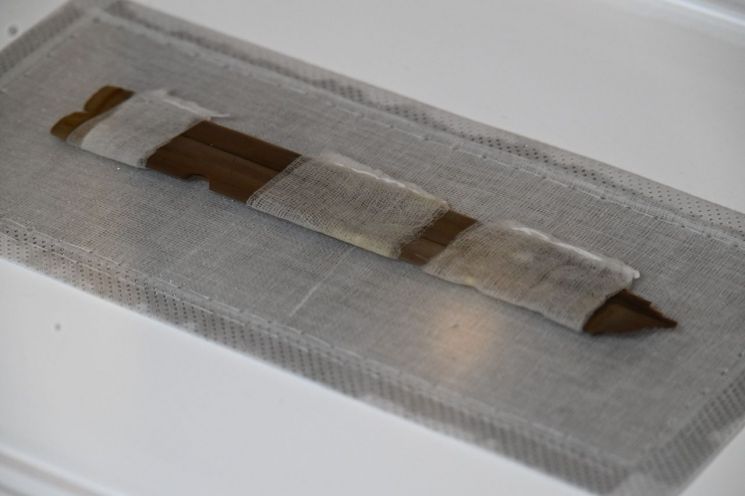
The breath that touched the lips of a Baekje person 1,500 years ago has miraculously awakened from a royal palace toilet pit.
On the 5th, the National Buyeo Cultural Heritage Research Institute of the National Heritage Administration released a transverse flute (hoengjeok, a side-blown flute) and 329 wooden tablets excavated from the Gwanbuk-ri site in Buyeo, South Chungcheong Province (presumed royal palace site from the Sabi period). The transverse flute is a landmark achievement that scientifically proves the actual existence of Baekje musical instruments. It is a bamboo pipe instrument measuring 22.4 cm in length and was recovered in a flattened state from a pit near the royal audience hall (Jodang, where court assemblies were held).
Hwang Inho, Director of the National Buyeo Cultural Heritage Research Institute, said, "An analysis of the organic matter inside the pit revealed a large quantity of herbaceous pollen and parasite eggs," adding, "There is a very high possibility that the place where the instrument was discarded was a toilet."
In an ordinary environment, the thin bamboo would have long since decayed away, but it was able to endure thanks to moisture and filth. The mud layer, formed like sludge, blocked oxygen and prevented microbial growth, effectively acting as a kind of "vacuum packaging."

Oh Hyundeok, Head Curator of the National Buyeo Cultural Heritage Research Institute, explained, "In places where groundwater is abundant and the soil covers objects, cutting off oxygen, there are cases where organic matter does not decompose and remains."
X-ray imaging confirmed that this instrument has four holes and that one end of the tube (the node on the blowing side) is closed. It can be identified as a side-blown transverse flute, essentially the prototype of today's Korean traditional instrument sogeum.
At the time of discovery, the instrument was broken, leaving only three finger holes (excluding the embouchure) that could be covered by the fingers. The institute restored it as an instrument with six finger holes. Director Hwang explained, "We reconstructed it in this way, taking into account Chinese written records stating that the flute (jeok) has seven holes including the blowing hole, as well as the fact that all the transverse flutes excavated in Japan from the 8th to 9th centuries, to which Baekje musical instruments were transmitted, have six finger holes."

The greatest focus of interest is the "sound." Performer Kim Yunhee, who demonstrated the restored instrument on site, said, "It produces a pitch about a whole tone and a half higher than that of the modern sogeum." She added, "The embouchure of the Baekje transverse flute is much smaller than that of the present-day sogeum, so it requires greater breath pressure to produce sound. The spacing between the finger holes is also such that the distance between the fourth and fifth holes is narrow, while the distance between the fifth and sixth holes is wide, which makes it difficult to play using modern fingering techniques."
Why was this noble instrument of the royal court discarded in a pit of filth? There are many aspects that do not fit with a simple case of loss. Director Hwang noted, "At the time of discovery, there were clear traces that someone had deliberately broken it, and the missing 30% of the fragments have never been found," and he speculated, "It is likely that there is some deep story behind it, rather than it being a simple disposal."
© The Asia Business Daily(www.asiae.co.kr). All rights reserved.