U.S. tech stocks plunge... KOSPI falls for the first time in three sessions
Bellwethers such as Samsung Electronics and SK Hynix drop sharply
Rotational market likely in sectors such as nuclear power, solar power, and batteries
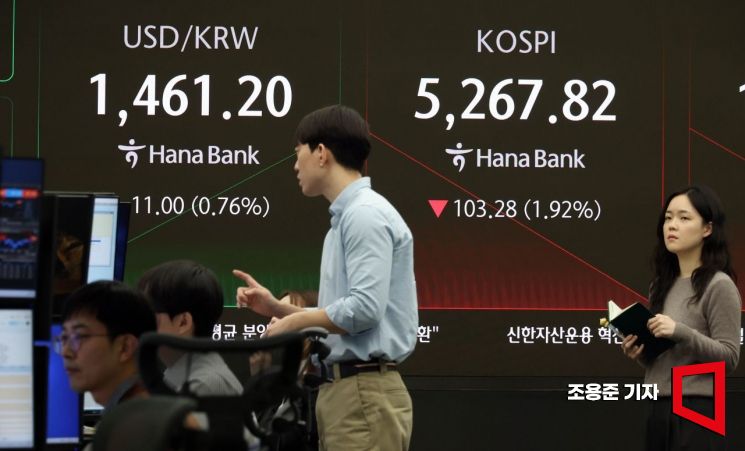 On the 5th, at the Hana Bank head office dealing room in Jung-gu, Seoul, an employee was monitoring the stock market and exchange rates. That day, the KOSPI opened at 5,251.03, down 120.07 points (2.24%) from the previous trading day (5,371.10), and the won-dollar exchange rate opened at 1,461.0 won, up 10.8 won. 2026.2.5 Reporter Cho Yongjun
The KOSPI turned lower for the first time in three trading days as the U.S. stock market weakened, led by technology stocks. However, in the securities industry, there are expectations that as semiconductors take a breather, rotational buying into other sectors that have been undervalued relative to their earnings performance - such as nuclear power, solar power, financials, automobiles, and batteries - could drive further gains in share prices.
KOSPI falls for the first time in three sessions on sharp drop in U.S. tech stocks
On February 5, the KOSPI opened at 5,251.03, down 120.07 points (2.24%) from the previous trading day. The KOSPI was affected as U.S. stock prices, particularly in technology names, fell sharply in the previous session.
On February 4 (local time), the Nasdaq Composite Index closed at 22,904.58, down 350.61 points (1.51%) from the previous trading day. As concerns mounted over a potential bubble in the artificial intelligence (AI) industry, investor sentiment toward technology stocks deteriorated across the board. Semiconductor company AMD fell 17.3% after reporting results that fell short of expectations, triggering broad-based selling in tech stocks.
Han Ji-young, a researcher at Kiwoom Securities, said, "The plunge in AMD's share price appears to have triggered the sharp decline in tech stocks," adding, "Uncertainty surrounding Kevin Warsh, the Federal Reserve chair nominee, remains, and interest rates are also under upward pressure, which has created a negative environment for interest-rate-sensitive tech and growth stocks."
The decline in U.S. tech stocks is having a negative impact on the share prices of domestic semiconductor companies such as Samsung Electronics and SK Hynix. Samsung Electronics started trading at 165,000 won, down 1.84% from the previous trading day. SK Hynix also opened at 878,000 won, down 2.34%. As bellwethers Samsung Electronics and SK Hynix dropped sharply, the KOSPI index is also showing weakness.
As semiconductors rest, rotational market into other sectors is possible
In the securities industry, many believe that while a correction centered on semiconductors may occur for the time being, the Korean stock market still has room for further medium- to long-term gains, led by earnings-driven stocks. There is also a possibility that, as the semiconductor sector takes a breather, a rotational market could emerge in which strength spreads to other sectors.
In fact, even though U.S. stocks have been generally declining since the start of February, the KOSPI rose for two consecutive days through the previous session and broke an all-time high. On the previous day, the KOSPI closed at a record high of 5,371.1 on a closing-price basis. While Samsung Electronics and SK Hynix remained flat, rotational buying into other sectors led to gains in most industries excluding semiconductors.
Looking at major sectors, nuclear-related stocks were strong the previous day after news emerged from the South Korea-U.S. foreign ministers' meeting that the two countries had discussed expanding cooperation in industries such as nuclear power, nuclear-powered submarines, and shipbuilding. Doosan Enerbility rose 6.58%, Korea Hydro & Nuclear Power Engineering (KEPCO E&C) gained 14.16%, and Korea Electric Power Corporation (KEPCO) also finished up 6.22%. On news that a technical team dispatched by Tesla CEO Elon Musk had conducted due diligence on a Chinese solar company, Hanwha Solutions hit the daily upper limit, while OCI Holdings surged 28.1%, leading strong gains in solar-related stocks.
Hyundai Motor, which is seeing strong sales in the U.S. and enjoys high expectations for its robotics business, closed the previous day at 501,000 won, up 1.93%, while Kia ended the session at 156,400 won, up 1.56%. Bank stocks also hit record highs as expectations for shareholder returns increased. KB Financial Group rose 2.59% to 142,400 won, Hana Financial Group climbed 3.09% to 113,600 won, and Shinhan Financial Group gained 3.41% to 91,000 won.
Experts noted that although the Korean stock market has so far risen mainly on semiconductors, momentum could spread to other sectors going forward. Lee Sang-yeon, a researcher at Shin Young Securities, said, "There is a high possibility that funds will move into sectors that did not rise as much as semiconductors, whose fundamentals remain intact and which delivered strong returns last year - sectors that investors have 'good memories' of," adding, "Nuclear power plants, power equipment, defense, shipbuilding, healthcare, automobiles, machinery, and securities all offer strong investment appeal."
© The Asia Business Daily(www.asiae.co.kr). All rights reserved.