Difficult to decide where to place trash cans, so installed outside
Trash piling up before collection hours...illegal dumping as well
"The downtown area is clean, but there are no trash cans in the market, so I'm confused about where to throw things away."
On the afternoon of the 4th, at Namdaemun Market in Jung-gu, Seoul. As you stepped inside from the entrance where hotteok stalls and cafes are clustered toward Bukchang-dong, foreign tourists could be seen lingering with plastic drink cups and food wrappers in their hands. Walking along the longest single straight alley from the entrance, about 370 meters in length, not a single public trash can was in sight. Even along the route of well over 1 kilometer that runs through famous food alleys such as the Braised Cutlassfish Alley and the Kalguksu Alley, there was nowhere to dispose of trash.
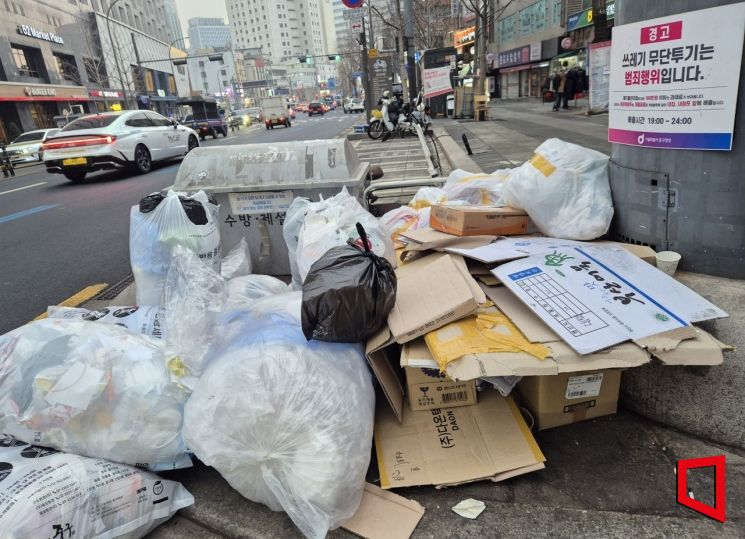 At around 5 p.m. on the 4th, a pile of garbage was dumped near Exit 5 of Hoehyeon Station at the edge of Namdaemun Market in Jung-gu, Seoul. Among various designated garbage bags, paper cups and cigarette butts believed to have been discarded by tourists were scattered. It was still before the designated time for putting out trash, 7 p.m. A sign on a utility pole read, "Illegal dumping of trash is a criminal act." Oh Jieun, Reporter
When turning around from the end of the market toward Namchang-dong near Hoehyeon Station, piles of garbage were spotted around a utility pole. Bags filled with filth were mixed together, and disposable items such as cigarette butts and paper cups were strewn across the ground. A foreign woman who appeared to be a tourist hesitated for a moment, then tossed a bundle of used wet wipes onto the pile of trash next to the pole. When asked why she threw it there, she hurried away, saying, "I didn't see a trash can, so I thought this was where trash was supposed to be collected."
Tourists who bought hotteok from several stalls popular enough to draw lines could be seen eating here and there and then looking around for a trash can. Lee (44), who said three generations of her family had come to the market together, said, "My child pointed at a honey-stained paper cup lying on the ground and asked what it was, and I was flustered, so I only said, 'A market is a place where lots of food is sold.'" Park (37), who came with her younger sibling to eat street food, frowned and said, "Because there are no trash cans, I see a lot of tourists illegally dumping garbage."
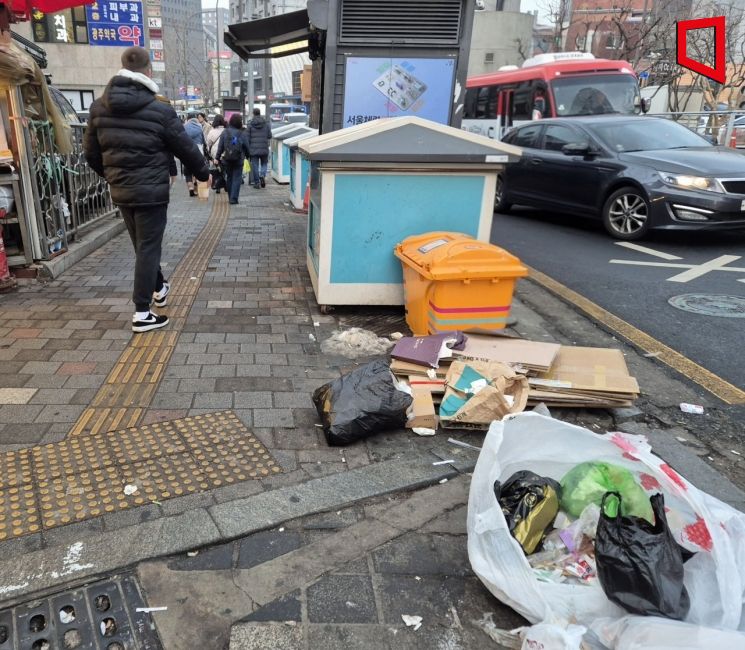 Around 5 p.m. on the 4th, trash was left on a street near Namdaemun Market in Jung-gu, Seoul. On the left side of the photo, a foreign passerby is walking while holding a disposable cup after finishing their drink. Photo by Oh Jieun
As Seoul's Namdaemun Market, with its roughly 600-year history, has emerged as a hot spot for foreign tourists, it is struggling due to a lack of public infrastructure for handling trash.
According to the Seoul Metropolitan Government, Namdaemun Market is the largest general market in the country, with more than 12,000 stores and over 50,000 workers. It is estimated to attract an average of 300,000 to 400,000 visitors per day and more than 100 million people per year. It handles more than 1,700 categories of goods, including not only food but also clothing, eyewear, and miscellaneous items.
Although its popularity is soaring as foreign tourists flock there, the lack of public infrastructure to handle trash generated inside the market has become a major concern. This is because the transfer station that had served as a garbage collection point was demolished in 2019 due to frequent breakdowns, and an adequate replacement collection system has not been established. The market now depends on each store handling its own waste. However, given the nature of "street food," where people eat while walking, it does not seem easy to carry trash back to the stores.
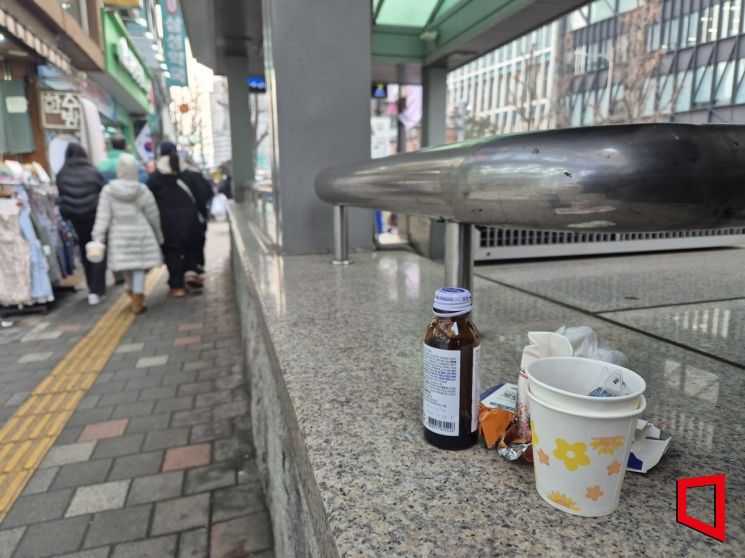 On the afternoon of the 4th, empty beverage bottles and paper cups are left at the entrance to the Namdaemun-ro underground shopping arcade at the entrance of Namdaemun Market in Jung-gu, Seoul. A trash can is installed at the bus stop about 50 meters from here. Photo by Oh Jieun
The local district office says it is difficult to install trash cans in highly visible locations for aesthetic reasons. Officials cite strong opposition from merchants near any spot where a trash can would be placed. Jung-gu has installed six trash cans around the outer perimeter of the market and near bus stops, but this is far from sufficient considering the number of visitors, including tourists.
By contrast, some smaller traditional markets, such as Gwangjang Market or Tongin Market in Jongno-gu, have 100-liter public trash cans installed near entrances or customer information centers.
There are growing calls to build infrastructure to keep the market clean in preparation for a further increase in foreign tourists driven by the Korean Wave. Jeong Ransu, a professor in the Department of Tourism at Hanyang University, said, "Local governments should install public trash cans at the entrances and keep them clean," adding, "When such beautification efforts are led in the public domain, merchants will have a stronger incentive to place trash cans inside the market as well."
© The Asia Business Daily(www.asiae.co.kr). All rights reserved.
![Clutching a Stolen Dior Bag, Saying "I Hate Being Poor but Real"... The Grotesque Con of a "Human Knockoff" [Slate]](https://cwcontent.asiae.co.kr/asiaresize/183/2026021902243444107_1771435474.jpg)


















