[On-site] Daedong Gear’s Sacheon plant goes into full-scale mass production of EV parts
New robotics business “ignited”... actuator prototypes to be developed in the first half of the year
Daedong Gear, a powertrain specialist located in Sanam-myeon, Sacheon-si, Gyeongnam Province, is broadly divided into Plant 1 and Plant 2. Plant 2 produces tractor parts that have enabled Daedong Gear to grow over the past 53 years. Plant 1, where the company recently made a large-scale investment in production facilities, manufactures electric vehicle (EV/HEV) components. If Plant 2 is the foundation of Daedong Gear, then Plant 1 represents its future. Based on the technological capabilities accumulated at Plant 2, Plant 1 is mass-producing core parts for electric vehicles and accelerating its entry into the new business of robot components. On February 4, we visited the site where an agricultural machinery parts company is transforming itself into a future mobility and robotics company.
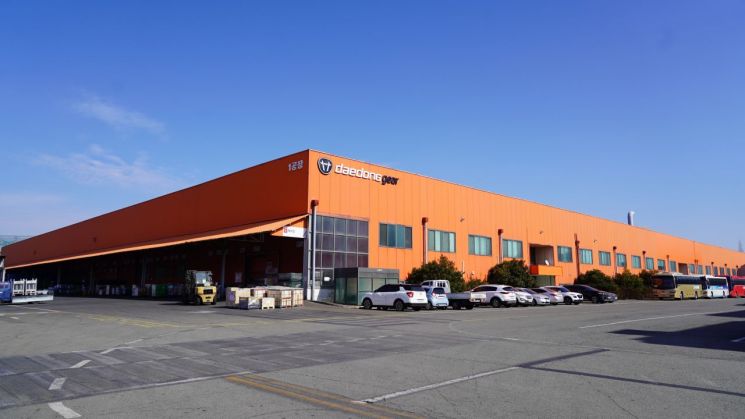
Seo Jonghwan, CEO of Daedong Gear, said, "We are simultaneously strengthening the two pillars of the core parts markets for future vehicles and robots, while also accelerating our efforts to tap overseas markets for existing agricultural machinery and industrial equipment powertrains." The strategy is to fully accelerate this year the development of electric vehicle parts, precision reducers, and actuator-based robot components, and to position the two fields of future mobility and robotics as new growth pillars.
Site where mass production of EV parts goes into full swing this year
Daedong Gear, which has supplied powertrain components for agricultural machinery and finished vehicles, has expanded its scope beyond simple parts to high value-added module businesses and invested about 27 billion won in electric vehicle parts production facilities, establishing a dedicated mass production system for these parts. On this basis, the company secured orders in 2024 worth about 1.24 trillion won, and in 2025 worth about 460 billion won for electric vehicle parts, internal combustion engine vehicles, and core drive parts for industrial equipment, expanding its cumulative order backlog to about 1.7 trillion won in just two years. Of this, orders for electric vehicle and next-generation hybrid vehicle components alone amount to about 1.33 trillion won, accounting for 78% of total orders. The company explains that its business portfolio is rapidly shifting to a future mobility-centered structure.
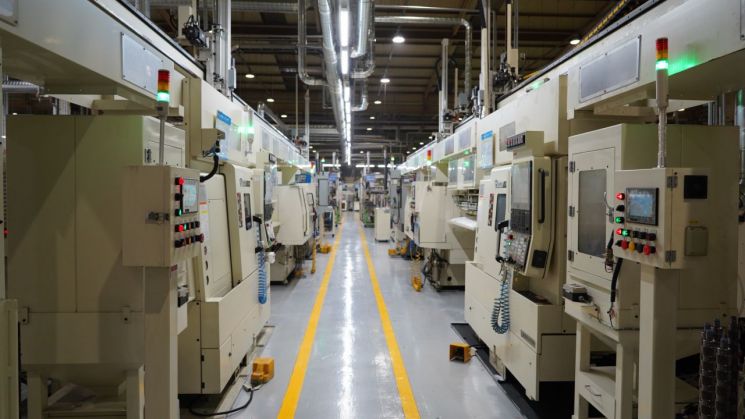 Sun gears are being produced on the production line at Daedong Gear Plant 1. This component is used in hybrid vehicle transmissions. Daedong Gear
The production lines at Plant 1, which we toured that day, were spaces where the technologies that made such orders possible are concentrated. The first to come into view was the sun gear machining line. While the production equipment runs nonstop, workers are hardly visible. Because the entire line is automated, only 0.5 to 1 management personnel per line are needed to stably produce about 290,000 parts annually. Hwang Sunghyun, head of the PT Development Team at Daedong Gear, explained, "The sun gears produced here enable hybrid vehicles to perform deceleration, acceleration, and reverse rotation according to driving conditions, and they play a key role in efficiently distributing power between the engine and the motor." This component is currently applied to transmissions in hybrid models of domestic finished vehicle makers. This line is a representative example of how Daedong Gear is strategically expanding its portfolio of hybrid and electrification components.
The output shaft assembly line, which produces the "output shaft" that transmits the rotational force coming out of the electric vehicle reducer to the outside, has also seen large-scale facility investments and, as an automated production line, turns out 300,000 parts annually. Hwang said, "Electric vehicles generate less noise, so component precision determines quality," adding, "We plan to further enhance quality stability this year by introducing gear transmission error measurement equipment."
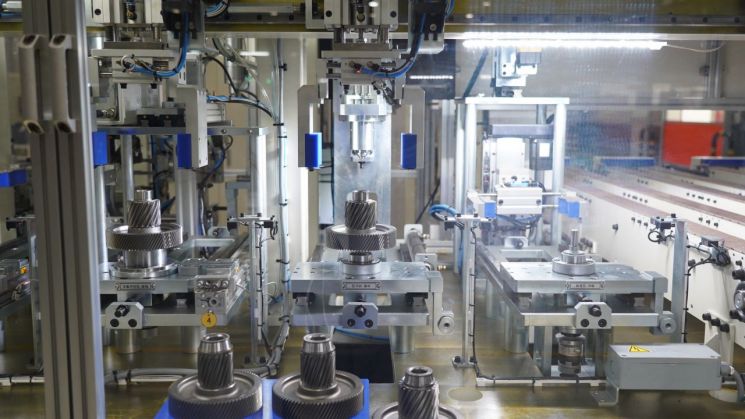 Daedong Gear is preemptively preventing defect risks with multiple quality measurement devices on the output shaft assembly production line at Plant 1. Daedong Gear
The electric vehicle parts produced here are driving performance growth. Daedong Gear estimated that its electric vehicle parts sales were about 10 billion won last year and will expand to about 33 billion won this year. The company explained that once deliveries of order volumes go into full swing starting this year, electric vehicle parts sales are expected to grow by an average of 35% annually through 2032.
Developing actuator prototypes for new robot business
The rotor (ROTOR) assembly line, which we next toured and which handles the core rotating component of electric motors, is a facility that Daedong Gear strategically built to preemptively respond to the expansion of the global electric vehicle market. The line is designed so that assembly errors that may occur during work are blocked in advance by equipment and systems, rather than relying on workers' skill levels.
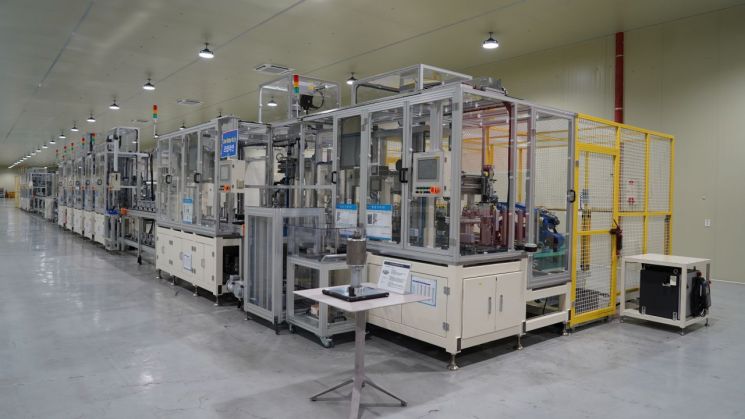 Rotor assembly production equipment inside the cleanroom at Daedong Gear's Plant 1 is waiting to be put into operation. Daedong Gear
Daedong Gear said that this infrastructure is not limited to electric vehicles, but serves as a base for long-term expansion into the robotics business. Participating in Daedong Group's robot project, Daedong Gear has secured development capabilities for reducers, a core component of robots, and is currently developing actuator prototypes for robots. The goal is to complete prototype development in the first half of the year. Based on this, the company plans to pursue supply negotiations with leading domestic and global robotics companies. The price competitiveness gained through in-house production of reducers is also expected to become an important differentiating factor in the robot parts market. CEO Seo explained, "Robots are an extension of electrified powertrains," adding, "We will proceed step by step by leveraging our existing manufacturing and quality capabilities."
For sustainable growth, Daedong Gear is also considering constructing a new plant depending on additional future orders. CEO Seo said, "While continuously enhancing the competitiveness of our electric vehicle parts business, we will also create a new growth story as a robot parts company by expanding our related technological capabilities in connection with the Group's robotics business."
© The Asia Business Daily(www.asiae.co.kr). All rights reserved.