Lawsuit Over Pizza Hut Differential Franchise Fees
Securing a Ruling to Return More Than 21.4 Billion Won
The Most Important Ruling Since the Franchise Business Act Took Effect
A Difficult Case the Courts Were Handling for the First Time
Even
"I believe this is the most important ruling since the Franchise Business Act came into effect in 2002."
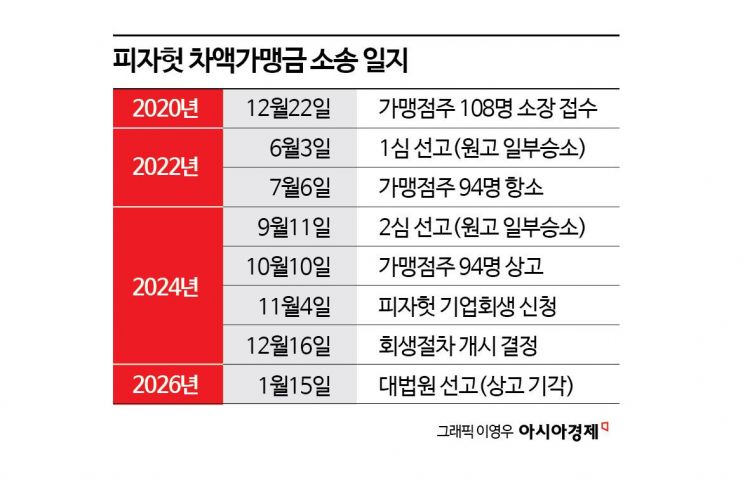
There is a case that has turned the domestic franchise industry upside down: the Pizza Hut "margin franchise fee" lawsuit. In December 2020, 108 Pizza Hut franchisees challenged the prices of the mandatory items they had been paying to headquarters for decades without question. After reviewing the disclosure document that was made public under the revised Franchise Business Act, they found that the prices of various supplies and food ingredients that headquarters purchased from third parties and supplied to the franchisees were much higher than prevailing wholesale market prices.
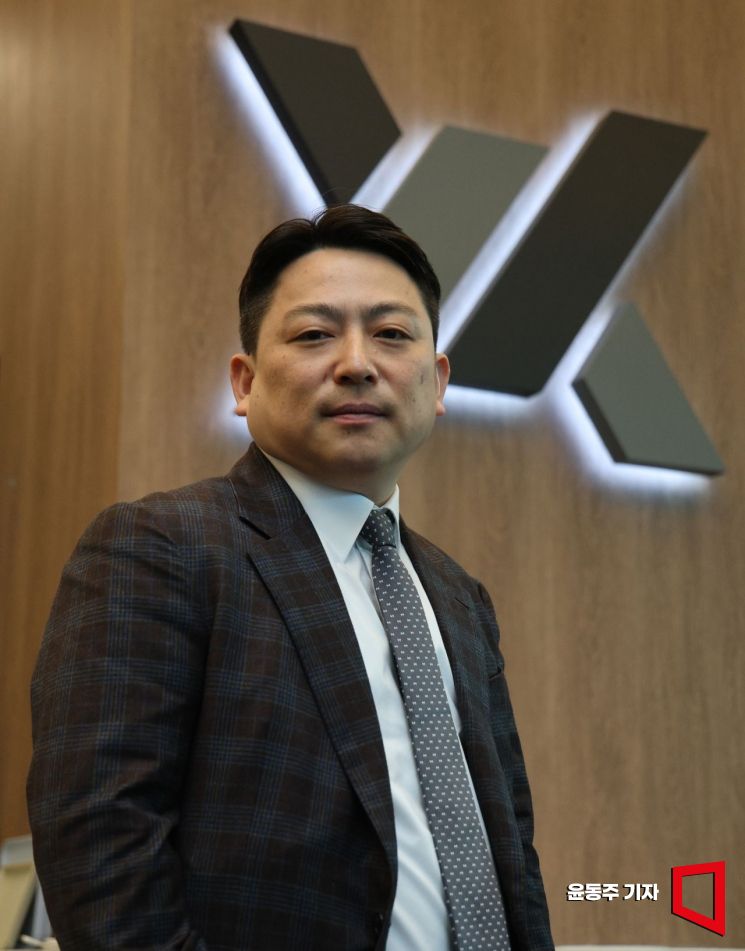 On the 2nd, at the YK Law Firm Gangnam main office in Gangnam-gu, Seoul, lawyer Hyun Minseok poses after finishing an interview with The Asia Business Daily. Photo by Yoon Dongju
Once the litigation started, it was not easy for the franchisees to fight against the franchisor. At that time, the level of understanding of margin franchise fees (the difference between the consideration received by the franchisor for supplying various goods to franchisees and an appropriate wholesale price, i.e., the distribution margin) was not very high. Because this was the first such case, even the court appeared unfamiliar not only with margin franchise fees but with the Franchise Business Act itself.
In the first instance, which was handled by small and mid-sized law firms, Pizza Hut headquarters argued in principle that "margin franchise fees are a type of franchise fee recognized under the Franchise Business Act, so the headquarters has a legal basis to receive them from the franchisees." The first-instance court sided with the franchisees, holding that "to receive margin franchise fees, an agreement is required, and there was no such stipulation or implied agreement between Pizza Hut headquarters and the franchisees." However, the scope of unjust enrichment that headquarters was ordered to return to the franchisees was limited to the margin franchise fees for 2019-2020, totaling about 7.5 billion won, which could be verified through the disclosure document.
Having lost in the first instance, Korea Pizza Hut retained Bae, Kim & Lee LLC (Taepyeongyang), the second-largest law firm in Korea by last year's revenue, for the appeal. The Bae, Kim & Lee lawyers persistently probed the question of "why an agreement is needed to receive margin franchise fees, which are a kind of margin." The atmosphere in court gradually shifted in favor of headquarters. Sensing a crisis that "if this continues, the result will be overturned," the plaintiff franchisees began looking for a new legal representative.
The person who gave these anxious franchisees hope that "we can win" was attorney Hyun Minseok of YK Law Firm (45, 39th class of the Judicial Research and Training Institute). Looking back on that time, Attorney Hyun said, "After reading the briefs submitted by Bae, Kim & Lee, I felt confident that I could break their logic. It seemed that, with respect to margin franchise fees, the Franchise Business Act granted a separate legal status distinct from purchase costs, unlike ordinary distribution margins."
Starting with the submission of his first 50-page brief, Attorney Hyun successfully persuaded the court that "since margin franchise fees are also a type of franchise fee recognized by law, they constitute an essential part of the franchise agreement, and therefore headquarters can only receive them if there is a 'specific agreement' between headquarters and the franchisees."
He devoted considerable effort, even going personally to Pizza Hut's document storage facilities to verify materials that were necessary to calculate the margin franchise fees to be returned to the franchisees, which Pizza Hut had failed to submit despite the court's order to produce documents. As a result, he enabled the franchisees to recover a total of over 21.4 billion won, including the margin franchise fees from 2016-2018 that had been dismissed in the first instance, as well as unjust enrichment that arose during the litigation period (2021-2022).
After the appellate judgment, franchisors pleaded that "the franchise industry base will collapse due to a wave of bankruptcies," but on January 15 the Supreme Court dismissed Pizza Hut's appeal and finalized the ruling in favor of the plaintiffs.
On February 2, at the YK Law Firm Gangnam main office in Gangnam-gu, Seoul, we met with Attorney Hyun to ask about the significance of the ruling in the Pizza Hut case and about the remaining margin franchise fee lawsuits he is handling.
The following is a Q&A with Attorney Hyun.
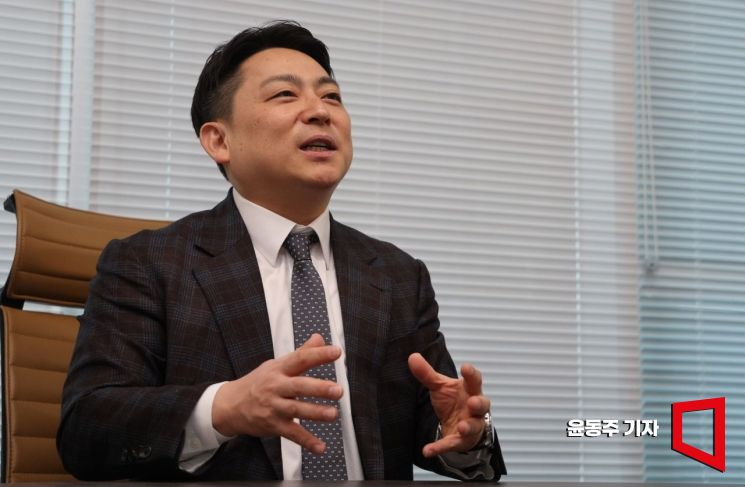 On the 2nd, Attorney Hyun Minseok is being interviewed by The Asia Business Daily at the YK Law Firm Gangnam main office in Gangnam-gu, Seoul. Photo by Yoon Dongju
-How do you feel about winning the first margin franchise fee case?
▲Personally, I believe this ruling is the most important since the Franchise Business Act came into effect in 2002. The case centered on whether the supply of goods constitutes an essential part of a franchise agreement, and this ruling has made it possible for the very revenue structure of franchisors to change. It also left a highly valuable precedent in terms of civil law theory, because it addressed what constitutes the "principal performance" under a civil contract. As a lawyer, I know very well how difficult it is to secure a ruling that can determine the direction of an entire industry, so from a professional standpoint, I am deeply honored.
-Did you expect to ultimately prevail at the Supreme Court?
▲The Supreme Court proceedings went on for more than a year, and that period felt extremely long to me. Associations made up of franchise CEOs kept appealing to the public, saying their businesses would go under, and they waged a public opinion campaign. I was worried that the Supreme Court might change its judgment in consideration of that. It was a continuous process of asking myself whether the legal theory I had conceived and advanced was correct. Nonetheless, I was confident from a legal standpoint. Former Supreme Court Justice Kwon Soonil, our managing partner, also told me after the appellate judgment, "It will be difficult for the Supreme Court to write a judgment that reverses this."
-We heard you had a hard time with the document production issue.
▲To calculate the amount of unjust enrichment, we needed data on the prices at which headquarters purchased raw and subsidiary materials from vendors and the prices at which it supplied them to franchisees, so we filed a motion for document production regarding statements of transactions and other records. Pizza Hut initially argued that the requirements for a document production order were not met, so it had no duty to submit the documents, or that it could not submit them because they were trade secrets. After the court issued a document production order, Pizza Hut then said the relevant data did not exist. Later, when it claimed that the volume of data was too large to submit, I said I would go and check it myself. When I actually went there, the volume was such that it could easily have been submitted. The Supreme Court stated that "the defendant's contradictory responses to the document production order must be actively taken into account in this case, where the relevant evidence is concentrated in the defendant's possession," and it actively accepted the plaintiffs' arguments regarding the calculation of unjust enrichment.
-What was the core of the court's reasoning in the Pizza Hut case?
▲The court held, first, that for a franchisor to receive margin franchise fees, there must be a "specific meeting of the minds," that is, a "specific agreement" with the franchisee, and second, that even if such agreement need not be explicit, at a minimum the criteria for calculating the fees must be established in advance. As the basis for this reasoning, the Supreme Court invoked its precedents on general contract law, which state that "with respect to essential or important terms of a contract, there must be a specific meeting of the minds, or at least an agreement on criteria and methods that can be concretely determined in the future." In other words, the payment of margin franchise fees, which are a type of franchise fee, is an essential and important part of the franchise agreement, and therefore an agreement is indispensable. That is also the legislative choice made by the lawmakers who enacted the Franchise Business Act. Meanwhile, Article 2(1) of the Franchise Business Act, which defines a franchise business, provides that the franchisor allows the franchisee to sell products using its brand and transfers business know-how, and in return the franchisee pays franchise fees as the "principal performance" under the franchise agreement. The supply of goods such as ingredients or equipment is not the principal performance of a franchise agreement.
-What is your outlook for the roughly 20 other cases you are currently handling?
▲Because the legal principle that "a specific agreement is required to receive margin franchise fees" will apply as is, the main issue in court will be fact-finding over whether such an agreement exists. Although each franchise brand has a different revenue structure and specific contractual terms, in broad terms the fact that margin franchise fees received by headquarters without agreement constitute unjust enrichment cannot change. For example, even if, unlike Pizza Hut, a franchisor does not charge separate royalties and instead relies on margin franchise fees as its main source of revenue, that fact alone cannot overturn the legal principle that "a specific agreement is required to receive margin franchise fees." Also, unlike in the Pizza Hut case, for other companies most of the margin franchise fees that headquarters received over the five years prior to the filing of the lawsuit have already been made public, so I believe franchisees will be able to recover exact amounts without having to estimate unjust enrichment.
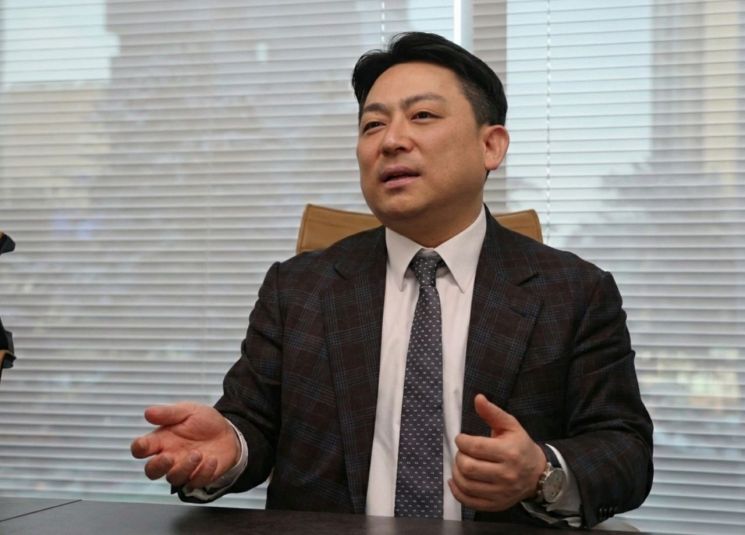 On the 2nd, Attorney Hyun Minseok is being interviewed by The Asia Business Daily at the YK Law Firm Gangnam main office in Gangnam-gu, Seoul. Photo by Yoon Dongju
-Despite winning the case, is there anything you find regrettable?
▲Because Pizza Hut filed for rehabilitation, it has become difficult for the franchisees to recover the full amounts recognized by the court, even though they won the lawsuit. Headquarters claimed it was because some franchisees who had prevailed in the appellate court had seized its bank accounts, but it could have prevented provisional enforcement of the appellate judgment by depositing cash with the court. Filing for rehabilitation without making proper efforts to repay its debts is fully deserving of criticism in terms of the controlling shareholder's moral hazard and the company's social responsibility.
-Right after the Supreme Court ruling, the Korea Franchise Association said it was "a decision that shakes up existing practices" and that "this ruling has pushed the industry to the brink of collapse."
▲This ruling does not say that franchisors must not receive margin franchise fees; it says they must provide sufficient information about margin franchise fees to the franchisees and receive them only after reaching an agreement. If, merely because a franchise agreement has been signed, the franchisor can arbitrarily designate mandatory items, require that they be purchased only through headquarters, and then go further and arbitrarily set the prices (margins) so that they are higher than normal wholesale prices, that is what is truly unjust. Unjust practices that exceed the limits of the principle of freedom of contract cannot be justified on the grounds that they are customary.
Through this ruling, the judiciary has finally confirmed the legislative decision embedded in the Franchise Business Act that "there is no such thing as an automatic margin." It can be seen as a stern command from the judiciary that franchisors and franchisees must meet again on the basis of "transparent contracts."
I believe this case has provided an opportunity to improve the backward practice in which franchisors covertly collect margin franchise fees without the franchisees' knowledge. More fundamentally, I hope it will serve as a turning point for moving away from a mutually adversarial structure in which franchisors bind franchisees within the framework of franchise agreements and extract economic benefits from them, and toward a win-win partnership in which the sales profits generated by franchisees are shared between franchisors and franchisees.
-Many franchisees worry that they will suffer disadvantages if they sue headquarters.
▲The Franchise Business Act allows franchisees to demand renewal of their franchise agreements for ten years from the time the initial agreement is signed. Because of this, there are many cases in which headquarters pressures franchisees whose contract period has exceeded ten years by saying, "If you join the lawsuit, we will not renew your contract." There are also an increasing number of cases in which headquarters conducts stricter sanitary inspections on franchisees that participate in lawsuits and then uses the results as a pretext to terminate or refuse to renew their contracts. Appropriate guidance and intervention by the Korea Fair Trade Commission are needed. The Franchise Business Act prohibits a franchisor from disadvantaging franchisees, or from making the conclusion of a franchise agreement conditional on not joining a franchisee organization such as a franchisee council, on the grounds of the formation, membership, or activities of such franchisee organizations. If this is violated, the Fair Trade Commission may order corrective measures or impose a surcharge of up to 2% of the related sales.
He is...
Jeju Jeil High School
Department of Law, Seoul National University
Passed the 49th National Bar Examination
Completed the 39th class of the Judicial Research and Training Institute
Lee & Ko
Master of Laws (LL.M.), Gould School of Law, University of Southern California (USC), United States
Passed the New York State Bar Examination, United States
YK Law Firm
© The Asia Business Daily(www.asiae.co.kr). All rights reserved.