Trade Minister Yeo Han-koo in Washington, launches all-out outreach
"U.S. holding interagency consultations on Federal Register publication"
"Maintaining position that Coupang is separate from digital trade issues"
"Also discussing convening the Korea-U.S. FTA Joint Committee"
While the United States is still leaving open the possibility of re-raising tariffs on Korean products and is reviewing whether to publish the measure in the Federal Register, Trade Minister for Negotiations Yeo Han-koo has stepped up the level of response by launching an all-out outreach campaign targeting U.S. government officials, members of Congress, and industry figures. There is an assessment that much of Washington’s misunderstanding surrounding the delay in Korean legislation has been cleared up, but tensions are rising as uncertainty persists over when and in what form any actual measures will be finalized.
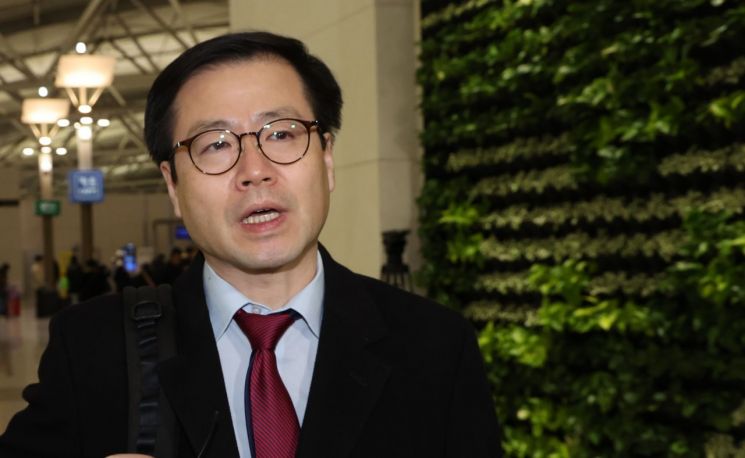
On February 3 (local time), after wrapping up his schedule of consultations with the U.S. administration, Minister Yeo met with Korean reporters at Union Station in Washington, D.C., before departing for New York, and said, “My understanding is that within the U.S. administration, the relevant departments are holding consultations on whether to formalize President Donald Trump’s announcement of tariff hikes on Korea by publishing it in the Federal Register.”
Earlier, on January 26, President Trump used social media (SNS) to raise an issue with the legislative progress in the Korean National Assembly on the Special Act on Investment in the United States and announced that he would raise tariffs on Korean automobiles, lumber, pharmaceuticals, and other items subject to reciprocal (country-specific) tariffs from the current 15% to 25%. Publication in the Federal Register is the procedure that fleshes out President Trump’s announcement and formalizes it administratively. It is a fact that the U.S. administration is preparing for this, but it appears that the timing of the tariff increase and other details have not yet been finally decided.
During this visit to the United States, Minister Yeo met with officials from the executive branch, including the Office of the United States Trade Representative (USTR), to directly grasp the background behind Washington’s tariff hike announcement, while focusing on explaining that existing agreements between Korea and the United States are being implemented without a hitch. In particular, he stressed the ripple effects that the measures would have on the two countries’ industries and economies, and conveyed the need to come up with a mutually acceptable solution. However, although he had a phone call with USTR Representative Jamieson Greer following President Trump’s SNS post and had been scheduled to meet him the previous day, the schedule was reportedly disrupted by the U.S. announcement of tariff cuts for India.
Minister Yeo also engaged in wide-ranging outreach to the U.S. Congress. He is said to have held closed-door meetings with about 20 senators and representatives involved in trade issues. “I focused on fully explaining that Korea is willing to fulfill its commitments in terms of investment and non-tariff measures toward the United States as stipulated in the bilateral agreement, and that there has been progress on that front,” he said. “There were aspects of our system that the U.S. side did not understand because it is different from theirs, and it seems we will need to continue our outreach going forward,” he added.
Regarding the view that, in the area of non-tariff digital trade, the U.S. side may be using the so-called “Coupang affair” as an issue, Minister Yeo said, “Digital issues are indeed considered important by the U.S. administration and Congress, but we have maintained the position that Coupang should be separated from digital trade issues,” stressing that “for Coupang, the core of the problem is the leakage of information.” He went on to say that President Trump’s threat to raise tariffs “appears, as stated in his SNS post, to have hinged primarily on the fact that legislation in the investment area has been somewhat delayed.”
As for some speculation that foreign media reports after an interview with Deputy Prime Minister and Minister of Economy and Finance Koo Yoon-cheol, suggesting that “Korea may slow its investment in the United States,” might have had an impact, he said, “That is something we can only speculate about, and it is difficult to know exactly what process within the U.S. government led to the SNS post.” When asked whether the schedule for the Korea-U.S. Free Trade Agreement (FTA) Joint Committee meeting, which was supposed to be held last December but was postponed, would be reset, he replied, “We discussed that as well,” adding, “We plan to continue discussions on setting a date.”
Meanwhile, within and outside the Korean government, there is speculation that the U.S. side may present additional conditions, separate from the formal legislative process. In particular, some suggest that the issue of building nuclear power plants in the United States could be raised as a bargaining chip by Washington. In fact, during his earlier visit to the United States, Minister of Trade, Industry and Energy Kim Jung-kwan is known to have met with Secretary of Energy Chris Wright to discuss cooperation in areas such as energy and resources. While Minister Kim said, “It is not something I can speak about in detail,” he also stated that “there were various discussions on cooperation related to nuclear power between Korea and the United States.”
Separately, Foreign Minister Cho Hyun, who is also visiting the United States, met with U.S. Secretary of State Marco Rubio to explain Korea’s domestic efforts to implement the Korea-U.S. tariff agreement and investment commitments toward the United States, and proposed that the two sides continue to cooperate at the diplomatic level so that trade authorities can maintain smooth communication and consultations, according to the Ministry of Foreign Affairs. The State Department’s readout did not include specific details of the two ministers’ discussions on this issue. This is being interpreted as an effort to ensure that the tariff issue does not affect agreed matters such as expanding Korea’s rights to enrich and reprocess nuclear material or the introduction of nuclear-powered submarines.
© The Asia Business Daily(www.asiae.co.kr). All rights reserved.
![Clutching a Stolen Dior Bag, Saying "I Hate Being Poor but Real"... The Grotesque Con of a "Human Knockoff" [Slate]](https://cwcontent.asiae.co.kr/asiaresize/183/2026021902243444107_1771435474.jpg)















