Rising Tensions in the Middle East Ahead of High-Level Talks
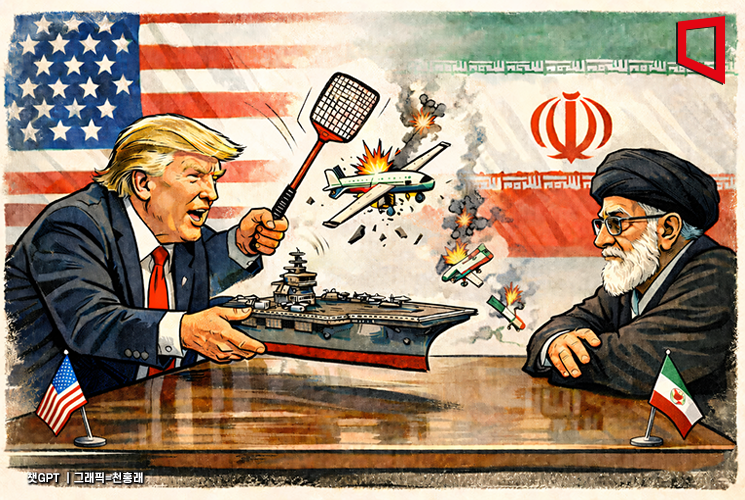
As the United States and Iran prepare for a high-level meeting, tensions in the Middle East are rising again after U.S. forces shot down an Iranian drone and Iranian forces threatened a U.S. oil tanker. However, the U.S.-Iran high-level talks scheduled for the 6th (local time) are expected to go ahead as planned.
On the 3rd, U.S. Central Command announced that it had shot down an Iranian drone that approached the aircraft carrier USS Abraham Lincoln in an aggressive manner in the Arabian Sea.
According to the statement, at the time the USS Abraham Lincoln was sailing in waters about 500 miles (800 kilometers) off the southern coast of Iran.
The drone, shot down by a U.S. F-35 fighter jet, was an Iranian Shahed-139 drone. The U.S. military explained that it had been flying toward the aircraft carrier with its "intentions unclear." There were no casualties among U.S. service members and no damage to U.S. equipment.
U.S. Central Command said that after the drone was shot down, forces of the Islamic Revolutionary Guard Corps (IRGC) carried out an incident in which they threatened a U.S.-flagged vessel in the Strait of Hormuz. It reported that two IRGC vessels and one Iranian Mohajer drone rapidly approached the oil tanker Stena Imperative and threatened to board and seize it. In response, a U.S. destroyer was dispatched to escort the tanker.
Tensions between the United States and Iran have been rising again since the outbreak of anti-government protests in Iran in December last year. At the beginning of last month, the Trump administration deployed military assets to the Middle East in response to the Iranian protests and has been demanding that Iran resume nuclear negotiations. The United States has left the door open to a diplomatic agreement, but it has also taken a hard-line stance that it will not rule out the use of force if necessary.
At the White House the previous day, President Trump, when asked about the possibility of military action, said, "I cannot say what we will do," adding, "We will see what happens."
The previous day, reports emerged that Iran had agreed to enter into talks and that U.S. Presidential Envoy Steve Witkoff and Iranian Deputy Foreign Minister Abbas Araghchi were scheduled to meet in T?rkiye on the 6th. If this meeting takes place, it will be the first high-level talks since the United States carried out the "Midnight Hammer" operation, a surprise strike on Iranian nuclear facilities, in June last year.
That day, White House spokesperson Karoline Leavitt, when asked by reporters about the impact of the drone shootdown and heightened tensions on the talks, said, "The talks with Iran will proceed as scheduled." She added, "President Trump always prioritizes diplomacy, but diplomacy requires cooperation from both sides. For diplomacy to succeed, you need a partner who is willing, and Envoy Witkoff is seeking and discussing that point in the high-level talks with Iran."
She went on to say, "Of course, as commander-in-chief, the president has various options on the table with regard to Iran," adding, "I believe Iran clearly understood that through the airstrikes carried out in the Midnight Hammer operation."
Meanwhile, when asked how President Trump reacted to Russia resuming attacks on Ukrainian energy facilities, which it had temporarily halted at his request to refrain from wintertime attacks on Ukraine, spokesperson Leavitt replied that he was "not surprised."
© The Asia Business Daily(www.asiae.co.kr). All rights reserved.


















