Minutes of the January 15 MPB Meeting Released
"Need for a Cut Remains" Voices, but
The Monetary Policy Board of the Bank of Korea unanimously decided last month to keep the base rate unchanged at 2.50% per annum, mainly due to the elevated won-dollar exchange rate and persistent instability in housing prices. While some members expressed the view that "the need for a rate cut remains," the majority took a cautious stance that monetary policy should lean toward maintaining the freeze rather than adjusting policy in a particular direction.
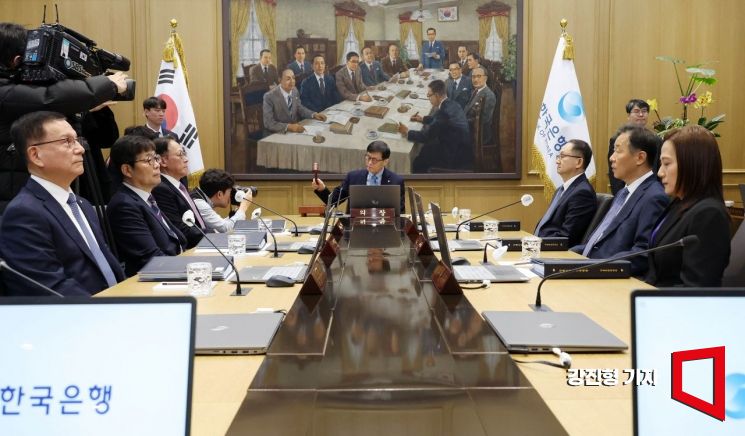 Lee Changyong, Governor of the Bank of Korea, is striking the gavel at the Monetary Policy Board plenary session held at the Bank of Korea headquarters in Jung-gu, Seoul on the morning of January 15, 2026. Photo by Kang Jinhyung
According to the minutes of the first Monetary Policy Board meeting of 2026 (held on January 15), released by the Bank of Korea on the 3rd, one member stated at the time, "The domestic financial market is generally stable, but in the foreign exchange market, the weak-won trend continues despite a massive current account surplus, as multiple factors are overlapping simultaneously," adding, "Although the growth in mortgage loans has slowed, it is desirable to keep the base rate unchanged, given that apartment prices in Seoul are still rising at a high pace."
At last month's meeting, all six Monetary Policy Board members, excluding Governor Lee Changyong, voted in favor of freezing the base rate at 2.50% per annum. Board member Shin Seonghwan, who had previously opposed freezes, also supported the decision this time. The number of members who saw a possibility of a rate cut within three months fell from three to one, and the phrase "rate cut" was removed from the monetary policy decision statement, effectively eliminating signals of monetary easing.
Board members voiced unanimous concern over the rise in the won-dollar exchange rate and unstable housing prices in the Seoul metropolitan area. One member noted, "The exchange rate fell sharply due to the foreign exchange authorities' market-stabilizing measures, but since the beginning of this year it has again climbed back to a level similar to that at the time of the previous Board meeting," and added, "Even after the surge has subsided, the continued upward trend in housing prices and the high level of the exchange rate are emerging as major issues in the financial market," explaining his support for a freeze. He pointed out that if rates were lowered, the side effects on financial stability could be greater than expected.
Another member also pointed out, "Compared with the time of the previous meeting (the November base-rate freeze), changes in the economic environment or indicators that would warrant an adjustment in the monetary policy decision have not become apparent." He said, "In the foreign exchange market, the interest-rate gap at home and abroad has narrowed due to the U.S. policy rate cut and the authorities have taken various stabilization measures, yet a high exchange rate level persists due to external conditions and a mismatch in foreign exchange supply and demand," and added, "In the financial market, although the pace of increase in housing prices has somewhat moderated, risks are still unfolding, as instability continues to be observed."
On the domestic economy, members projected a recovery in the growth rate, but expressed concern that the growth trend is being driven mainly by exports in the IT sector. They judged that the sluggish recovery in domestic demand, delays in the recovery of construction investment, and lingering difficulties for industries heavily affected by tariffs and for small and medium-sized enterprises in regional areas still remain. However, some members assessed that "this year, consumption conditions are improving and the slump in construction investment is also easing somewhat, so upside factors have increased compared with before."
While views diverged on the future direction of monetary policy, the balance tilted toward caution.
One member stated, "Under the given policy conditions, the current level of the base rate is generally appropriate for achieving the goals of price stability and financial stability," and added, "Going forward, it is appropriate to place somewhat more weight on the possibility of continuing to keep the base rate unchanged when conducting monetary policy." Another member likewise noted, "For the time being, it is necessary to maintain the current level of the base rate while carefully monitoring changes in domestic and external conditions, the resulting trends in growth and inflation, and the state of financial stability, and to manage policy prudently."
Yet another member added support to the cautious stance, saying, "Although the real economy is not sufficiently strong, it is gradually entering a recovery phase," and, "With price variables already at elevated levels, repeatedly rising and falling as they search for direction while watching for policy changes, any monetary policy adjustment that could provide momentum in a particular direction requires a cautious approach."
By contrast, one member stated, "The domestic economy has not yet achieved a sufficiently broad-based recovery, so from the perspective of the real economy, the need for a rate cut remains," and continued, "Given that a negative GDP gap (the gap between potential GDP and actual GDP) is expected to persist for some time and that inflation concerns are not significant, there is still a need to maintain an accommodative monetary policy stance."
© The Asia Business Daily(www.asiae.co.kr). All rights reserved.
![Clutching a Stolen Dior Bag, Saying "I Hate Being Poor but Real"... The Grotesque Con of a "Human Knockoff" [Slate]](https://cwcontent.asiae.co.kr/asiaresize/183/2026021902243444107_1771435474.jpg)
















