Lee Junseok Draws a Line on Election Alliance
"Jang Donghyeok Likely to Repeat Hwang Kyo-ahn's Mistakes"
As the People Power Party begins in earnest to prepare for the June 3 local elections, regional disparities are deepening. In the Seoul metropolitan area, it is difficult even to recruit candidates, whereas in stronghold regions such as Daegu and North Gyeongsang Province (TK), a large number of incumbent lawmakers and senior figures are flocking to run, creating a situation of "abundance amid poverty."
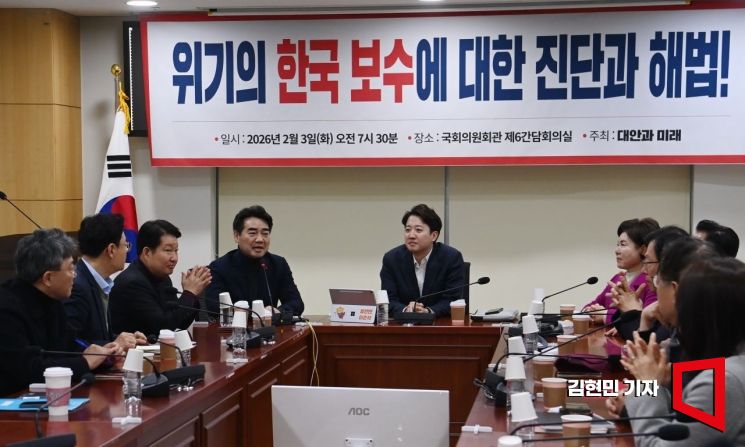 Lee Junseok, leader of the Reform New Party, is attending a discussion forum on the diagnosis and solutions for the crisis of Korean conservatism, hosted by the 'Alternatives and Future' group of young members of the People Power Party, held at the National Assembly Members' Office Building on February 3, 2026. Photo by Kim Hyunmin
According to political circles on the 3rd, five incumbent lawmakers alone - Joo Ho-young, Yoon Jae-ok, Choo Kyung-ho, Choi Eun-seok, and Yoo Young-ha - have thrown their hats into the ring as candidates for mayor of Daegu Metropolitan City. This means that nearly half of Daegu’s 12 National Assembly members have decided to run. In addition, former Korea Communications Commission Chairperson Lee Jin-sook has also announced her intention to run.
In the North Gyeongsang Province gubernatorial race, heavyweight figures including the incumbent Governor Lee Cheol-woo, Pohang Mayor Lee Kang-duk, former Deputy Prime Minister for Economy Choi Kyung-hwan, and Supreme Council member Kim Jae-won have joined the competition. Because TK is traditionally a stronghold for the conservative camp, and the primary is effectively considered the real race, candidates are concentrating there.
The situation in the Seoul metropolitan area, however, is in stark contrast. Aside from incumbent local government heads, only a few figures outside the National Assembly have officially declared their intention to run: former lawmaker Yoon Hee-sook in Seoul, former lawmakers Won Yoo-cheol and Shim Jae-chul in Gyeonggi Province, and Son Beom-gyu, head of the Namdong-gu Gap district party chapter, in Incheon. Seoul Mayor Oh Se-hoon, who is seeking a fifth term, said the previous day, "My heart, as well as that of those running in the Seoul metropolitan area, is as black as charcoal," urging the party leadership to change its stance on the so-called "absolute Yoon" line that categorically rules out breaking with President Yoon.
Meanwhile, "Alternatives and Future," a gathering of young lawmakers within the People Power Party, held a public forum in the morning, inviting Lee Junseok, leader of the Reform New Party. Lee identified the cause of the crisis in the conservative camp as the disappearance of traditional regional and generational political alignments, and proposed as alternatives: (1) embracing youth-generation discourse at the party level and (2) reforming representation and institutions in line with changes in the support base.
However, Lee drew a clear line against the idea of an electoral alliance with the People Power Party. He said, "Chairman Jang Dong-hyuk talks about unification, but he is saying he will do it while excluding those who could become potential rivals, and that is highly likely to end in a result similar to that of former Chairman Hwang Kyo-ahn, who stepped down after losing the 21st general election," adding, "Why would I knowingly walk into political unification under such circumstances?"
© The Asia Business Daily(www.asiae.co.kr). All rights reserved.

















