"Special Act on the Itaewon Disaster" Approved at Cabinet Meeting
Explicit Ban on Secondary Victimization, Expanded Victim Support
False Information and Other Offenses Punishable Under Relevant Laws
Secondary victimization of the victims and survivors of the Itaewon disaster will be prohibited by law. This includes the dissemination of false information and acts of defamation carried out through newspapers, broadcasting, and information and communications networks.
The Ministry of the Interior and Safety announced on February 3 that a partial amendment bill to the "Special Act on the Protection of the Rights of Victims of the 10·29 Itaewon Disaster, Fact-Finding, and Prevention of Recurrence," which centers on these measures, was approved at a Cabinet meeting presided over by the President that morning.
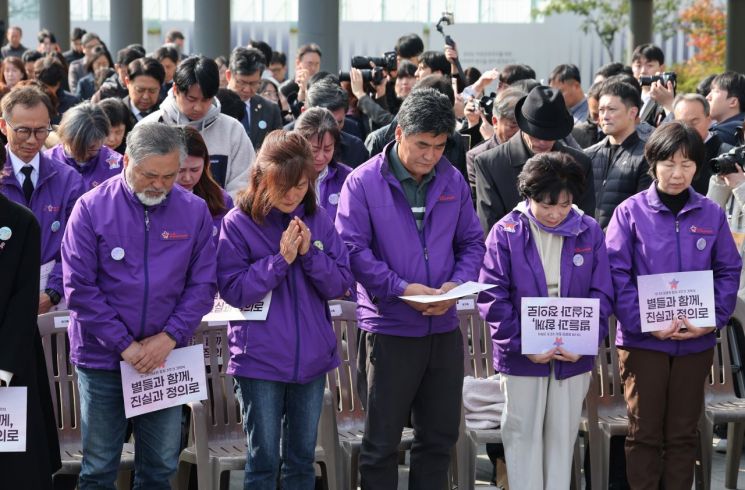 Families of the bereaved attending the third anniversary memorial for the Itaewon disaster at Gwanghwamun Square in Seoul on October 29 last year. Yonhap News
This amendment to the Special Act focuses on preventing secondary victimization of the victims of the 10·29 Itaewon disaster and strengthening the protection of their rights so that they can fully recover both physically and mentally.
First, the Special Act explicitly stipulates the prohibition of secondary victimization of the victims and survivors of the 10·29 Itaewon disaster. Accordingly, no one is allowed to disseminate false information or defame the victims and survivors through newspapers, broadcasting, or information and communications networks. Violations will be punished under the relevant laws. In addition, the state and the relevant local governments are obliged to establish and implement measures to prevent secondary victimization, including publicity and education.
The application deadlines for various types of victim support, including recognition as a victim, have also been adjusted to be more realistic. The deadline for applying for recognition as a victim, which was originally within two years from the enforcement of the Special Act (until May 20, 2026), has been extended to within six months after the end of the activities of the Special Investigation Committee (until March 15, 2027).
The deadline for applying for healing leave has been extended from within one year after the enforcement of the Special Act (until May 20, 2025) to within one year after the end of the activities of the Special Investigation Committee (until September 15, 2027), and the leave period has been expanded from the original six months to a maximum of one year.
The extinctive prescription period for claims for damages has also been set at five years from the date the victim becomes aware of the damage and the perpetrator, so that the victims' rights can be guaranteed more broadly. In addition, a legal basis has been established for the state and the relevant local governments to conduct long-term follow-up studies on the health conditions of the victims. The government plans to use the research findings to develop more effective support policies, including preventing the social isolation of victims and managing their aftereffects.
Minister of the Interior and Safety Yoon Hojoong said, "We hope that this amendment to the Special Act will provide practical help in consoling the wounds of the victims and bereaved families of the 10·29 Itaewon disaster and in restoring their daily lives," adding, "Until the enforcement of the Special Act, the government will thoroughly carry out all follow-up measures during the three-month preparation period, and we will also provide more proactive guidance so that no one misses out on support simply because they are unaware of the details."
© The Asia Business Daily(www.asiae.co.kr). All rights reserved.
![Clutching a Stolen Dior Bag, Saying "I Hate Being Poor but Real"... The Grotesque Con of a "Human Knockoff" [Slate]](https://cwcontent.asiae.co.kr/asiaresize/183/2026021902243444107_1771435474.jpg)















