Advancing in Step with the Development of Agentic and Physical AI
The Personal Information Protection Commission announced on February 2 that it has launched the 2026 Artificial Intelligence (AI) Privacy Public-Private Policy Council and held its first plenary session.
The Commission established the AI Privacy Public-Private Policy Council in October 2023 to jointly design a regulatory framework that addresses the rapidly changing personal information processing environment following the emergence of ChatGPT. The council has proposed open personal information processing standards and privacy risk management models that form the foundation of AI development.
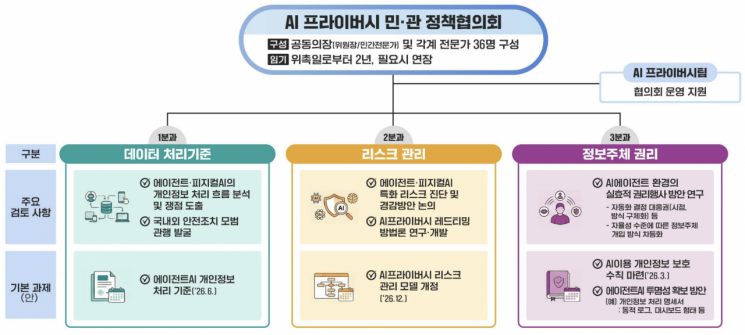 Composition of the Artificial Intelligence (AI) Privacy Public-Private Policy Council. Provided by the Personal Information Protection Commission
Recently, AI has been rapidly expanding into agentic AI and physical AI. As a result, the scope of personal information processing has also broadened from internal model input and output to encompass the entire service flow, including real-time connectivity, inference, and execution. The Commission explained that the regulatory framework for personal information must also be further advanced to keep pace with these changes.
Accordingly, during the reorganization of the public-private council, the Commission shifted the policy focus to "complex risks." This year, the council consists of 37 members from industry, academia, the legal sector, and civil society. Through this, expertise on emerging technologies such as agentic AI and physical AI has been strengthened. The government chair is the Chairperson of the Personal Information Protection Commission, while the private sector chair is Kwon Changhwan, Chief Judge at the Busan Bankruptcy Court.
The public-private council operates through three subcommittees: the Data Processing Standards Subcommittee (headed by Professor Kim Byungpil of KAIST), the Risk Management Subcommittee (headed by Professor Choi Daeseon of Soongsil University), and the Data Subject Rights Subcommittee (headed by Professor Yoon Hyesun of Hanyang University). Each subcommittee will analyze personal information processing flows and risk factors, and discuss risk mitigation measures as well as ways to guarantee the rights of data subjects.
In addition, major issues and current affairs identified through the "Public AX Innovation Support Help Desk" operated by the Commission will be discussed within the public-private council, with the results to be reflected in guidelines and manuals.
Meanwhile, at the launch event held at the Bankers Club in Jung-gu, Seoul on the same day, the results of the "Domestic AI Technology Adoption and Utilization Survey" policy research, which was promoted by the Commission last year and conducted by the Korea Information and Communication Technology Association, were introduced.
Co-chair Kwon Changhwan stated, "As we rapidly transition to an era of agentic and physical AI that goes beyond large language models (LLMs) and integrates with the real world, I hope the public-private council will address newly emerging AI privacy issues in a balanced way, protecting the rights and interests of the public while also creating a policy foundation that allows for predictable innovation in the industry."
Song Kyunghee, Chairperson of the Commission, said, "The year 2026 will be a pivotal turning point, with AI becoming deeply embedded in daily life and solving various problems. We will operate this as a practical policy platform where the public and private sectors work together to design safety measures, so that AI can become a trusted partner for the public."
© The Asia Business Daily(www.asiae.co.kr). All rights reserved.
![Clutching a Stolen Dior Bag, Saying "I Hate Being Poor but Real"... The Grotesque Con of a "Human Knockoff" [Slate]](https://cwcontent.asiae.co.kr/asiaresize/183/2026021902243444107_1771435474.jpg)















