[Interview] Ryu Kyung-gi, Mayor of Jungnang District
The Challenge: Creating a Livable City
Doubling University Admission Rates through Increased Investment in Education
"Jungnang is currently undergoing the greatest transformation of its urban space since its establishment. Now is the time for a qualitative shift."
On January 27, Ryu Kyung-gi, Mayor of Jungnang District in Seoul, summarized his eight-year district administration philosophy and vision in one word: "organized city." The "organized city" he envisions is not simply about improving the environment, but rather a paradigm shift that upgrades the entire city through large-scale housing development, the construction of metropolitan transportation networks, and innovation in educational infrastructure.
Mayor Ryu emphasized that Jungnang District has now entered a new phase. "The challenge before us is how to elevate this city to a higher level. If this plan is realized, the skyline and urban landscape of Jungnang will be completely transformed in ten years."
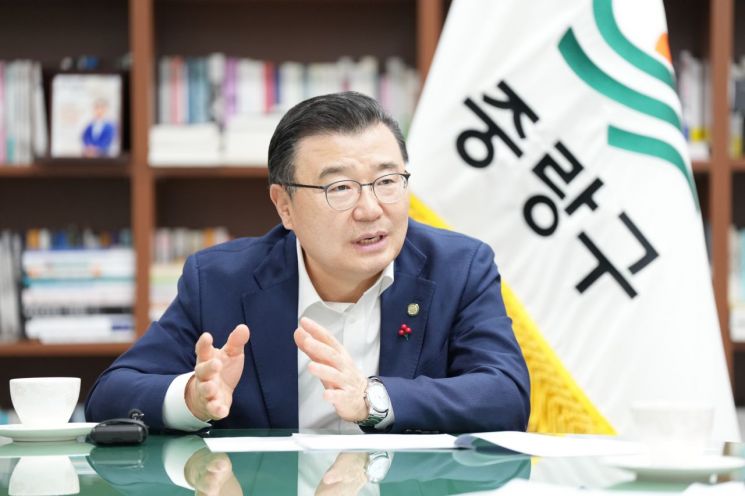 Ryu Kyung-gi, Mayor of Jungnang District, summarized his district administration philosophy and vision in one word: "organized city," in an interview with The Asia Business Daily. Provided by Jungnang District.
Urban Restructuring through Seoul’s Largest Redevelopment
The core of the organized city is the fundamental restructuring of the urban framework. Currently, Jungnang District has designated a total of 27 sites, including 14 Moa Towns, as housing development candidates. Both in terms of number and area, this is the highest among all Seoul districts. Upon completion, approximately 40,000 new housing units will be supplied.
Mayor Ryu explained that this is not simply redevelopment, but a complete reconstruction of the city’s infrastructure. "About 60% of Jungnang District’s total area is residential, and more than 80% of these homes are aged, having been built over 20 years ago. The houses that were hastily built in the past not only lowered the quality of living, but also led to a lack of basic infrastructure such as roads, parking lots, and parks."
In 2023, Mayor Ryu established the Housing Development Task Force, assigning dedicated personnel, and formed a Housing Development Support Group of about 200 people. He brought together 200 experts in fields such as design, construction, tax, and law to provide tailored support for each district. For the past four years, a nine-month "Housing Development Academy" program has also been operated.
Alongside housing development, transportation infrastructure is another pillar of the organized city. The area around Sangbong Station is expected to undergo the most significant changes in Jungnang District. The KTX Jungang Line will stop there, and the GTX-B metropolitan express railway line is scheduled to open in 2030. The Sangbong Station Integrated Transfer Center will begin operations in 2031. The Myeonmok Line urban railway is set to begin construction in 2029.
"When these projects are completed, the area around Sangbong Station will become a comprehensive transfer hub centered on the GTX-B line, connecting Line 7, the Gyeongui-Jungang Line, the Gyeongchun Line, KTX, and bus transfers all in one place. It will take less than 10 minutes to reach Seoul Station from Sangbong, and about 37 minutes to reach Songdo in Incheon. This area will develop beyond a transportation hub into a complex city center that combines residential, business, and cultural functions."
Designing the City’s Future through Education
The completion of the organized city is achieved through education. The numbers prove it. Eight years ago, the rate of Jungnang District students entering four-year universities in the Seoul metropolitan area was 24%. Last year, it nearly doubled to 44%.
How was such a change possible? During Mayor Ryu’s two terms, the budget for school support increased more than fourfold, from 3.8 billion won to 16 billion won. Over 40 new educational infrastructure projects were established, including two Bang Jeong-hwan Education Support Centers and two media centers. The number of new spaces and urban infrastructure reached 182.
"Jungnang District is the only district to independently operate facilities such as the Bang Jeong-hwan Education Support Center. We are also the only district to directly manage a media center. We are even building an astronomical science center in Yongma Falls Park."
The "Reading 1,000 Books Before School" program has also been running for eight years. "Children aged five to seven read one book a day with their parents. Developing the habit of reading a lot leads to literacy, which becomes the foundation of future competitiveness. In the age of artificial intelligence (AI), the ability for people to master technology is even more important, and the foundation of that is reading books."
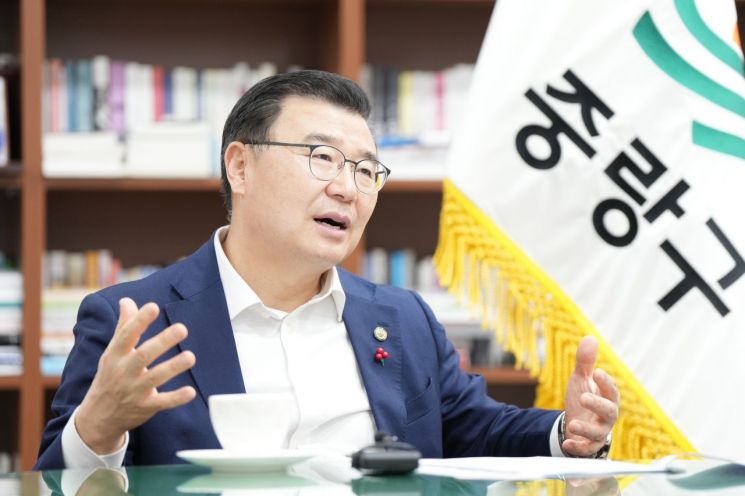 Ryu Kyung-gi, Mayor of Jungnang District, explaining the changes in Jungnang District. Provided by Jungnang District.
Mangwoo Historical and Cultural Park Transformed into a Cultural Space
The organized city also includes improvements to the physical environment. Projects such as undergrounding 2 kilometers of overhead cables along Mangwoo-ro, upgrading signage, and installing 45 pieces of public art have been carried out. Jungnang District was selected by Seoul City as the best city for undergrounding overhead cables for two consecutive years, receiving 5.2 billion won in support.
"An organized city is a clean, simple, and beautiful city. We spend much more time in public spaces than in our private homes. The state of the streets determines the quality of life."
A representative example of reinterpreting urban assets is Mangwoo Historical and Cultural Park. After converting a cemetery into a park, annual visitors increased from 40,000 to 730,000, an eighteenfold rise.
"When it was a cemetery, only bereaved families visited during holidays. Now, it is completely different. By informing people that historical figures such as Han Yong-un, Yu Gwan-sun, Bang Jeong-hwan, Park In-hwan, Lee Jung-seop, and Oh Se-chang are buried here, the space has been completely reborn." The name was changed to "Mangwoo Historical and Cultural Park," and the cemetery was renovated while continuously expanding the park’s infrastructure.
As a result of these efforts, Jungnang District ranked second in Seoul for improvement in quality of life. Mayor Ryu said this is clear evidence that the city is being upgraded. "Building an organized city means building a livable city. That is our goal."
© The Asia Business Daily(www.asiae.co.kr). All rights reserved.