Marriage Intentions Rise for Second Year in National Population Survey
60.8% of Men and 47.6% of Women Express Plans to Marry
A recent survey found that 6 out of 10 unmarried men and about half of unmarried women have a positive view of marriage. The proportion of respondents expressing an intention to marry has increased for both men and women for the second consecutive year.
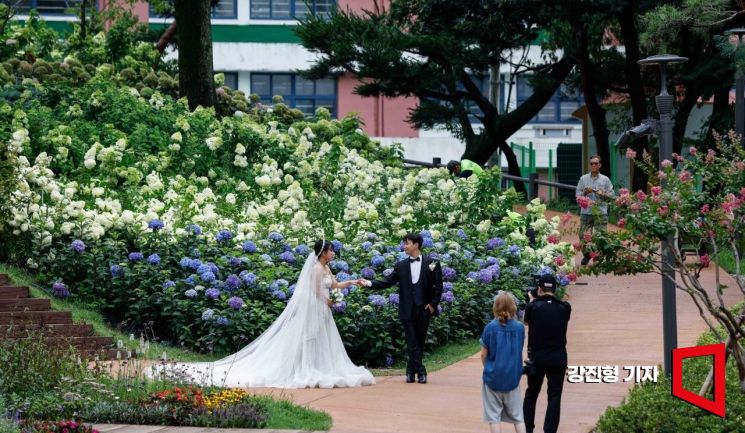 A couple preparing for marriage is taking photos during a wedding shoot event at Choansan Hydrangea Hill in Nowon-gu, Seoul.
The Korea Population, Health and Welfare Association released the results of the "3rd National Population Behavior Survey" on February 1, which was conducted in September of last year among 2,050 men and women aged 20 to 44 nationwide.
According to the survey, 60.8% of unmarried men said they intend to get married, up 2.3 percentage points from the previous year. Among unmarried women, 47.6% responded positively to the same question, an increase of 3.0 percentage points from a year earlier. The association analyzed that attitudes toward marriage are gradually recovering among both unmarried men and women.
On the other hand, respondents who were reluctant to marry or were postponing their decision cited practical burdens as the reason. For men, the biggest factor was the financial burden of marriage, while among women, the most common response was the difficulty of finding a partner who meets their expectations.
Increase in Intention to Have Children Across All Groups
There was also a slight but positive change in perceptions about having children. The proportion of those expressing an intention to have children increased in all four groups-unmarried men, unmarried women, married men, and married women-compared to the previous year. The highest rate was among unmarried men at 62.0%, followed by unmarried women at 42.6%. For married men, the figure was 32.9%, and for married women, it was 24.3%.
The expected number of children varied by marital status and gender. On average, married men expected to have 1.69 children, the highest among the groups, followed by married women at 1.67, and unmarried men at 1.54. Unmarried women had the lowest expected number of children at 0.91.
Across most groups, the main reason for hesitancy or unwillingness to have children was the economic burden. However, among unmarried women, the most common reason was the belief that "children may not have a happy future," which differed from other groups.
This survey also newly included questions about perceptions of marriage, children, and life values. When asked about the meaning of marriage, 86.1% of respondents said that "marriage is necessary to form a strong family community." In response to the statement "A society becomes more prosperous as the number of married people increases," 76.2% agreed.
However, there was also a perception of burden regarding the institution of marriage. 76.1% of respondents said that "commitment to each other is more important than legal marriage," and more than half agreed that "marriage brings more burdens than benefits."
Perceptions of children were also found to be mixed. While a high proportion agreed with concerns about the cost of raising children and uncertainties about the future of the next generation, most respondents also reacted positively to the mental growth and joy that comes from raising children.
The most important condition for becoming a parent was "a stable relationship." This was followed by the presence of a spouse to share responsibilities, an environment where work and childcare can be balanced, and sufficient financial resources as key factors.
As for factors contributing to a sense of fulfillment in life, "work or a job that can be done with joy" received the highest response rate. This was followed by authentic romantic relationships and financial stability, while having children and getting married ranked relatively lower.
© The Asia Business Daily(www.asiae.co.kr). All rights reserved.












![The Special Connection Between the Statue of Martyr Lee Jun in Jangchungdan Park and Mayor Oh Sehoon ③ [Current Affairs Show]](https://cwcontent.asiae.co.kr/asiaresize/319/2026012110001599450_1768957215.jpg)
