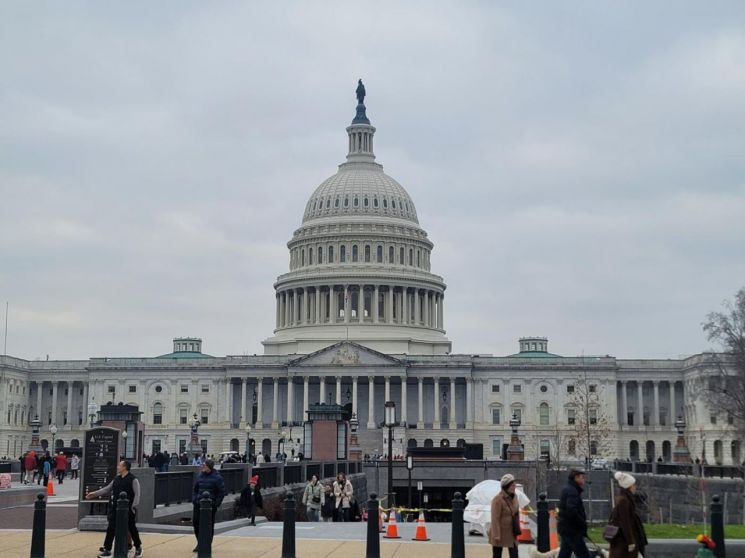
On January 30 (local time), the U.S. Senate passed the federal government budget bill, which was prepared through bipartisan agreement, just before the deadline.
The budget bill, which had faced the possibility of collapse due to political conflict over immigration enforcement, narrowly passed the Senate before midnight, thereby averting a full-scale government shutdown (temporary suspension of government operations) for now.
However, since the budget bill that passed the Senate still requires additional approval from the House of Representatives, a temporary budget gap for several days is inevitable until the House processes the bill on February 2.
On this day, the Senate voted on a budget package that includes five appropriations bills to fund key federal agencies such as the State Department and the Department of Health and Human Services through September 30, as well as a measure to temporarily extend funding for the Department of Homeland Security (DHS) for two weeks. The package passed with 71 votes in favor and 29 against.
The total scale of the budget bill passed this time is 1.2 trillion dollars (about 1,741 trillion won), which is the bipartisan budget bill previously agreed upon by the White House and the Democratic Party.
The Democratic Party has demanded that the DHS budget be separated from the main budget bill and processed independently, insisting that they would not pass the DHS budget until the Trump administration agreed to reforms that would regulate the Immigration and Customs Enforcement (ICE)'s hardline immigration enforcement.
Accordingly, President Trump and the Democratic Party agreed the previous day to first process the five appropriations bills excluding the DHS, and to separately pass a temporary funding extension for the DHS at current levels for two weeks.
The House of Representatives, currently in recess, is expected to convene a plenary session early next week to address the budget bill.
Mike Johnson, Speaker of the House and a member of the Republican Party, is reportedly seriously considering processing the bill through a fast-track procedure on February 2. According to Politico, this procedure requires approval from at least two-thirds of all members.
Bipartisan negotiations on the DHS's annual budget are expected to continue in the future.
This month, public sentiment has sharply deteriorated following an incident in Minneapolis, Minnesota, where two citizens were killed in a shooting involving federal agents. The conflict between the Republican and Democratic parties over the DHS budget has intensified as a result.
The Democratic Party has announced a reform bill requiring ICE agents to remove their masks and wear body cameras during enforcement operations, and to halt random checks and warrantless searches and arrests, urging the White House and the Republican Party to accept these measures.
Although there is a possibility of a budget gap at some federal agencies over the weekend until the budget bill is finally processed by the House, U.S. media outlets predict that the actual impact will be limited.
© The Asia Business Daily(www.asiae.co.kr). All rights reserved.













![The Special Connection Between the Statue of Martyr Lee Jun in Jangchungdan Park and Mayor Oh Sehoon ③ [Current Affairs Show]](https://cwcontent.asiae.co.kr/asiaresize/319/2026012110001599450_1768957215.jpg)
