① Controversy over Overstepping the Authority of Other Standing Committees
② The Committee as a Graveyard for Bills
③ A Channel for Protecting Lawyers' Professional Interests
It is nothing new that news related to the Legislation and Judiciary Committee occupies a significant portion of National Assembly coverage. This is not only due to the importance of the committee's jurisdiction over the courts, the prosecution, and the Ministry of Justice, but also because it plays the so-called role of the "upper house" of the National Assembly by delaying legislation or changing the content of bills through its authority to review legislative structure and wording.
For this reason, every aspect-from which party will control the committee, to who will serve as its chair, to which agenda items will be reviewed-becomes newsworthy. In political circles, there have been consistent calls for reform, arguing that the Legislation and Judiciary Committee has been granted excessive authority.
The report titled "At the Crossroads of Abolishing or Maintaining the Legislative Structure and Wording Review Authority of the National Assembly Legislation and Judiciary Committee," published by the National Assembly Research Service on January 26, 2026, compiles the issues that have been raised regarding the committee.
According to the report, the Legislation and Judiciary Committee was established in the 2nd National Assembly in 1951. From its inception, it was granted the authority to review legislative structure and wording, but its role was limited at the time. The National Assembly then operated under a "plenary session-centered" system, so the committee served as an auxiliary body to shorten the time spent in plenary deliberations. However, since the 6th National Assembly adopted a "standing committee-centered" system, its status has changed.
The Legislation and Judiciary Committee gained the authority to decide whether or not to pass bills reviewed by other standing committees. As its authority grew, it was increasingly used as a tool to block legislation, leading to discussions about reforming the committee. Proposals ranged from abolishing the committee altogether to creating a separate standing committee dedicated solely to legislative structure and wording review.
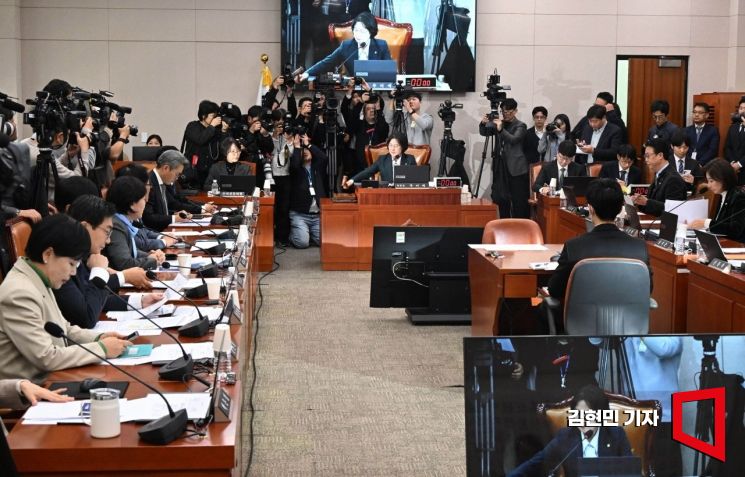 Choo Mi-ae, Chair of the National Assembly's Legislation and Judiciary Committee, is striking the gavel at the plenary meeting of the Legislation and Judiciary Committee held at the National Assembly on January 7, 2026. Photo by Kim Hyunmin
What are the problems with the Legislation and Judiciary Committee?
1) Controversy over Abuse of Authority
The committee has often been criticized for "overstepping its authority," as in the case of the "Information and Communications Network Act," which passed the plenary session on December 24 of last year. The relevant standing committee, the Science, ICT, Broadcasting, and Communications Committee, had approved an amendment to strengthen punitive damages and other sanctions for the distribution of false or manipulated information. However, during the Legislation and Judiciary Committee's review of legislative structure and wording, the sanctions were further strengthened to prohibit the distribution of such information. As controversy grew, the original version passed by the standing committee was resubmitted as a revised bill at the plenary session, and the version amended by the Legislation and Judiciary Committee was discarded. In other words, the committee had changed the standing committee's bill, but ultimately, the original version was reintroduced and passed by the plenary session.
The National Assembly Research Service also noted that, during the 20th National Assembly, the Legislation and Judiciary Committee amended a mandatory provision-intended to ensure gender diversity on corporate boards in the "Capital Markets and Financial Investment Services Act"-to a non-binding recommendation, which sparked controversy. The committee had lowered the legal requirement from "must be implemented" to a mere recommendation, thereby overturning the legislative intent of the relevant standing committee. After much public debate, the original version from the standing committee was again reintroduced as a revised bill and passed in the plenary session, replacing the version amended by the Legislation and Judiciary Committee.
2) Legislative Delays
The committee's review of legislative structure and wording is a process to ensure that new laws are consistent with the Constitution and the existing legal system. While such review is necessary given the importance of legislation, it has sometimes been abused for political purposes or to serve the interests of specific individuals.
In the past, when the second-largest party held the committee chair, the opposition would use the committee to block legislation from the majority party. In this way, the committee was used as a political tool by minority parties to impede legislation. As more bills were stalled in the committee, the National Assembly eventually established a procedure allowing bills to bypass the committee and go directly to the plenary session with the approval of the relevant standing committee. To date, 23 bills have bypassed the committee's review of legislative structure and wording and proceeded to the plenary session through standing committee approval.
According to the National Assembly Research Service's analysis of these 23 cases, bills sent to the committee by the relevant standing committee remained unreviewed for an average of 216 days. In some cases, bills were held up in the committee for as long as 720 days. Furthermore, 59 bills were left pending in the committee and ultimately discarded due to the expiration of the legislative term. These bills remained in limbo for an average of 505 days. This is why the committee is often criticized as a graveyard for bills.
3) Conflicts of Professional Interest
Among the various standing committees in the National Assembly, the Legislation and Judiciary Committee has the highest concentration of members with legal backgrounds. Judges, prosecutors, and lawyers make up the majority of the committee members. In fact, 12 out of 18 members of the committee in the first half of the 22nd National Assembly were from legal professions. Considering that one out of every five lawmakers is a legal professional, it is clear that legal professionals are overrepresented on the committee. While this composition may reflect the expertise required for the committee's work, it also raises concerns about the excessive representation of legal professionals' interests.
In fact, the committee has acted as a barrier in cases where bills conflicted with the interests of other professional groups, such as patent attorneys or tax accountants, versus lawyers.
For example, during the 21st National Assembly, an amendment to the Patent Attorney Act-which would have allowed patent attorneys to jointly represent clients with lawyers in intellectual property litigation-was blocked by the committee and ultimately discarded at the end of the legislative term. While the science and technology sector, industry, and the Korean Intellectual Property Office supported the bill for reasons such as reducing litigation costs and increasing efficiency, it could not overcome the opposition from committee members holding law licenses.
Similarly, an amendment to the Certified Tax Accountant Act, which would have removed the provision granting tax accountant qualifications to those who obtain a law license, was repeatedly blocked by the committee since the 16th National Assembly and was only passed in the 20th National Assembly. The bill was passed not by the committee's approval, but by bypassing the committee through the relevant standing committee's decision.
© The Asia Business Daily(www.asiae.co.kr). All rights reserved.














![The Special Connection Between the Statue of Martyr Lee Jun in Jangchungdan Park and Mayor Oh Sehoon ③ [Current Affairs Show]](https://cwcontent.asiae.co.kr/asiaresize/319/2026012110001599450_1768957215.jpg)
