WTI and Brent Crude Both Rise
Gold, a Safe-Haven Asset, Also Climbs
International oil prices and gold prices surged on expectations that a U.S. airstrike on Iran was imminent.
On January 29 (local time), West Texas Intermediate (WTI) crude oil on the New York Mercantile Exchange (NYMEX) closed at $65.42 per barrel, up $2.21 (3.49%) from the previous trading day. WTI rose for the second consecutive day, marking the highest level since late September of last year for two days in a row.
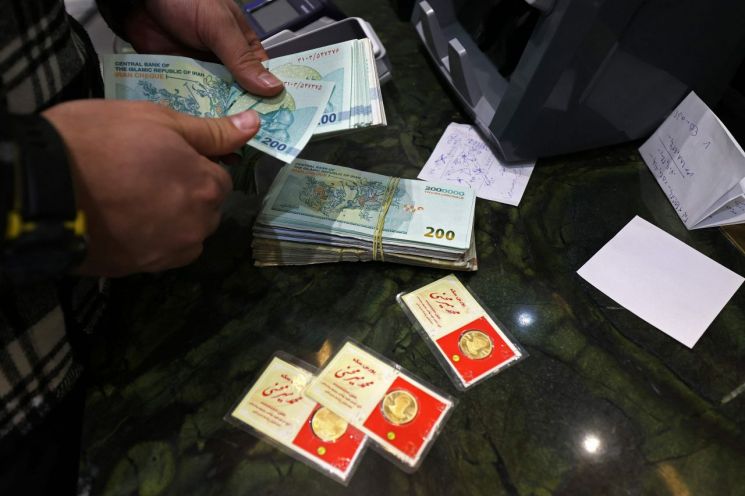 A man is counting rials while purchasing gold at a shop in Tehran, Iran. Tehran, Iran = AFP Yonhap News.
On the same day, Brent crude, the global oil price benchmark, also closed at $70.71 per barrel, up 3.4% from the previous session. This is the first time in about six months, since late July of last year, that Brent crude has exceeded the $70 per barrel mark.
As geopolitical tensions intensified, gold, a safe-haven asset, also rose. The international spot price of gold surpassed $5,500 per ounce for the first time ever during intraday trading. On this day, gold prices soared to a new all-time high of $5,595.44 per ounce. Although some profit-taking led to a brief pullback, prices quickly rebounded and resumed their upward trend.
Heightened military tensions between the United States and Iran are impacting the commodities market. President Donald Trump has repeatedly stated that the U.S. could intervene at any time in the protests taking place in Iran, and in recent days, large-scale troops have actually begun to be deployed to the Middle East. On the social networking service Truth Social, he warned, "A massive fleet is moving toward Iran," adding, "The fleet led by the aircraft carrier Abraham Lincoln is even larger than the one sent to Venezuela."

The BBC reported, "After tracking recent trends in the U.S. military buildup in the Middle East, at least 15 fighter jets have arrived at an airbase in Jordan," adding, "We have confirmed the arrival of dozens of transport and refueling aircraft in the region, and observed drones and reconnaissance planes operating near Iranian airspace." Amid these developments, U.S. Secretary of Defense Pete Hegseth stated at a White House cabinet meeting that "we are prepared to carry out any mission President Trump expects," raising the possibility of military intervention.
There are also predictions that Iran, under U.S. pressure, could attack neighboring countries or blockade the Strait of Hormuz. The Strait of Hormuz is a key chokepoint through which 20% of the world's daily oil supply-20 million barrels-is transported by tanker, and any blockade would be expected to significantly disrupt supply chains. The Wall Street Journal (WSJ) analyzed, "The possibility of a U.S. attack on Iran could add a geopolitical premium of $3 to $4 per barrel to oil prices," and warned, "Prices could rise even further if tensions escalate."
© The Asia Business Daily(www.asiae.co.kr). All rights reserved.
![Clutching a Stolen Dior Bag, Saying "I Hate Being Poor but Real"... The Grotesque Con of a "Human Knockoff" [Slate]](https://cwcontent.asiae.co.kr/asiaresize/183/2026021902243444107_1771435474.jpg)
















