Controversies Over Eating on Incheon and Seoul Subways Continue
Ban Enforced on Buses, But Not on Subways
Strict Penalties in Countries Like Singapore and Hong Kong
Calls for Amendments to Related Ordinances and Regulations
Recently, footage of a passenger eating cup noodles inside a subway car has been released, sparking public outrage among citizens. While complaints regarding eating food inside subway trains number around 1,000 cases annually, there is currently no clear legal basis to explicitly prohibit or penalize such behavior.
On January 30, a video showing a passenger, presumed to be a student, eating cup noodles inside a subway car spread across various online communities and social networking services (SNS). Passenger A, who filmed the video, expressed discomfort, saying, "The smell of noodles filled the car, and the passenger was eating noodles with one hand while looking at their phone with the other." It is reported that this scene was filmed on January 27 on Incheon Subway Line 1.
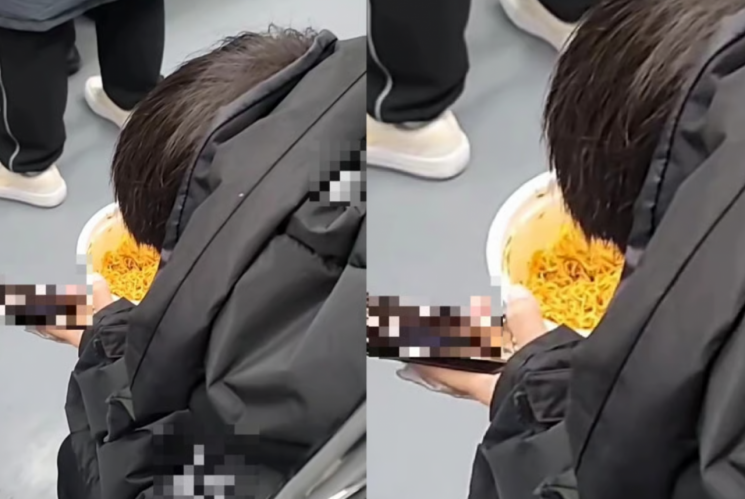 On the 30th, a video showing a passenger presumed to be a student eating cup noodles inside a subway car spread across various online communities and social networking services (SNS). Online communities
The passenger in question reportedly ate noodles for about two to three minutes, from the moment they boarded until they got off. Viewers of the video responded by emphasizing the need to observe proper etiquette in public spaces. Others shared their own experiences with "subway villains," such as elementary school students playing YouTube videos loudly, couples eating hamburgers, and elderly men suggesting to share fried chicken. Last November, a similar controversy arose when a photo of a passenger eating bossam and kimchi while seated on Seoul Subway Line 2 spread on social media. At that time, it was also reported that the passenger spilled food on the floor of the train.
Over 1,000 Subway Food Complaints Annually, Regulations Remain at the Recommendation Level
According to data submitted by Seoul Metro to Seoul City Council member Yoon Younghee (People Power Party, Transportation Committee), complaints regarding food consumption inside subways were as follows: 1,009 cases in 2021, 620 in 2022, 833 in 2023, 907 in 2024, and 828 cases as of September 2025. Complaints covered a wide range of foods, from strongly scented items such as gimbap, sundae, and kimchi to cup noodles, dumplings, squid, French fries, lunch boxes, and canned beer.
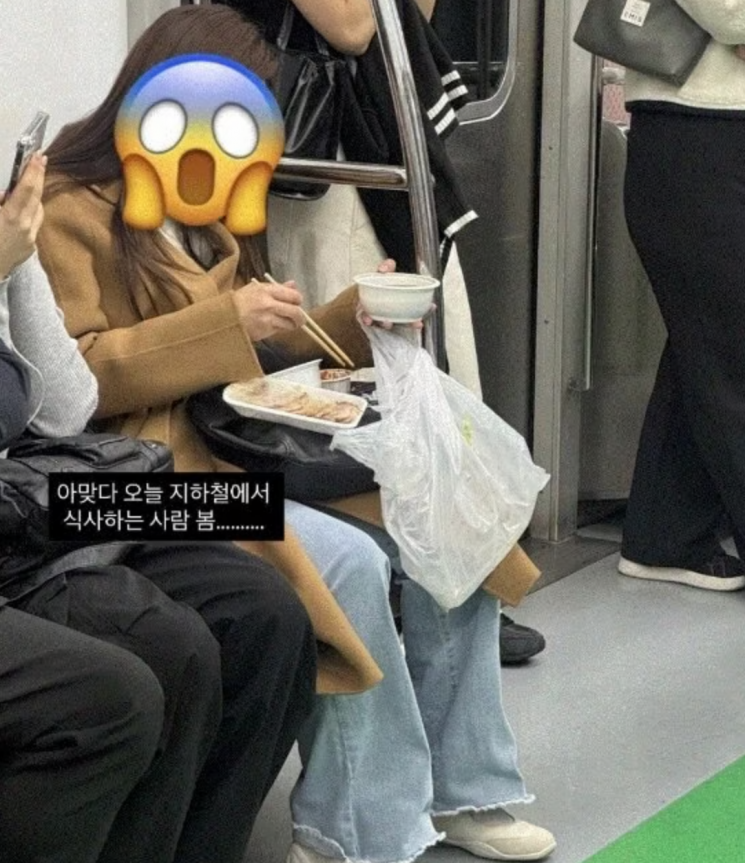 Last November, a controversy arose when a photo of a passenger eating bossam and kimchi while sitting on a seat in Seoul Subway Line 2 spread on social media. Screenshot from social media
Numerous complaints were also filed about passengers causing disturbances by drinking soju, beer, or Makgeolli inside train cars. Some complaints included statements such as, "The smell makes me nauseous," and "It was unbearable riding with my child." Council member Yoon stated, "There was controversy when eating was first banned on buses, but now it has become a natural part of public awareness. The subway system should also consider institutionalizing regulations on food and alcohol consumption by gathering broad public opinion."
Seoul Metro and other subway operators currently recommend that passengers refrain from eating food inside train cars. Article 34 of the current Seoul Metro Passenger Transport Terms and Conditions restricts the bringing of "items that are unclean or may cause discomfort due to foul odors," but there is no explicit clause prohibiting the act of eating food itself. As a result, even when on-site staff intervene, it usually remains at the level of a recommendation. In contrast, the Seoul Metropolitan Government amended its ordinance in 2018 to ban the consumption of food and beverages on city buses, and this regulation has since become established practice.
Meanwhile, major cities overseas are already enforcing strict penalties. In Singapore, eating or drinking on the subway can result in a fine of up to 500 Singapore dollars (about 500,000 won), while in Hong Kong, the maximum fine is 2,000 Hong Kong dollars (about 350,000 won). A Seoul Metro official stated, "As citizen complaints about eating on the subway continue to be raised, we will actively consider improving related regulations."
© The Asia Business Daily(www.asiae.co.kr). All rights reserved.
![Clutching a Stolen Dior Bag, Saying "I Hate Being Poor but Real"... The Grotesque Con of a "Human Knockoff" [Slate]](https://cwcontent.asiae.co.kr/asiaresize/183/2026021902243444107_1771435474.jpg)

















