Automobile Management Act Amendment Passed at National Assembly Plenary Session
An objective standard for evaluating the performance of used batteries will be established. Only pre-registered businesses will be allowed to handle them, and it will become mandatory to undergo safety inspections in advance, even after the batteries are incorporated into finished products such as automobiles.
The Ministry of Land, Infrastructure and Transport announced on January 29 that the National Assembly plenary session had passed the Automobile Management Act containing these provisions. Used batteries refer to those that have been installed in eco-friendly vehicles such as electric, hydrogen, or hybrid cars and have reached the end of their service life due to performance degradation or malfunction. To ensure their sustainable use, the current administration is pursuing the introduction of performance evaluation, safety inspections, and a history management system as a national policy initiative. The rationale is that a systematic management and support infrastructure is necessary for the battery-related service industry (BaaS), such as battery subscription and leasing, to become established in the mid- to long-term.
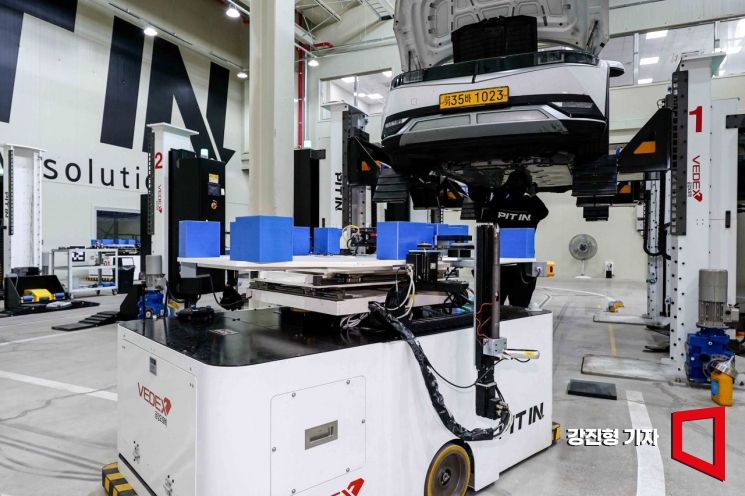 At the headquarters of Pit-in in Anyang, Gyeonggi Province, mechanics are replacing electric vehicle battery packs. Photo by Kang Jin-hyung
Currently, there is no separate standard for evaluating the remaining performance of used batteries. Going forward, standards will be established to assess them, and depending on the level of remaining performance, batteries will be classified for remanufacturing, reuse, or recycling. Only remanufactured battery businesses registered as parts manufacturers will be permitted to remanufacture used batteries. There will also be an obligation to verify the safety of the remanufactured batteries they produce.
When selling or operating vehicles equipped with remanufactured batteries, it will be mandatory to undergo safety inspections in advance to check the installation status and proper functioning. Regular safety inspections will also be required during operation. In some cases, the existing regular automobile inspection can substitute for this requirement. In addition, standards for facilities and handling methods to ensure safe storage and transportation will be established.
A history information management system will also be introduced. This will provide a management framework covering the entire lifecycle of batteries, from manufacturing to operation and disposal. After review by the Cabinet, this amendment will take effect on July 1, 2027.
On the same day, the plenary session also passed amendments to the Certified Real Estate Agents Act, granting the Korea Association of Certified Real Estate Agents legal entity status, and to the Parking Lot Act, allowing for fines or towing measures when entrances to off-street or annexed parking lots are blocked. If someone fails to comply without a valid reason after obstructing a parking lot entrance, local governments may impose a fine of up to 5 million won. A new regulation was also introduced to impose a fine of up to 1 million won for parking for more than one month without a valid reason in free public parking lots. Both amendments will take effect six months after Cabinet review and promulgation.
© The Asia Business Daily(www.asiae.co.kr). All rights reserved.
![Clutching a Stolen Dior Bag, Saying "I Hate Being Poor but Real"... The Grotesque Con of a "Human Knockoff" [Slate]](https://cwcontent.asiae.co.kr/asiaresize/183/2026021902243444107_1771435474.jpg)















