Vaccines Administered to Three Female Elephants
Effects of Vaccination Can Last Up to Seven Years
The Thai government has administered contraceptive vaccines to female wild elephants for the first time ever in an effort to control the rapidly increasing elephant population.
According to The Thaiger, a Thai media outlet, on January 27 (local time), the Department of National Parks, Wildlife and Plant Conservation (DNP) in Thailand vaccinated three female wild elephants in Trat Province in the east of the country on January 25. This marks the first birth control program targeting wild elephants in Thailand.
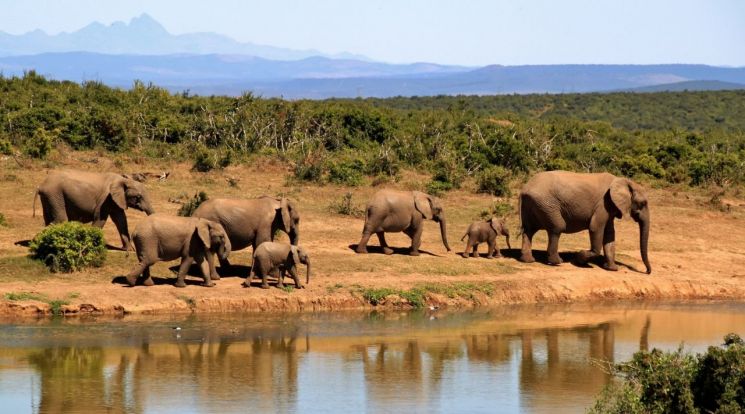
The department explained that veterinarians, in cooperation with researchers from Chiang Mai University, carried out the vaccinations in the area around Khlong Kaeo Waterfall National Park. The vaccinated elephants were part of a herd consisting of 12 individuals. Recently, the wild elephant population in the forests of eastern Thailand has been increasing rapidly, leading to shortages of water and food. In fact, the number of wild elephants in eastern Thailand rose from 334 in 2015 to 799 last year, with an average annual growth rate of 8.2%.
As a result, more elephants have been moving into farmland and residential areas due to territorial conflicts and food shortages, leading to a series of human casualties and crop damages. Since 2012, over 140 people have died and more than 170 have been injured in elephant-related incidents. The affected areas span more than 100 administrative districts across six provinces.
Authorities explained that the mechanism of the vaccine used this time is a non-surgical method that induces an immune response in female elephants to temporarily suppress reproduction. They added, "The effect of the vaccination can last up to seven years, and if not re-administered, reproductive ability will naturally recover." With Thailand's wild elephant population currently estimated at about 4,000 and an annual birth rate of 7-8%, it is expected to reach 6,000 within four years if appropriate measures are not taken.
Sukie Boonsang, Director of the Wildlife Conservation Office, emphasized, "If population management is not implemented, food shortages, accidents, electrocutions, and conflicts with humans could intensify." He added, "Contraception is a humane management method that does not harm elephant welfare."
Recently, Thailand has continued to experience various damages caused by elephants. On December 10 last year, a woman in her 40s was killed by an elephant attack while walking along a trail in Phu Kradueng National Park in Loei Province, northern Thailand. She was reportedly attacked by an elephant searching for food. Then, on the night of December 29, a herd of about 80 to 100 elephants ravaged orchards and fields near Thap Lan National Park in Nakhon Ratchasima Province, central Thailand. Authorities believe that the herd of elephants, which had been staying in the national park, invaded areas with abundant food due to human activity.
© The Asia Business Daily(www.asiae.co.kr). All rights reserved.
![Clutching a Stolen Dior Bag, Saying "I Hate Being Poor but Real"... The Grotesque Con of a "Human Knockoff" [Slate]](https://cwcontent.asiae.co.kr/asiaresize/183/2026021902243444107_1771435474.jpg)















